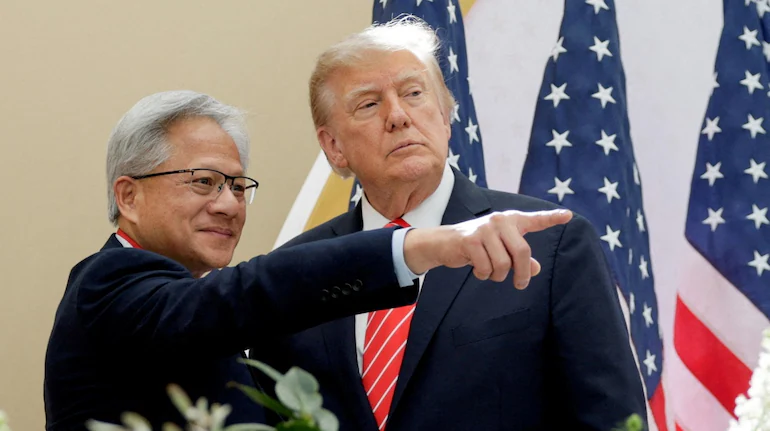
US President Donald Trump has said China could have attempted to recruit Nvidia co-founder Jensen Huang for a senior position had the chipmaker’s board not reinstated him as chief executive. His remarks highlight Washington’s concerns about retaining influential technology leaders as the United States competes with China for dominance in Artificial Intelligence and advanced semiconductors.
Trump said he personally intervened in Nvidia’s leadership crisis, contacting board members and persuading them to bring Huang back after his resignation on November 12. The President argued that losing Huang could have created an opportunity for Beijing to attract one of the most influential executives in the global AI industry.
The campaign to restore Huang’s position involved several senior members of the Trump administration, including Vice President JD Vance, Commerce Secretary Howard Lutnick and Treasury Secretary Scott Bessent. Meanwhile, Nvidia’s board is continuing its investigation into the controversy surrounding the CEO’s departure, and Huang is scheduled to testify before the US Senate on December 3.
Trump Says He Personally Persuaded Nvidia’s Board
In an interview with CNBC, Trump acknowledged speaking directly to Nvidia’s board about Huang’s return. He said he had made the case for reinstating the executive, describing him as an important figure for America’s technology industry.
“I spoke to them. Let me just put it that way. And I convinced them,” Trump said during the interview.
According to an Associated Press report, the President viewed Huang’s departure as a potential setback for US efforts to maintain its technological advantage over China. The administration was concerned that a Chinese technology company could offer Huang a senior position and benefit from his experience in the semiconductor and AI industries.
Huang’s influence extends beyond Nvidia’s corporate leadership. The company develops advanced graphics processing units (GPUs) and other computing technologies that underpin the development and deployment of artificial intelligence systems. Its products are used by technology companies, research institutions and businesses building large-scale AI infrastructure.
Trump argued that Huang’s specialised knowledge would be difficult to replace. Referring to the executive’s expertise, he said, “This is different because the vast amount of knowledge in his brain.”
The President’s comments suggest that the administration viewed the leadership dispute not only as a corporate governance matter but also as an issue connected to America’s broader technological and economic competitiveness.
JD Vance, Howard Lutnick and Scott Bessent Helped Secure Huang’s Return
The effort to reinstate Huang reportedly involved multiple senior officials from the Trump administration. Vice President JD Vance played a leading role over the weekend, coordinating with Huang and making the case to Nvidia’s board.
Commerce Secretary Howard Lutnick and Treasury Secretary Scott Bessent were also involved in the discussions. Their participation reflected the administration’s concern about the possible consequences of losing a key executive at a company central to the global AI supply chain.
According to CNN, the administration also sought to reassure Nvidia that it had found no evidence that Huang posed a national security threat. The issue had become more sensitive following reports about his personal relationships, including an alleged association with a woman suspected by US officials of having links to Chinese intelligence.
Trump personally contacted board members to express his support for Huang and argued that keeping him at the company was important for the United States. Nvidia subsequently announced his reinstatement on Monday, 11 days after his resignation.
The involvement of senior government officials underlines how closely semiconductor leadership and national security concerns are connected in the current competition between Washington and Beijing. Advanced chips are essential to AI development, and Nvidia occupies a significant position in the global market for these technologies.
Controversy Surrounding Huang’s Resignation
Huang’s departure followed revelations about multiple alleged extramarital relationships, including one involving an executive at a Singapore-based company. The reports raised questions about corporate governance and prompted concerns about whether his personal associations could have implications for national security.
The controversy placed Nvidia’s board under pressure to examine the allegations and consider their potential implications for the company. It also attracted attention from US officials because of Nvidia’s strategic importance to the country’s technology sector.
Trump, however, argued that Huang’s contribution to the technology industry should be considered alongside the controversy surrounding his personal life. He also referred to the CEO’s apology to Nvidia, his family and the country.
“He’s apologised for that to the company, to the country and to his family and his wife, who’s a fantastic person,” Trump said.
The President’s intervention helped secure Huang’s return, but the allegations have not been resolved simply by the leadership announcement. Nvidia’s board has confirmed that its investigation will continue, leaving questions about the company’s governance process and the circumstances surrounding the resignation open.
Nvidia Board Investigation to Continue After Reinstatement
Huang’s return as CEO has not ended scrutiny of the episode. Nvidia’s board is continuing its investigation into the allegations and the circumstances that led to his resignation on November 12.
The company faces the task of addressing governance concerns while maintaining leadership continuity at a time when demand for AI computing infrastructure remains a major driver of the technology industry. The ongoing investigation could provide further information about the issues raised during the leadership crisis.
Separately, the US Senate Banking Committee has scheduled a public hearing with Huang for December 3. Senator Tim Scott announced the hearing as lawmakers continued examining the circumstances surrounding the CEO’s departure and reinstatement.
Democratic leaders Chuck Schumer and Hakeem Jeffries have criticised the decision to return Huang to the company’s top position. Jeffries described the reinstatement as “indefensible, irresponsible and incomprehensible”.
The criticism indicates that the controversy has become a subject of political debate in Washington, with lawmakers raising questions about corporate accountability and the handling of potential national security concerns.
Former House Speaker Newt Gingrich, who is among Trump’s allies, also questioned the decision to reinstate Huang. He raised concerns about returning him to lead a company responsible for developing some of the world’s most advanced chips while questions about his personal associations remained under scrutiny.
Huang’s Return Draws Attention to US-China AI Competition
The possibility of China recruiting Huang was central to Trump’s explanation for intervening in the leadership dispute. The President’s comments reflect wider concerns in Washington about the movement of advanced technology expertise and the importance of retaining experienced executives in strategically significant industries.
Artificial intelligence development depends on more than software and computing infrastructure. It also requires specialised semiconductor knowledge, engineering experience, research capabilities and leadership capable of coordinating complex technology ecosystems.
Nvidia has become a major supplier of the processors used to train and run advanced AI models. Its position gives the company considerable importance in the global technology industry, while its leadership has become closely associated with the expansion of AI computing.
For the United States, retaining influential technology companies and their leadership is part of the wider effort to maintain competitiveness in advanced computing. China, meanwhile, is investing in its own semiconductor and artificial intelligence capabilities.
Trump’s remarks do not establish that a Chinese company had formally approached Huang with a job offer. Instead, they describe the possibility that Beijing could have sought to recruit him if Nvidia had not restored his position.
The distinction is important because the President’s comments reflect his assessment of the potential risks surrounding Huang’s departure rather than confirmation of an actual recruitment offer.
Nvidia Shares and US Markets Reacted to Leadership Change
Nvidia’s leadership turmoil also had implications for financial markets. The company’s shares came under pressure following reports of Huang’s resignation, adding to concerns about the outlook for major technology companies and the sustainability of the AI-driven stock market rally.
Investors closely monitor Nvidia because of its central role in supplying chips for artificial intelligence applications. Changes in the company’s leadership can therefore attract attention beyond its own shareholders, particularly when the developments involve uncertainty about corporate governance and strategic direction.
Following the announcement of Huang’s reinstatement, Nvidia shares recovered, helping improve sentiment across US equities. According to the Associated Press, the S&P 500 gained 4.7% on Monday after the announcement.
The market reaction demonstrated the importance investors attach to Nvidia’s leadership and its position in the AI industry. However, a positive response to Huang’s return does not resolve the governance questions or establish how the ongoing investigation will affect the company.
What Happens Next for Jensen Huang and Nvidia?
Nvidia now faces two parallel priorities: maintaining operational and strategic continuity under Huang’s leadership and addressing the concerns that led to his resignation. The board’s continuing investigation will be important in determining how the company responds to the allegations and whether further governance measures are required.
The December 3 Senate hearing is another significant development. Huang’s testimony could bring additional attention to the circumstances surrounding his departure and return, as well as the broader questions raised by lawmakers.
For the Trump administration, the episode has highlighted the connection between corporate leadership, national security and competition in advanced technology. Trump’s concern that China could have recruited Huang illustrates how Washington views key semiconductor executives as important contributors to the country’s technological position.
Although Huang has returned as Nvidia CEO, the controversy remains unresolved. The board investigation, congressional scrutiny and continuing political debate will determine how the episode develops beyond the initial leadership decision.
For breaking news and live news updates, like us on Facebook or follow us on Twitter and Instagram. Read more on Latest Business on thefoxdaily.com.




COMMENTS 0