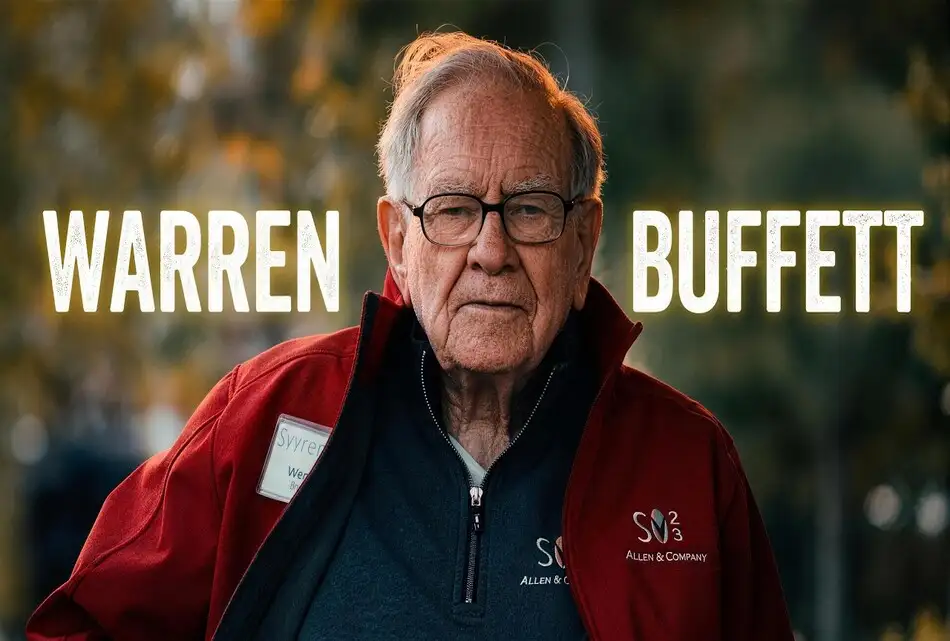
Warren Buffett marked Thanksgiving 2026 with another major charitable contribution, donating approximately $5.5 billion worth of Berkshire Hathaway shares. But alongside the enormous gift, the legendary investor used his annual message to recognise three people whose influence shaped his thinking: Benjamin Graham, Tom Murphy and Joe Rosenfield.
One story stood out in particular. Rosenfield, a former Grinnell College trustee and an influential figure in Buffett’s life, helped the college acquire 300 shares of Berkshire Hathaway for just $5,252. Those shares could have been worth approximately $260 million if held until today. Instead, Grinnell sold them between 1989 and 1993 for a combined $3.7 million.
The difference illustrates how a relatively small early investment can become extraordinarily valuable over decades when a company compounds its earnings and its share price rises. It also offers a lesson about the difficulty of holding an investment long enough to realise its full potential. However, the comparison is a retrospective estimate, not proof that selling the shares was necessarily an unreasonable decision at the time.
Warren Buffett’s Thanksgiving Message: Kindness Compounds Better Than Investments
Buffett announced the donation on November 16 through a message released by Berkshire Hathaway. Rather than focusing only on the size of the contribution, he used the occasion to reflect on the people who helped shape his life and career.
“Last Thanksgiving I wrote that kindness is costless but also priceless. A year later, I would only add that it compounds, and at a better rate than anything Charlie and I ever bought,” Buffett wrote.
He was referring to the lasting influence of three people: Benjamin Graham, Joe Rosenfield and Tom Murphy. Buffett said that he and his longtime business partner Charlie Munger, who died in 2023, received immeasurable benefits from their guidance and generosity.
“Both of us received beyond measurement costless benefits from a few teachers such as Ben Graham, Joe Rosenfield and Tom Murphy. Because of this we not only prospered mightily but were able to pass along many of the benefits we received,” he wrote.
Buffett’s message ended with an appeal that extended beyond financial giving. He encouraged readers to recognise people who had helped them and, where possible, offer similar support to others.
“This Thanksgiving, thank one of those selfless people in your own life. Better yet, be a benefactor for someone else,” he wrote.
Who Are the Three Teachers Buffett Thanked?
The three individuals named by Buffett influenced different parts of his personal and professional development. Two were prominent figures in American business and investing, while Rosenfield’s contribution was rooted in a long friendship and his work with Grinnell College.
1. Benjamin Graham: The Teacher Who Shaped Buffett’s Investment Philosophy
Benjamin Graham is widely associated with the development of value investing, an approach that focuses on identifying securities trading below their estimated intrinsic value. Buffett studied under Graham at Columbia University and later worked for him.
Graham’s investment philosophy had a lasting impact on Buffett’s approach to analysing businesses, assessing risk and thinking about the relationship between a company’s value and its market price.
Buffett has frequently acknowledged Graham’s influence on his career. By including him in the Thanksgiving message, Buffett again recognised the importance of the teacher whose ideas helped establish the intellectual foundation of his investment approach.
2. Tom Murphy: A Business Leader and Berkshire Board Member
Tom Murphy was another important influence. He built Capital Cities/ABC into a major media business and later served on Berkshire Hathaway’s board.
Murphy’s experience in managing companies and making long-term business decisions made him an important figure in Buffett’s professional circle. His relationship with Buffett extended beyond discussions about investments to the broader principles of leadership and business management.
Buffett’s reference to Murphy reflects the value he placed on learning from people with practical experience in building and running successful organisations.
3. Joe Rosenfield: The Grinnell College Trustee Behind the $5,252 Berkshire Investment
Joe Rosenfield’s story is particularly striking because of his connection to Grinnell College in Iowa. A lawyer who later became chairman of the department-store chain Younkers, Rosenfield joined the college’s board of trustees in 1941.
In 1967, friends introduced him to Buffett, who was then a 37-year-old investment manager from Omaha. The two developed a close friendship. Their connection reportedly began at an event at Grinnell where Martin Luther King Jr. delivered a speech in October that year.
Rosenfield subsequently purchased 300 Berkshire Hathaway shares for the college at a total cost of $5,252. The investment became one of the most remarkable examples of Berkshire’s long-term appreciation.
Buffett’s relationship with Rosenfield was not limited to business. In a profile of Rosenfield published in 2000, Buffett described their friendship in deeply personal terms, saying he would have adopted Rosenfield as his father after his own father’s death if that had been possible.
How Grinnell College’s $5,252 Investment Could Have Become $260 Million
The numbers behind Rosenfield’s Berkshire investment explain why the story has attracted attention. The 300 shares cost Grinnell College $5,252 when they were purchased in the late 1960s. The college eventually sold its holdings between 1989 and 1993 for a combined $3.7 million.
At the Berkshire Hathaway share price used for the recent retrospective calculation, the original 300-share investment would have been worth approximately $260 million if the college had continued holding it.
That means the estimated present value would be around 70 times the amount Grinnell received from selling the shares. The comparison is striking, particularly because the original investment was relatively small for an institution that would later build a substantial endowment.
However, the $260 million figure is a hypothetical calculation based on the value the shares would have reached if retained. It does not represent money the college actually lost from its accounts, nor does it account for the timing and financial considerations behind the original sales.
Importantly, the reason for selling the Berkshire shares has not been established. According to the account of Rosenfield’s investment history, neither Buffett, Rosenfield nor people at Grinnell could recall precisely why the college decided to dispose of the holdings.
Was Selling the Berkshire Shares a Financial Mistake?
With hindsight, retaining the 300 shares would have produced an extraordinary financial outcome. But judging an investment decision made decades ago solely by its eventual market value can overlook the circumstances in which the decision was taken.
Colleges and charitable institutions have financial obligations that differ from those of individual investors. They must manage endowment funds to support scholarships, academic programmes, staff, infrastructure and other long-term commitments. Selling an investment can be part of managing those responsibilities, even when the asset later appreciates substantially.
There is also an important distinction between knowing a company will become successful and recognising that success in advance. Berkshire Hathaway’s later growth was not guaranteed when Rosenfield purchased the shares. Holding an investment through decades of changing markets requires confidence, patience and the ability to tolerate uncertainty.
The story therefore offers a lesson about the potential rewards of long-term ownership, but it should not be interpreted as proof that every investment should be held indefinitely. Investors must still assess the underlying business, valuation, risks and their own financial requirements.
Rosenfield’s Wider Legacy at Grinnell College
The Berkshire investment was only one part of Rosenfield’s contribution to Grinnell. His involvement with the institution extended over several decades, and he played a significant role in its financial development.
Rosenfield helped grow the college’s endowment from approximately $11 million to more than $1 billion. That record places the sale of the Berkshire shares in a broader context: although the investment could have become worth much more, his overall stewardship helped build a substantial financial foundation for the institution.
His approach to investing was also characterised by patience. In the 2000 profile, Rosenfield offered a straightforward principle: “If you like a stock, you’ve got to be prepared to hold it and do nothing.”
The advice captures the central idea behind the Berkshire story. Long-term returns can depend not only on selecting a strong business but also on resisting the urge to sell simply because an investment has appreciated or because market conditions have changed.
Where Is Buffett’s $5.5 Billion Thanksgiving Donation Going?
Alongside his message about kindness, Buffett announced a donation of 9,225,000 Berkshire Hathaway Class B shares to four charitable foundations associated with his family.
The distribution was divided as follows:
- The Susan Thompson Buffett Foundation: 3,690,000 Class B shares.
- The Sherwood Foundation: 1,845,000 Class B shares.
- The Howard G. Buffett Foundation: 1,845,000 Class B shares.
- The NoVo Foundation: 1,845,000 Class B shares.
The total contribution was valued at approximately $5.5 billion. The Susan Thompson Buffett Foundation is named after Buffett’s late first wife, while the other three foundations are associated with his children Susie, Howard and Peter Buffett.
The foundations support different charitable priorities. Their work includes reproductive healthcare, early childhood education, food security, conflict mitigation and initiatives aimed at empowering women and girls.
Buffett said his children had spent decades supporting worthy causes and expressed complete confidence in their ability to continue directing the philanthropic resources responsibly.
Buffett’s Plan to Give Away His Berkshire Hathaway Fortune
The Thanksgiving contribution is part of Buffett’s broader plan to distribute his Berkshire Hathaway holdings to charitable foundations. He has said that his remaining shares are intended to be donated by December 31, 2034, with the aim of increasing grants made by the foundations over time.
The November 2026 donation was his first Thanksgiving contribution since stepping down as Berkshire Hathaway’s chairman and chief executive. He remains chairman emeritus and has said his confidence in the company remains strong.
The donation also reflects a shift towards greater responsibility for the next generation of the Buffett family in managing and distributing charitable wealth. Buffett has repeatedly emphasised that his children have developed their own philanthropic experience and are prepared to take on that responsibility.
The Bigger Lesson Behind Buffett’s Thanksgiving Message
The story of the $5,252 Berkshire investment is an unusually clear illustration of how compounding can transform a small sum over several decades. But Buffett’s message was not simply about Stock Market returns or the consequences of selling shares too early.
By naming Graham, Murphy and Rosenfield, he highlighted the people who helped him and Munger develop their judgement, careers and capacity to create wealth. His central argument was that their generosity produced benefits that extended far beyond the original acts of kindness.
Rosenfield’s investment for Grinnell shows how one decision can acquire extraordinary significance with time. Yet his larger contribution to the college’s endowment also demonstrates that a legacy cannot be measured by one investment alone.
For Buffett, the most important form of compounding may be the effect of generosity passed from one person to another. His Thanksgiving appeal was simple: remember those who helped you, acknowledge their contribution and become a source of support for someone else.
For breaking news and live news updates, like us on Facebook or follow us on Twitter and Instagram. Read more on Latest World on thefoxdaily.com.





COMMENTS 0