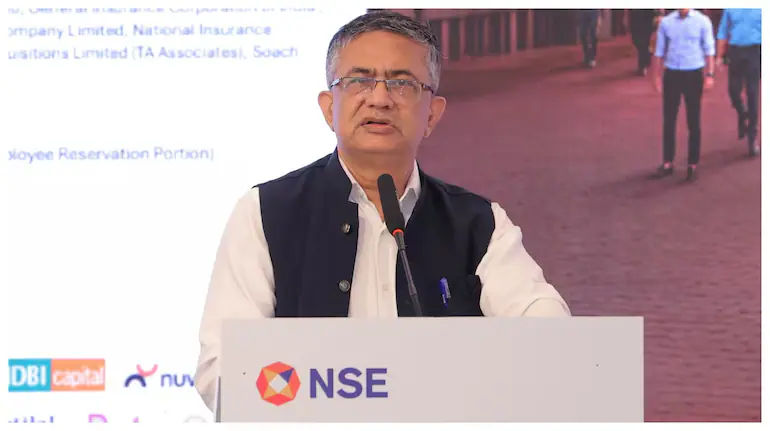
India’s economic growth is expected to accelerate in the coming year, supported by strong macroeconomic fundamentals, rising domestic savings and renewed interest from foreign investors, National Stock Exchange (NSE) Managing Director and CEO Ashishkumar Chauhan has said.
Speaking to ANI during Muhurat trading on the occasion of Diwali, Chauhan expressed confidence in India’s economic outlook and said the country continues to be the world’s fastest-growing major economy. He highlighted the country’s reported year-on-year GDP growth of 7.5%, strong tax collections and infrastructure investments as important factors supporting investor confidence.
He also pointed to improving foreign institutional investor (FII) sentiment ahead of the new Samvat year, saying overseas investors had started showing renewed interest in Indian equities. According to Chauhan, strong domestic savings and returning foreign capital could provide further support to the country’s financial markets.
Key Highlights
- NSE CEO Ashishkumar Chauhan expects India’s economic growth momentum to strengthen in the coming year.
- India recorded a reported year-on-year GDP growth rate of 7.5%, according to Chauhan.
- Domestic financial savings have grown to nearly $1.4 trillion annually, supporting market liquidity.
- Foreign institutional investors are showing renewed interest in Indian equities ahead of the new Samvat year.
- NSE is upgrading its technology and digital platforms while encouraging investors to prioritise long-term wealth creation.
India’s Economic Growth Expected to Accelerate
Chauhan said India’s economic outlook remains positive despite global uncertainties and pressure from volatile crude oil prices. He described India as the fastest-growing large economy in the world and expressed confidence that its growth rate could improve further over the coming year.
The reported 7.5% year-on-year GDP growth reflects the strength of the Indian Economy, according to the NSE chief. He also highlighted the country’s ability to manage fiscal pressures while continuing to support infrastructure development and employment generation.
Strong domestic economic activity, improving government revenues and continued investment are among the factors supporting this outlook. These conditions can also influence investor confidence by strengthening expectations about corporate growth and the broader business environment.
High Crude Oil Imports Remain a Concern for India
Despite the positive economic outlook, Chauhan identified India’s dependence on imported crude oil as a continuing challenge. The country imports nearly 85% of the oil it consumes, making its economy vulnerable to changes in international energy prices.
Higher crude oil prices can increase India’s import bill, put pressure on the current account and contribute to inflation. They can also raise operating costs for businesses and affect household spending.
However, Chauhan said strong tax collections and effective fiscal management have helped the government maintain stability despite these external pressures.
He explained that strong tax buoyancy gives the government greater financial capacity to invest in infrastructure and job creation. Such spending can support economic activity and improve confidence among businesses and investors.
Domestic Savings Provide Strong Support to Indian Markets
Chauhan highlighted the growing importance of domestic savings in supporting India’s financial markets. According to him, India’s financial savings have reached nearly $1.4 trillion annually, making the country one of the world’s largest pools of savings.
These savings provide an important source of capital for investments in equities and other financial instruments. Domestic investors have also played a significant role in supporting the Stock Market, particularly during periods when foreign investors reduce their exposure to Indian assets.
Strong participation from domestic investors can help improve market liquidity and reduce dependence on overseas capital flows. It also reflects the growing role of household savings in the country’s financial system.
However, market movements can still be influenced by global interest rates, economic conditions, corporate earnings and investor sentiment. Domestic savings provide support but do not eliminate market risks.
Foreign Institutional Investors Show Renewed Interest
One of Chauhan’s key observations was the improvement in foreign investor sentiment towards Indian equities. He said foreign institutional investors had started favouring Indian markets again, describing the development as a positive sign for the upcoming Samvat year.
Foreign institutional investors are important participants in India’s stock market. Their investments can influence market liquidity, share prices and overall investor sentiment, particularly in large-cap companies.
Renewed foreign interest, combined with strong domestic investment flows, could provide additional support to Indian equities. However, foreign capital movements can change quickly depending on global financial conditions, currency movements, valuations and investment opportunities in other markets.
Chauhan’s comments indicate optimism about India’s ability to attract overseas capital while continuing to benefit from domestic savings.
NSE Strengthens Technology and Introduces AI-Based Services
Chauhan also discussed the National Stock Exchange’s technological progress, highlighting improvements in its trading infrastructure over the past year.
He said the exchange had achieved nanosecond-level response times and described its technology infrastructure as the fastest globally. Faster systems are important for modern financial markets, where efficient processing and reliable technology support trading activities.
The NSE is also deploying artificial intelligence to provide retail investors with richer information, improved analytics and better market insights.
According to Chauhan, the exchange is introducing major upgrades to its digital platforms, including improvements to the NSE website and mobile application. The changes are intended to improve the experience of retail investors and make market-related information more accessible.
Technology-driven services could help investors access information more efficiently. However, AI-based analytics should be treated as tools for understanding markets rather than guarantees of investment returns.
NSE Expands Financial Literacy and Investor Awareness
Alongside technology upgrades, the NSE is focusing on investor education and financial awareness. Chauhan said the exchange’s physical seminars currently reach approximately 10 lakh to 15 lakh investors.
The exchange is also expanding its digital outreach through social media, traditional broadcasting platforms and direct-connect programmes. These initiatives aim to reach a wider audience and help new market participants understand how financial markets operate.
Investor education is particularly important as more individuals participate in equity markets and derivatives trading. Understanding market volatility, investment risks and financial products can help people make more informed decisions.
Chauhan emphasised that investors should understand the risks involved before entering activities such as intraday trading and derivatives. Greater awareness can help reduce decisions driven by speculation or short-term market tips.
Ashishkumar Chauhan Advises Investors to Focus on Long-Term Wealth Creation
Chauhan urged investors to prioritise long-term investing instead of trying to make quick profits through speculative trading. He advised market participants to avoid intraday trades and derivatives positions unless they understand how to manage the associated risks.
His advice reflects the importance of having a clear investment strategy, understanding individual risk tolerance and avoiding decisions based solely on short-term market movements.
Long-term investing generally focuses on building wealth over an extended period rather than attempting to predict daily price changes. Investors still need to evaluate company fundamentals, diversification, valuations and their financial goals before making investment decisions.
Derivatives and intraday trading can involve substantial risks, particularly for inexperienced market participants. Without adequate knowledge and risk-management strategies, losses can accumulate quickly.
What the Outlook Means for Indian Investors
Chauhan’s comments point to several factors that could influence India’s financial markets in the coming year. Strong economic growth, rising domestic savings and renewed foreign investor interest may support market activity and improve confidence.
At the same time, dependence on imported crude oil and uncertainty in the global economy remain important risks. Changes in energy prices, international interest rates and Foreign Investment flows could affect India’s economic and market outlook.
The NSE’s technology upgrades and financial literacy initiatives also highlight the growing importance of accessible information and responsible participation in financial markets.
Conclusion
India’s economy is expected to strengthen further in the coming year, according to NSE CEO Ashishkumar Chauhan. He pointed to strong macroeconomic fundamentals, substantial domestic savings, effective fiscal management and returning foreign investor interest as key sources of confidence.
His comments also underline the importance of technology, investor education and responsible market participation. While India’s growth outlook remains positive, global uncertainties and crude oil dependence continue to pose challenges. For individual investors, Chauhan’s central message is to focus on long-term wealth creation and understand the risks before entering speculative trading.
For breaking news and live news updates, like us on Facebook or follow us on Twitter and Instagram. Read more on Latest Business on thefoxdaily.com.






COMMENTS 0