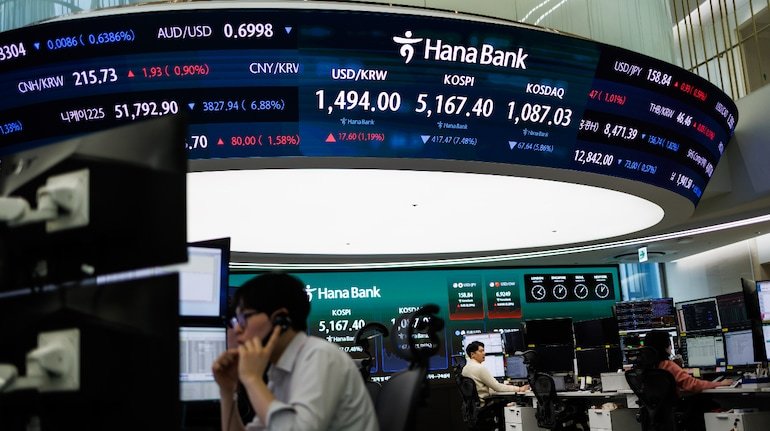
South Korea has announced a series of phased measures to contain Stock Market volatility after a sharp sell-off in technology shares dragged its benchmark Kospi index to a 10-month low. The steps include preparing a stock market stabilisation fund, easing daily share buyback limits for listed companies and intensifying surveillance of illegal short-selling activities.
The measures come as concerns about Artificial Intelligence (AI) valuations, semiconductor industry prospects and rising debt have triggered widespread selling across global technology markets. South Korean authorities are seeking to prevent international market weakness from developing into a deeper domestic financial disruption.
Finance Minister Lee Hyoung Il, Bank of Korea Governor Shin Hyun Song and the heads of the Financial Services Commission (FSC) and Financial Supervisory Service (FSS) discussed the situation during an emergency meeting on Sunday. According to a joint government statement, officials examined possible spillover effects from the US stock market sell-off and discussed contingency plans to respond to further volatility.
South Korea Prepares Stock Market Stabilisation Fund
One of the central measures is the preparation of a stock market stabilisation fund that can be activated if market conditions require intervention.
The government said preparations would begin immediately to ensure the fund is ready for use when necessary. The announcement signals that authorities want to establish a response mechanism before further market declines potentially intensify investor concerns.
However, preparing the fund does not mean that it has already been activated or that authorities have committed to a specific amount of intervention. The government has indicated that the fund will be available as a contingency measure, depending on market conditions.
Such stabilisation mechanisms are generally intended to provide support during periods of severe market disruption. Their effectiveness depends on the scale of market stress, the resources available and the confidence investors place in the measures.
For South Korea, the immediate priority is to prevent sharp price movements from triggering additional panic selling and weakening confidence in its equity market.
Share Buyback Limits to Be Eased for Three Months
South Korean authorities will also temporarily ease daily share buyback limits for listed companies for three months. The measure is designed to give companies greater flexibility to repurchase their own shares and potentially help reduce excessive price volatility.
Share buybacks can support investor confidence by allowing companies to purchase shares in the market. They can also reduce the number of outstanding shares, potentially improving earnings per share when corporate earnings remain unchanged.
During periods of heavy selling, companies with sufficient financial resources may use buybacks to signal confidence in their business prospects. However, the impact depends on the scale of purchases, the company’s financial position and overall market sentiment.
The temporary relaxation is intended to make it easier for listed companies to participate in market stabilisation efforts. It does not guarantee that companies will increase buybacks or that share prices will recover.
The three-month duration also indicates that the government is treating the measure as a temporary response to the current period of heightened volatility rather than a permanent change to market rules.
Intensive Monitoring of Illegal Short-Selling Activities
Another part of the government’s response focuses on market surveillance. Authorities will introduce a special intensive monitoring period lasting three months to identify illegal short-selling activities.
Officials said they would respond strictly if violations were detected. The move is intended to reinforce market discipline at a time when investors are particularly sensitive to sharp price movements and trading activity.
Short-selling involves borrowing shares and selling them in the expectation that their prices will decline, allowing the seller to buy them back at a lower price. It is a recognised market strategy, but illegal practices can undermine market fairness and investor confidence.
By increasing scrutiny, regulators aim to deter misconduct and ensure that market participants follow existing rules. The announcement does not suggest that the broader market decline has been caused by illegal short-selling. Authorities have linked the recent volatility primarily to uncertainty surrounding the AI and semiconductor industries.
Why Is South Korea’s Kospi Index Under Pressure?
The latest intervention follows a steep decline in South Korean equities. The benchmark Kospi fell 5.2% on Friday, reaching its lowest closing level in 10 months as technology stocks faced heavy selling pressure.
The index has also experienced a dramatic reversal after a strong rally earlier in the year. It had climbed above 9,100 in mid-June but subsequently fell below the 5,000 mark. The reported decline of 46.57% from its peak highlights the scale of the correction.
South Korea is particularly exposed to changes in global technology sentiment because its stock market has significant exposure to semiconductor and other technology-related businesses. As a result, developments affecting the AI industry can have an outsized influence on investor expectations and benchmark performance.
The recent sell-off reflects concerns about whether heavy spending on AI infrastructure will generate sufficient financial returns. Investors are also reassessing technology company valuations and the risks associated with rising debt.
When expectations about future growth become uncertain, investors may reduce exposure to companies whose share prices have already risen substantially. This can create additional selling pressure, particularly in markets where a relatively small group of large technology companies has a significant influence on the main index.
Global Technology Sell-Off Adds to Market Anxiety
South Korea’s market weakness has developed alongside a broader decline in international technology stocks. US equities experienced substantial selling pressure, with technology shares leading the downturn.
The concerns extend beyond individual company performance. Investors are increasingly questioning whether the scale of investment in AI infrastructure can be justified by future revenue and profits. Rising financing costs and uncertainty about the pace of adoption have added to those concerns.
Anthropic’s high-profile initial public offering (IPO) had been viewed by some investors as a possible catalyst for renewed enthusiasm towards AI-related stocks. However, the listing failed to generate the broader recovery in risk appetite that market participants had hoped for.
The reaction illustrates an important distinction: strong investor interest in an individual AI company does not necessarily resolve concerns about valuations across the wider technology sector. Investors may continue to support selected businesses while reducing exposure to companies they consider expensive or financially vulnerable.
Goldman Sachs Group Inc. traders have also warned that the US stock market sell-off could continue. The bank’s panic gauge climbed close to its maximum level during Friday’s decline, according to its traders, indicating elevated concern about further selling pressure.
These developments matter for South Korea because international investors often adjust their exposure to technology-heavy markets when global risk appetite weakens. Continued weakness in US technology stocks could therefore place additional pressure on the Kospi.
South Korean Officials Urge Investors to Avoid Panic Selling
Despite announcing emergency preparations, South Korean officials have cautioned investors against excessive anxiety. They acknowledged that uncertainty surrounding the AI and semiconductor industries has significantly increased volatility in both domestic and international markets.
However, the officials also said that long-term growth expectations for the AI industry remain intact. Their message suggests that the recent market decline should not automatically be interpreted as evidence that the broader AI investment opportunity has disappeared.
This distinction is important because short-term share price movements can reflect changes in investor expectations, valuations and market positioning rather than an immediate deterioration in the underlying business outlook.
AI-related demand could continue to support the semiconductor industry over the longer term. Nevertheless, companies will need to demonstrate that investment in computing infrastructure, chips and related technologies can translate into sustainable commercial returns.
For investors, the challenge is to distinguish between temporary market volatility and a more fundamental reassessment of future growth prospects.
Earlier Measures Failed to Prevent Further Market Declines
The latest announcement is not the first attempt by South Korean authorities to address the market downturn. Earlier in November, officials held discussions following sharp declines in the Kospi and announced temporary easing of margin loan rules to reduce the risk of forced stock selling.
Margin trading allows investors to borrow money to purchase shares. When stock prices fall sharply, investors using borrowed funds may face margin calls and be required to provide additional collateral or sell holdings.
Forced selling can intensify market declines by adding supply when prices are already under pressure. Temporarily easing margin loan rules was intended to reduce this risk and limit the possibility of a further downward spiral.
However, the subsequent decline indicates that concerns about global technology valuations and market fundamentals remain significant. Regulatory and liquidity measures may help address some sources of volatility, but they cannot independently resolve uncertainty about corporate earnings, AI spending or future economic conditions.
Bank of Korea Rate Decision Could Add Another Market Trigger
Monetary policy will be another important factor for South Korean markets in the coming week. The Bank of Korea is scheduled to hold its policy meeting on Thursday, November 26, with economists surveyed by Bloomberg expecting a 25-basis-point increase in the benchmark interest rate.
A 25-basis-point increase would represent a quarter-percentage-point rise. Higher interest rates can influence equity valuations by increasing borrowing costs for businesses and households while making interest-bearing investments more attractive relative to shares.
For companies, higher financing costs may affect investment decisions and profitability, particularly in industries that require substantial capital expenditure. Technology and semiconductor businesses could face additional scrutiny if investors become more concerned about the cost of funding future expansion.
However, the expected rate increase remains a market forecast rather than a confirmed decision. Investors will examine the central bank’s announcement and guidance for indications about future policy direction.
The timing is particularly important because the rate decision comes amid falling equity prices and heightened uncertainty about the global economic outlook.
What the Stabilisation Measures Mean for Investors
South Korea’s phased response demonstrates that authorities are preparing several tools to address different sources of market stress. The stabilisation fund is intended to provide a potential intervention mechanism, relaxed buyback limits give listed companies greater flexibility, and tighter short-selling surveillance aims to strengthen market oversight.
However, these measures should not be interpreted as a guarantee of an immediate market recovery. Government intervention can help improve liquidity and confidence during periods of stress, but share prices ultimately remain influenced by corporate earnings, valuations, economic conditions and investor expectations.
The effectiveness of the measures will depend partly on whether global technology stocks stabilise. If concerns about AI spending and semiconductor valuations continue to drive international selling, South Korean equities could remain under pressure despite domestic support measures.
On the other hand, improved global sentiment, stronger confidence in AI-related earnings and reduced selling pressure could help the Kospi recover. The extent of any rebound would also depend on the response of domestic investors and foreign funds.
South Korea Faces a Test of Market Confidence
The sharp decline in the Kospi has placed South Korean authorities under pressure to prevent financial market volatility from becoming more disruptive. Their latest package combines preparations for possible market intervention with temporary corporate buyback flexibility and stricter regulatory monitoring.
The measures show that officials are seeking to address immediate market stress while maintaining confidence in the country’s longer-term technology growth prospects. However, the central challenge remains global uncertainty surrounding AI investment, semiconductor demand and the financial sustainability of the technology boom.
The Bank of Korea’s upcoming policy decision and the performance of international technology stocks will provide important signals for investors. Whether the new measures can stabilise sentiment will depend not only on domestic policy action but also on how Global Markets respond to the concerns driving the current sell-off.
For breaking news and live news updates, like us on Facebook or follow us on Twitter and Instagram. Read more on Latest Business on thefoxdaily.com.





COMMENTS 0