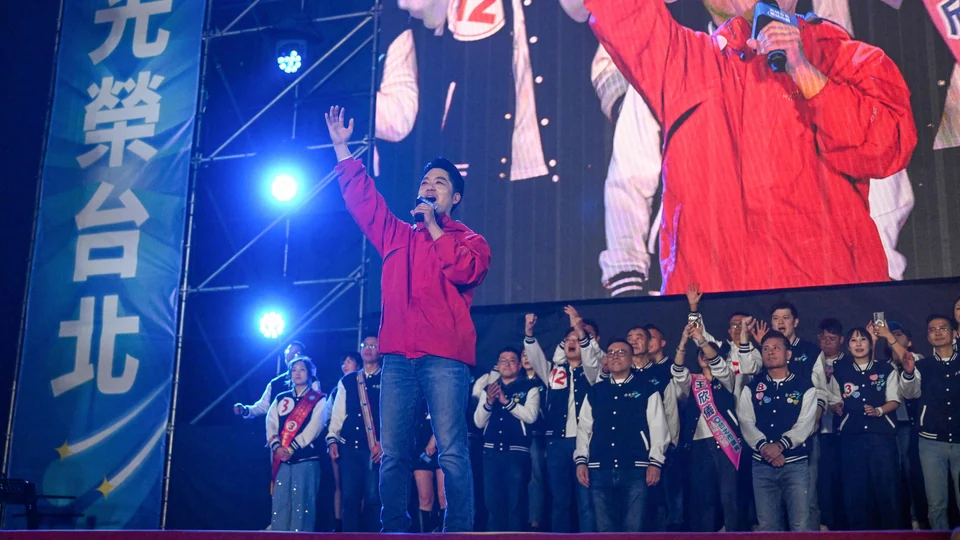
Taiwan is heading into a closely watched round of local elections that could reshape its political landscape ahead of the January 2028 presidential contest, with an unexpectedly competitive mayoral race in Taipei drawing particular attention. Around 19.6 million eligible voters are choosing mayors and county chiefs across 22 cities and counties, alongside thousands of other local representatives, in an election that will test the strength of the ruling Democratic Progressive Party (DPP) and the opposition Kuomintang (KMT).
The results could influence which political figures emerge as potential presidential contenders, how the two major parties position themselves and how Taiwan manages its increasingly sensitive relationship with China. Beijing is watching the outcome closely because the KMT generally advocates more engagement with China, while the DPP supports Taiwan’s right to determine its own future and has faced sustained opposition from the Chinese government.
Although local elections are primarily focused on everyday issues such as transport, childcare, food safety and living costs, their political implications extend well beyond municipal government. Taipei’s mayoral contest between incumbent Chiang Wan-an of the KMT and DPP candidate Puma Shen has become a particularly important test of political momentum.
Why Taiwan’s Local Elections Matter Ahead of 2028
Taiwan’s local elections are an important measure of public support for the island’s major political parties. The DPP has achieved an unprecedented run of three consecutive presidential victories, but the party has historically struggled to match the KMT’s strength in local government.
The opposition KMT has maintained extensive grassroots networks across Taiwan for decades. Those local political connections have helped it win mayoral and county leadership positions even when the DPP has performed strongly in national elections.
The latest vote will test whether President Lai Ching-te’s DPP can convert its national electoral success into stronger local representation. For the KMT, the results will indicate whether it can retain its traditional local-government advantage and establish a strong foundation for the next presidential election.
The outcome could also influence the selection and positioning of potential presidential candidates. Taiwan’s local government leadership has historically provided a pathway to national politics. Four of the island’s five directly elected presidents previously served as mayors, including three who led Taipei.
That history makes the capital’s mayoral election particularly significant. A victory could strengthen a candidate’s national profile, while a defeat could complicate the political ambitions of figures seeking to lead their respective parties into 2028.
Taipei Mayoral Contest Draws National Attention
The most closely watched contest is taking place in Taipei, where incumbent KMT Mayor Chiang Wan-an is seeking re-election against DPP challenger Puma Shen. The DPP is hoping to regain control of the capital for the first time since 1994.
Chiang is a prominent figure in the KMT and has attracted attention because of his political background and family history. He studied and practised law in the United States and is widely described as a great-grandson of Chiang Kai-shek, the former leader of the Republic of China who retreated to Taiwan after losing the Chinese Civil War to Mao Zedong’s Communist forces.
Chiang has visited mainland China and met Chinese officials, a background that contrasts with the more confrontational approach taken by some DPP politicians towards Beijing.
His challenger, Puma Shen, is a legislator known for his strong opposition to Chinese political pressure. Beijing has sanctioned Shen and Chinese police have accused him of separatism, allegations connected to his political position on Taiwan. Shen has rejected Beijing’s claims over the island’s status.
Shen has also said his campaign faced an alleged cyberattack. He has described security precautions taken during overseas travel, including wearing a bulletproof vest, and has campaigned in a vehicle fitted with bulletproof shields.
The contrast between the candidates reflects a broader political divide in Taiwan over relations with China. However, the election is not simply a referendum on cross-strait policy. Voters will also assess the candidates’ local-government records, campaign promises and ability to address practical problems in the capital.
Independent Voters Could Determine the Outcome
Both major parties are competing for voters who do not consistently identify with the DPP or the KMT. According to Lev Nachman, an associate professor at National Taiwan University who has researched Taiwan’s political views for a decade, independent voters account for approximately 30% to 40% of the electorate.
This group represents a significant share of voters and could influence closely contested races, particularly in major cities where neither party can rely entirely on its traditional supporters.
Austin Wang, an associate professor of political science at the University of Nevada, Las Vegas, has argued that the central question is whether either party can expand its appeal beyond Taiwan’s entrenched political divisions.
For both campaigns, winning over independent voters may require a stronger focus on local governance rather than relying exclusively on ideological differences or the debate over China.
Issues such as traffic congestion, food safety, childcare availability and the cost of living are likely to influence how voters assess their local leaders. These concerns can have a more immediate effect on household life than national debates over foreign policy.
China’s Role Adds a Geopolitical Dimension
Although the election concerns local government positions, China remains an important part of the political backdrop. Beijing claims Taiwan as part of its territory, even though the island has never been governed by the People’s Republic of China.
Taiwan operates as a self-governing democracy with its own elected leadership, military, institutions and political system. The DPP supports Taiwan’s right to determine its future, a position that has led Beijing to ostracise the party and increase pressure on the island.
The KMT, meanwhile, generally supports maintaining channels of communication and pursuing more stable relations with mainland China. Its approach is often viewed by investors and political observers as carrying lower immediate cross-strait tensions than the DPP’s position, although that does not mean the party accepts Beijing’s claims over Taiwan.
Yen Wei-ting, an assistant research fellow at Academia Sinica in Taipei, said a poor KMT performance could affect Beijing’s calculations about the island’s political direction.
“A poor showing by the KMT would certainly affect Beijing’s calculations going forward,” Yen said. “It would likely push the KMT to moderate its approach in parliament and move closer to the political center.”
The results could therefore influence not only Taiwan’s domestic political calculations but also how Beijing assesses the prospects for engagement with the island’s opposition parties.
However, local election results cannot automatically be treated as a prediction of the 2028 presidential outcome. National elections typically involve different issues, voter coalitions and political calculations, particularly when cross-strait relations and foreign policy become more prominent.
Why the Six Special Municipalities Are Important
Political attention is concentrated on Taiwan’s six special municipalities: Taipei, New Taipei, Taoyuan, Taichung, Tainan and Kaohsiung. These cities are among the island’s most important population and economic centres, and their results can provide clues about broader political trends.
UBS Group AG’s sales desk highlighted the importance of the mayoral races in these municipalities, noting that their outcomes have often been watched as indicators of the political environment ahead of presidential elections.
“All eyes will be on the mayor elections in the six special municipalities, including Taipei, New Taipei, Taoyuan, Taichung, Tainan and Kaohsiung, as the results tend to provide a good indicator for the next presidential election about a year away,” UBS wrote in a note to clients.
The bank also noted that the KMT has historically been perceived as presenting lower cross-strait risks, a perception that can influence how investors assess Taiwan’s geopolitical environment.
New Taipei is another important battleground for the DPP. Taiwan’s most populous municipality is a target for the ruling party after it suffered a defeat there by almost 25 percentage points in the 2022 local elections.
Kaohsiung, meanwhile, is a traditional DPP stronghold that the ruling party is seeking to defend. The party’s performance in these cities will help determine whether it can broaden its local support or whether the KMT retains its established advantage.
What Happened in Taiwan’s 2022 Local Elections?
The previous local elections in 2022 produced a clear advantage for the KMT. The opposition party won 14 of Taiwan’s 22 cities and counties, while the DPP secured five.
The result reflected the KMT’s longstanding local networks and its ability to mobilise support beyond the island’s major national political debates. Local elections often reward candidates with established community relationships and a reputation for administrative performance.
The DPP’s challenge this time is to improve on that performance while defending the municipalities it already controls. The party is also seeking to demonstrate that its three consecutive presidential victories represent a broader shift in public support rather than a strength limited to national elections.
For the KMT, retaining its local-government advantage would strengthen its position ahead of the next presidential contest. However, the party must also navigate internal political calculations over its approach to Beijing and the expectations of voters who may prefer a more moderate position.
Taiwan’s Economy Is Strong, but Investors Are Watching Political Risks
Taiwan’s economy is performing strongly, largely because of international demand for technology products and semiconductor-related manufacturing. The island plays a central role in the global artificial intelligence supply chain through its chip industry.
The statistics bureau raised its estimate for full-year economic growth to more than 13% and forecast expansion of 6.5% in 2027, reflecting continued demand for technology products.
Despite the strong economic outlook, many Taiwanese residents feel they are not fully benefiting from the AI boom. The gains from technology exports and the performance of major companies do not necessarily translate into lower household costs or improved living standards for every section of the population.
At the same time, Taiwan’s technology-heavy equity market is facing pressure amid questions about the durability of the global artificial intelligence investment cycle. Overseas investors sold approximately NT$1 trillion, or around US$30.4 billion, worth of local shares on a net basis in November, according to Bloomberg-compiled data.
The scale of the outflow put the market on course for a record monthly net withdrawal of foreign funds. Investors are therefore watching the elections for clues about the political direction of the island and the potential impact on relations with China.
Political stability matters to Taiwan’s technology sector because semiconductor production and exports are deeply connected to international supply chains. Any escalation in cross-strait tensions could increase uncertainty for businesses, investors and global technology companies that depend on Taiwanese manufacturing.
China’s Alleged Election Interference Raises Security Concerns
Taiwan’s government has warned about alleged attempts by China to interfere in its elections. The concerns include disinformation campaigns, illicit political funding, cyberattacks and the use of artificial intelligence-generated deepfakes to influence public opinion.
These warnings reflect a wider concern that digital manipulation and coordinated information campaigns could undermine trust in candidates, political institutions and the electoral process.
China has historically increased pressure on Taiwan during election periods. The government in Taipei has therefore treated election security as an important part of protecting the island’s democratic institutions.
However, individual allegations of interference must be assessed separately. The existence of government warnings does not establish that every suspicious online post, cyber incident or campaign controversy is directed by Beijing.
The alleged cyberattack targeting Puma Shen’s campaign has added to the security debate surrounding the Taipei race. His campaign’s concerns come amid broader warnings about digital threats and attempts to influence political discussions.
How Taiwan Ensures Transparency in Its Elections
Taiwan follows a voting system that requires eligible voters to cast their ballots in person in the area where their household registration is recorded. This system is designed to maintain a direct connection between voters and their registered constituencies.
Ballot counting is conducted publicly, allowing observers and members of the public to follow the process and monitor the results. These procedures are intended to strengthen transparency and reduce opportunities for electoral fraud.
Taiwan’s elections are widely regarded as a major democratic exercise in the Chinese-speaking world. The Stockholm-based Global State of Democracy Initiative has identified Taiwan as one of the highest-performing societies in areas including democratic rights, political representation, participation and the rule of law.
The election’s scale is substantial, with approximately 19.6 million people eligible to vote across 22 cities and counties. More than 11,000 additional local positions are also being contested.
Voters Travel to Taiwan to Participate in the Election
The importance of local elections has also drawn participation from Taiwanese citizens living overseas. One voter, identified only by her surname Wang, travelled from Singapore to Taipei to cast her ballot for the DPP’s Puma Shen.
The 35-year-old finance worker said it was her first time voting in a local election and described the experience as an opportunity to participate in a potentially significant political change.
“This is exciting,” Wang said. “It’s the first time we might see change.”
Her decision illustrates how local contests can attract interest beyond the communities directly affected by municipal decisions. For some voters, the election represents a chance to influence the political direction of Taiwan ahead of the next national contest.
Referendum on Nuclear Power Adds Another Issue to the Vote
Alongside the local elections, Taiwanese voters are also participating in a nationwide referendum on whether the government should revive nuclear power.
The issue comes as Taiwan debates its future energy mix and the need to ensure a reliable electricity supply for households and energy-intensive industries. The island’s semiconductor sector, in particular, requires dependable electricity to support manufacturing operations.
The government is already exploring plans to restart shuttered nuclear power plants. The referendum adds a public dimension to that discussion, allowing voters to express their views on whether nuclear energy should return as part of the country’s electricity system.
The nuclear question is separate from the mayoral and county leadership contests, but it reflects the range of domestic issues shaping Taiwan’s political debate.
What the Election Could Mean for Taiwan’s 2028 Presidential Race
The local election results will offer an early indication of how the DPP and KMT are positioned before the next presidential and legislative elections, expected in January 2028. They will also help determine which local leaders gain the political influence needed to emerge as potential national candidates.
A strong KMT performance could reinforce the party’s local-government network and strengthen politicians advocating more engagement with China. A stronger showing by the DPP could help President Lai’s party demonstrate that its national electoral success can also translate into local support.
But the outcome will not settle the presidential contest. Voters may prioritise municipal performance in local elections and shift their attention towards national security, foreign policy, economic strategy and relations with Beijing when choosing the next president.
For China, the results will provide another indication of Taiwan’s political mood and the prospects for its preferred approach to cross-strait engagement. For investors, the election could offer clues about geopolitical risk at a time when Taiwan’s technology industry remains central to the global AI economy.
The most important immediate test is whether either major party can expand its appeal among independent voters while maintaining support among its traditional base. As Taiwan’s political landscape becomes increasingly competitive, the local elections are likely to shape the debate well before campaigning for the 2028 presidential race formally begins.
For breaking news and live news updates, like us on Facebook or follow us on Twitter and Instagram. Read more on Latest World on thefoxdaily.com.

COMMENTS 0