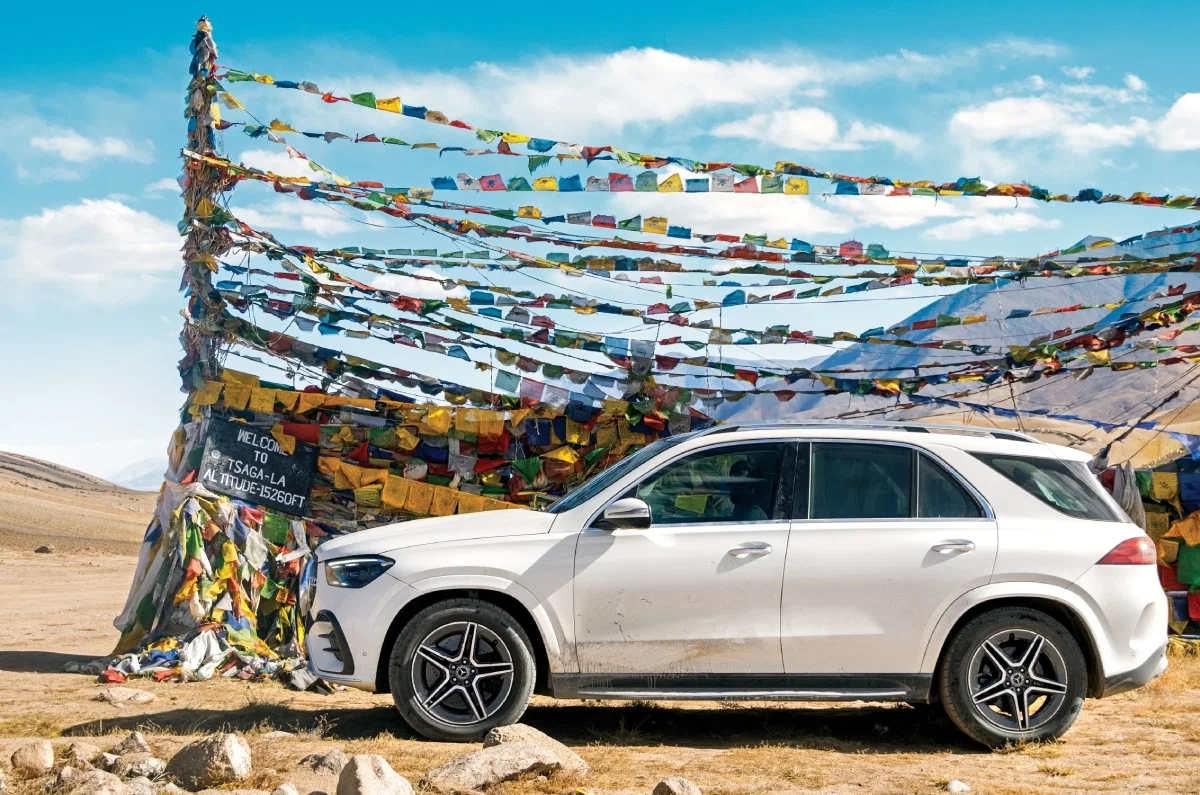
When Carl Benz patented the world’s first motor car in 1886, he could hardly have imagined how far the automobile would travel in the following 140 years. Mercedes-Benz has since become one of the most recognised names in the automotive world, with a history shaped by engineering milestones, luxury and innovation. To celebrate the brand’s 140th anniversary, we decided to mark the occasion with a rather unusual road trip.
The idea was simple: take 140 hours to explore some of the highest motorable passes in Ladakh, covering as many as possible within the time limit. The challenge, however, was anything but simple. High-altitude roads, unpredictable weather, rough surfaces, falling temperatures and the effects of altitude would test both the crew and the vehicle.
Our companion for this adventure was the Mercedes-Benz GLE 450. Picked from the brand’s SUV range, it offered a combination of performance, comfort and off-road ability without being excessively large for narrow mountain roads. With 381hp and 500Nm of torque, along with 4MATIC all-wheel drive and air suspension, it seemed well suited to the task.
The Countdown Begins: 140 Hours Left
Our expedition began at Zoji La, located at an altitude of 11,649 feet. The pass connects Srinagar with the Ladakh region and serves as an important gateway into the mountains. However, reaching its summit is not always straightforward. Steep gradients, sharp hairpins, slow-moving trucks and the possibility of falling rocks make it a demanding stretch.
Behind the wheel of the lead GLE was Rahul Kakar, our Manager of Special Projects and the person we rely on when a deadline involves covering serious distance. I followed in a support GLE, keeping close to the lead car throughout the journey.
Zoji La is also known as the Mountain Pass of Blizzards, but the weather was relatively kind to us. After reaching the summit, we began the 140-hour countdown, captured the obligatory photographs and continued towards Kargil.
We deliberately kept the first day relatively relaxed. Acclimatising to the altitude was important before heading towards more remote routes in the coming days. The real challenge was still ahead.
The Road Less Travelled: 125 Hours Left
Even after several trips to Ladakh, there are always places left unexplored. For Rahul, Hamboting La was one such destination. Unlike the popular NH1 route connecting Kargil and Leh, reaching this pass requires taking a narrower road away from the main highway. At 13,380 feet, it offered a peaceful contrast to the tourist-heavy Zoji La.
There was hardly anyone around when we reached the summit. It was a reminder that Ladakh has plenty of hidden routes and viewpoints beyond the familiar destinations that dominate travel photographs.
From Hamboting La, we continued towards Shashi La at 14,045 feet, followed by Kaldang Kildang La. The latter had no signboard indicating its altitude, but the GLE’s onboard altimeter came in handy, showing a reading of 4,091 metres, or approximately 13,425 feet.
Roadworks and narrow village lanes slowed us down in places, but the GLE’s 500Nm of torque made steep climbs feel relatively effortless. The vehicle’s performance was particularly useful when navigating gradients at high altitude, where the conditions can make driving more demanding.
With several more passes on the day’s itinerary, lunch became an easy sacrifice. After rejoining the Kargil-Leh highway, we crossed Namik La at 12,189 feet and then headed towards Fotu La, which stands at 13,479 feet.
By the end of the day, we had covered five additional passes, taking our running total to six. Our night halt was near Lamayuru, where the barren, almost lunar landscape offered a dramatic change of scenery.
Zanskar Calling: 101 Hours Left
Lamayuru is usually a brief stop for travellers heading towards Leh, but we decided to spend the night there to make the next day’s route more manageable. Our plan was to head south towards the Zanskar Valley and explore some of its less-travelled mountain passes.
The road through the valley was narrow but largely well-paved, winding between steep cliffs and dramatic mountain scenery. As we approached Sirsir La, the valley began to open up before the road climbed towards the pass at approximately 15,700 feet.
Historically, travelling through this terrain would have involved walking or relying on pack animals. We, however, had the GLE’s 381hp engine at our disposal, making the steep ascent considerably easier.
Next came Bumiktse La at 13,780 feet, followed by Singe La at approximately 16,590 feet. The altitude was beginning to affect the crew, with temperatures dropping to 3.5 degrees Celsius. Constantly getting in and out of the cars to capture photographs, combined with the winding roads and thin air, was taking its toll.
When one crew member began feeling light-headed, the GLE’s rear seat provided a comfortable place to rest. He reclined, took some oxygen from a portable canister and allowed himself time to recover. Staying hydrated, avoiding unnecessary physical exertion and recognising the effects of altitude were becoming increasingly important.
Our next destinations, Kiupa La and Murgum La, were both located just above 14,400 feet. These routes were so remote that Google Maps could not reliably guide us. Asking local residents for directions became the most effective way to locate the passes and find our way back to the main road.
The road conditions also became more challenging. Smooth tarmac gave way to broken surfaces, dirt and mud. This was an ideal opportunity to use the GLE’s off-road mode, 4MATIC all-wheel-drive system and adjustable air suspension. The latter allowed us to raise the ride height when required, while the all-wheel-drive system helped maintain traction on loose surfaces.
Despite a few wrong turns, we eventually returned to smoother roads and reached Padum for the night. We had covered eleven passes so far, with plenty more still on the list.
The Long Haul: 77 Hours Left
Having benefited from local guidance the previous day, we once again turned to someone familiar with the region. This time, it was our hotel manager in Padum, who was surprised that we wanted to take a route that would require around 15 hours of driving when a newer highway could get us to Leh much sooner.
After explaining the challenge, we received directions towards the Manali-Leh highway. The route offered some stunning and largely deserted stretches, with Shinku La at approximately 16,580 feet serving as the first major highlight. Snow-covered surroundings provided a welcome change from the dry, rocky landscape we had encountered earlier.
We then continued towards Baralacha La, which stands at 15,912 feet. The next major challenge was the Gata Loops, a series of 21 hairpin bends that gain altitude rapidly. The road is narrow, and traffic can make progress particularly difficult, especially when trucks approach from opposite directions.
The GLE’s 360-degree camera proved useful in these situations, helping us judge the vehicle’s position when negotiating tight sections. Beyond the loops, we crossed Nakee La at 15,547 feet.
The road conditions along this section of the Manali-Leh highway have improved considerably over the years. Long stretches of well-engineered tarmac now connect some of the country’s most remote and challenging terrain. The work carried out by the Border Roads Organisation has played a significant role in making these routes more accessible.
Our next stop was Lachung La at 16,616 feet. At this altitude, atmospheric pressure is roughly half of what it is at sea level, and the cold made spending extended periods outside particularly uncomfortable.
We then crossed the vast Morey Plains, a high-altitude plateau where the open landscape can make judging distances difficult. Despite the seemingly smooth surface, sudden dips and undulations meant that maintaining a sensible speed was essential.
As daylight began to fade, we reached Taglang La at 17,482 feet, the highest point of the journey so far. After approximately 15 hours on the road, fatigue was setting in. Fortunately, a comfortable stay and a hot meal awaited us in Leh, along with a special guest.
Boss’ Day Out: 53 Hours Left
When our editor, Hormazd Sorabjee, first heard about the expedition, he immediately expressed an interest in joining us. Despite a packed schedule, he managed to make the journey to Leh straight from an event in Saudi Arabia.
For Rahul, this meant giving up the driver’s seat for a day and becoming a passenger. Hormazd, meanwhile, brought with him decades of experience travelling through Ladakh. His first visit to the region was in 1987, when many of the roads were little more than rough tracks.
As we headed towards Khardung La, he recalled how challenging the route used to be. At 17,982 feet, it was once widely regarded as the world’s highest motorable road. Today, it attracts thousands of tourists, often resulting in considerable traffic near the summit.
Our next destination was Wari La at 17,429 feet. Although slightly lower than Khardung La, it offers a quieter alternative for those looking to escape the crowds. From there, we continued towards Chang La at 17,688 feet.
The climb to Chang La was steep but beautifully paved. The GLE’s effortless performance made the ascent feel easy, while its comfortable cabin provided some relief from the demanding conditions outside. The altitude, however, was still noticeable, and we avoided spending too much time at the summit.
For Hormazd, the drive was also an opportunity to reflect on how much the region had changed. He recalled travelling through Ladakh in 2001 in a Mercedes-Benz E-Class, at a time when luxury cars were rarely seen on Indian roads. The region’s infrastructure has evolved considerably since then, but the pleasure of driving a Mercedes through these mountains remains special.
After returning to Leh, we continued towards Nyoma. By this point, we had crossed nineteen passes, and the countdown was becoming increasingly difficult to ignore.
Into The High Country: 29 Hours Left
Our night at a homestay in Nyoma was colder than any of the previous stops. Despite limited sleep, the crew was eager to get back on the road. The GLE’s cabin had become a familiar refuge after several days of driving through high-altitude terrain.
We managed the cabin temperature carefully to avoid sudden changes when getting in and out of the vehicle. The heated seats were particularly useful, while the heated cupholders and storage areas proved handy for keeping gloves and caps warm before stepping outside.
The day began with Pologongka La at 16,240 feet. Although it required a slight detour, we decided it was worth adding to the list. We then doubled back towards Kaksang La at 17,851 feet, followed by Thato La at 16,669 feet.
The roads leading to these passes featured sharp hairpins and challenging gradients. The GLE continued to demonstrate its versatility, with the suspension absorbing broken sections without making the cabin uncomfortable. Its 4MATIC all-wheel-drive system also provided reassuring traction on loose surfaces.
Despite running on 20-inch wheels, we had no hesitation in taking the SUV onto dirt sections when the route demanded it. The combination of adjustable air suspension and off-road driving modes made the GLE more capable than its luxury positioning might suggest.
We then stopped at Tsaga La, located at 15,260 feet. This brought our running total to 23 passes. The number was impressive, but the biggest challenge was still waiting for us.
The Final Push: Five Hours Left
We spent the night in Hanle, home to India’s highest dark-sky reserve. By the time we woke up, only five hours remained on the clock. Our target was Umling La, but reaching it within the deadline would require careful planning and a little luck.
We began with a climb towards Fotu La, which stands at approximately 18,124 feet. Once across and near Chisumle, we faced a decision: head directly towards Umling La or attempt to add Nurbu La to the list, risking the possibility of missing our final destination.
We chose Nurbu La, and the detour turned out to be worthwhile. The views were spectacular, although the weather began to deteriorate as snow started falling near the summit. This raised concerns about our final climb towards Umling La.
The route to Umling La was familiar in character by now, with long climbs, sweeping bends and uneven surfaces. However, the conditions were particularly challenging, with black ice adding another layer of difficulty. We selected the GLE’s off-road mode and used the 9G-Tronic transmission in manual mode to maintain a steady pace.
The temperature display showed minus 7 degrees Celsius. Fortunately, the wind was not as strong as it can be at this altitude. As we continued climbing, the distinctive yellow stone plinth at the summit finally came into view against the snow-covered mountains.
With approximately 22 minutes remaining, we reached the top of Umling La. At 19,024 feet, it was the highest point of our expedition and the perfect location to complete the challenge.
The summit was far from deserted. Several motorcyclists had also made the journey, and some visitors were struggling with the altitude and icy conditions. A few asked if they could take shelter inside the GLE, and we were happy to offer them a place to rest.
By then, our crew had adapted reasonably well to the altitude and was feeling much better than during the earlier stages of the expedition.
26 Passes In 140 Hours: Mission Accomplished
The objective was achieved. Over 140 hours, the crew and two Mercedes-Benz GLE SUVs crossed 26 mountain passes, beginning at Zoji La and finishing at Umling La.
The journey covered a remarkable variety of terrain, from smooth highways and well-paved mountain roads to broken tracks, loose gravel, mud and snow-covered surfaces. It also tested the team’s endurance, requiring careful scheduling, local knowledge and an understanding of the challenges associated with high-altitude travel.
Throughout the expedition, the GLE 450 proved to be a capable companion. Its 381hp engine and 500Nm of torque made steep climbs easier, while the 4MATIC all-wheel-drive system helped maintain traction on challenging surfaces. The adjustable air suspension added another layer of flexibility, and the comfortable cabin became increasingly valuable during long days on the road.
The GLE also demonstrated that a luxury SUV can handle more than just smooth highways and city commutes. While few owners are likely to subject their vehicles to the kind of terrain we encountered, the expedition highlighted the versatility built into the SUV.
A Fitting Celebration Of Mercedes-Benz’s 140-Year Journey
In 1886, Carl Benz’s first motor car represented the beginning of a journey that would transform transportation around the world. Fourteen decades later, a Mercedes-Benz GLE 450 reached Umling La, one of the highest motorable passes on the planet.
The two vehicles could hardly be more different in terms of technology, performance and capability. Yet they represent different chapters of the same automotive story: a continuous pursuit of engineering progress and the ability to go further.
Crossing 26 passes in 140 hours was not simply about reaching a collection of high-altitude destinations. It was about celebrating Mercedes-Benz’s history through an adventure that pushed both the vehicle and its crew beyond familiar territory.
And with the GLE standing at 19,024 feet at Umling La, we could hardly have found a more fitting place to celebrate 140 years of Mercedes-Benz.
For breaking news and live news updates, like us on Facebook or follow us on Twitter and Instagram. Read more on Latest Automobile on thefoxdaily.com.



COMMENTS 0