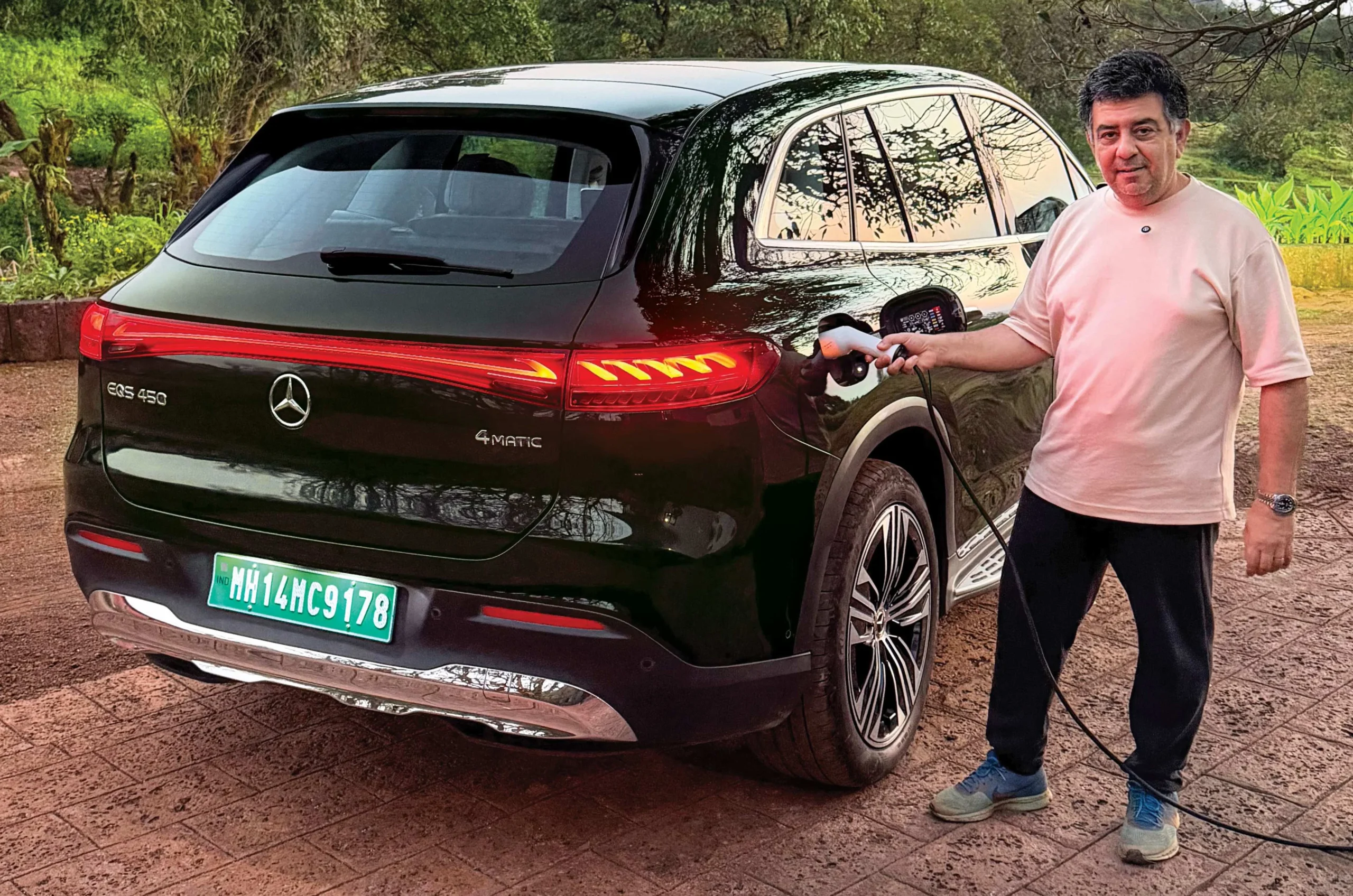
It is time to say goodbye to our long-term Mercedes-Benz EQS 450 SUV after 35,000km. During its time with us, this all-electric luxury SUV has delivered an experience defined by comfort, refinement and effortless performance. Its hushed powertrain, exceptionally quiet cabin and well-insulated suspension have made it particularly enjoyable in Mumbai’s demanding traffic conditions.
Few luxury SUVs offer the same sense of isolation from the outside world. Whether navigating crowded city streets or travelling on highways, the EQS SUV has consistently demonstrated what Mercedes-Benz does best: creating a comfortable and sophisticated driving environment.
City Driving: Surprisingly Easy To Manage
Driving a large luxury SUV in Mumbai is not always a relaxing experience. Traffic congestion, narrow roads and unpredictable road users can make everyday journeys stressful. The infamous Saat Rasta junction in Mahalaxmi, where different forms of transport compete for limited space, is a particularly demanding environment.
Despite its considerable dimensions, the EQS 450 SUV handles these conditions remarkably well. Its high seating position and excellent visibility make it easier to judge the vehicle’s edges and monitor surrounding traffic. This is particularly useful when two-wheelers squeeze past the SUV with very little clearance, frequently triggering its proximity sensors.
Rear-wheel steering is another feature that makes a significant difference in everyday use. It effectively reduces the turning effort required from such a large vehicle, making tight manoeuvres and narrow turns considerably easier. Even negotiating the sharp 90-degree turn into a driveway becomes a relatively simple task. It is one of the features that will be particularly missed after the long-term test ends.
Interestingly, the EQS 450 SUV proved more enjoyable to drive than to experience from the rear seat. Despite weighing close to three tonnes, it feels remarkably responsive. The instant torque from its electric powertrain delivers strong acceleration, allowing the SUV to gather speed effortlessly and move through gaps in traffic with surprising ease.
Its size and weight are quickly forgotten once the vehicle is moving. The smooth delivery of electric power makes city driving less demanding, while the responsive acceleration gives the driver plenty of confidence.
Hyperscreen And MBUX: A Cabin Technology Highlight
The Mercedes-Benz Hyperscreen remains one of the biggest highlights of the EQS SUV. Its display clarity, graphics and ease of use make it one of the most impressive infotainment systems experienced during the long-term test.
The interface is logically arranged, information is presented clearly and the system avoids unnecessary clutter. Even the climate controls are conveniently accessible through a permanently visible strip at the bottom of the central display. The icons are sufficiently large, making them easier to operate than many touchscreen-based systems.
The experience highlights how mature Mercedes-Benz’s MBUX infotainment system has become, even as the manufacturer moves towards its newer MB.OS software architecture. The digital instrument cluster also deserves appreciation for its clean layout, customisation options and clear presentation of information.
However, the touch-sensitive controls on the steering wheel remain a minor annoyance. Navigating the instrument cluster using these controls can feel fiddly, especially when compared with conventional physical buttons.
The built-in navigation system also required an update during the test. While driving along Mumbai’s Coastal Road, the map initially showed the vehicle travelling through the Arabian Sea instead of following the actual road. After the issue was reported to Mercedes-Benz, the company updated the maps, and the Coastal Road appeared correctly.
Ambient Lighting: One Of The Best Cabin Experiences
The EQS SUV’s ambient lighting system is among the best experienced in any car. Its crisp LED accents create a sophisticated atmosphere without making the cabin look excessively flashy. The lighting complements the interior materials and enhances the sense of luxury, particularly after sunset.
More importantly, the lighting is not just decorative. It also illuminates practical storage areas, including the spaces beneath the centre console, door bins and even the area under the front seats. These small details improve everyday convenience while adding to the cabin’s premium appeal.
Real-World Range: An Impressive Mahabaleshwar Drive
No long-term electric vehicle test would feel complete without a trip to Mahabaleshwar. The route has become a useful benchmark for evaluating real-world EV range, particularly because of its final 40km climb from near sea level to approximately 4,500 feet.
This steep section puts considerable demand on an electric vehicle’s battery, making it a useful test of energy consumption and range management. The EQS SUV handled the climb exceptionally well.
After completing the journey, the vehicle reached Mahabaleshwar with 35 per cent battery charge remaining and a predicted range of 174km. This was one of the most impressive range performances recorded during the long-term EV experience and demonstrated the Mercedes-Benz’s ability to manage demanding driving conditions without causing range anxiety.
Charging at the destination was less sophisticated but perfectly manageable. The SUV was connected to a regular 15-amp socket, which delivered approximately 3.3kW of charging power. At this rate, a substantial battery top-up required around 30 hours.
While this is considerably slower than charging through a dedicated high-power charger, it was convenient enough for an extended stay. Being able to charge at the accommodation also meant there was no need to search for a public charging station or wait in a queue during a busy holiday weekend.
Ground Clearance And Long-Distance Comfort
The EQS SUV also handled the rougher sections of the Mahabaleshwar route with confidence. Large speed breakers did not pose a significant problem, thanks to its generous ground clearance. Even on narrow ghat roads, where moving two wheels onto the earthen shoulder was occasionally necessary to make room for oncoming traffic, the SUV remained reassuringly capable.
However, the long-distance journey revealed an important weakness: the suspension is softer than ideal. The air suspension does an excellent job of absorbing sharp bumps and keeping road imperfections away from the cabin. But over undulating surfaces, the heavy body tends to pitch and heave more than expected.
The excessive vertical movement means the SUV does not always feel settled, particularly on uneven roads. Switching to Sport mode helps reduce some of the suspension’s floatiness and makes the vehicle feel more controlled. However, it does not completely eliminate the movement.
The issue is particularly noticeable because the rest of the cabin experience is so refined. The EQS SUV isolates occupants from road noise and sharp impacts exceptionally well, but its suspension could do a better job of controlling the movement of its heavy body.
Braking Performance: A Disappointing Weak Point
The braking system is another area that could be improved. The response can feel inconsistent, which becomes more noticeable when slowing down a vehicle weighing close to three tonnes. The concern is particularly evident on steep descents, where predictable braking behaviour is important.
With regenerative braking reduced, the friction brakes did not always inspire the same confidence. As a result, there was a tendency to rely more heavily on maximum regenerative braking to help control the vehicle’s speed.
During the descent from Mahabaleshwar, the steering-mounted regeneration paddles proved particularly useful. They allowed the driver to increase regenerative braking in stages, much like using engine braking in a conventional petrol or diesel vehicle.
While this approach works effectively, the transition between regenerative braking and conventional friction braking could be smoother. Their coordination does not feel as natural as expected in a luxury electric SUV of this price and positioning.
Considering how well the EQS SUV performs in most other areas, the braking experience stands out as a disappointing weakness.
Rear Seat Comfort: Good Space, But Not Quite S-Class Luxury
The EQS SUV offers a comfortable rear-seat experience, with good legroom, decent under-thigh support and a relatively high seating position. Its large windows also provide an excellent view outside, making the cabin feel spacious and open.
However, the rear seat does not quite deliver the level of luxury associated with the Mercedes-Benz S-Class. The seats are not as plush, and the available powered adjustments are limited. Rear sunshades are another noticeable omission, especially considering the vehicle’s premium positioning.
Getting in and out of the rear cabin can also be challenging. The relatively high floor and step up into the vehicle make entry less graceful than expected. This was particularly noticeable for passengers wearing traditional clothing such as a saree, where climbing into the cabin required additional effort.
The low-speed ride quality also deserves attention. Although the suspension absorbs sharp road imperfections effectively, the SUV has a persistent underlying movement over uneven surfaces. There is a gentle side-to-side rocking sensation, accompanied by some vertical movement, which prevents the body from settling completely.
This does not make the ride harsh or uncomfortable in the conventional sense. Instead, it creates a slightly restless sensation that feels out of place in a vehicle otherwise designed around exceptional refinement.
Boot Space: The Spare Wheel Takes Its Toll
Despite its large exterior dimensions, the EQS SUV does not make the most efficient use of its available luggage space. The spare wheel takes up a significant portion of the boot area, reducing the room available for luggage.
During everyday city use, removing the spare wheel freed up useful additional space and made the boot considerably more practical. However, this also highlights a compromise in the vehicle’s packaging, particularly for a large luxury SUV that would otherwise be expected to offer generous luggage capacity.
Mercedes-Benz EQS 450 SUV: Final Verdict After 35,000km
After covering 35,000km, the Mercedes-Benz EQS 450 SUV leaves behind a largely positive impression. Its exceptional refinement, smooth electric powertrain, impressive real-world range and technology-rich cabin make it a remarkably comfortable vehicle for everyday use.
Its high seating position, excellent visibility and rear-wheel steering also make it surprisingly manageable in crowded city conditions. On longer journeys, the impressive range performance provides additional confidence, while the Hyperscreen and ambient lighting make the cabin a particularly pleasant place to spend time.
However, the SUV is not without its shortcomings. The overly soft suspension allows too much body movement over undulating roads, the braking response lacks consistency, and the rear-seat experience does not quite match the expectations associated with an S-Class. The compromised boot space is another practical limitation.
Nevertheless, these shortcomings do not take away from what the EQS SUV does exceptionally well. It makes everyday driving feel effortless, isolates occupants from much of the chaos outside and offers an impressive combination of performance, comfort and electric range.
In a city as demanding as Mumbai, the ability to travel in near silence while remaining comfortable in heavy traffic is a significant luxury. After 35,000km, the Mercedes-Benz EQS 450 SUV has certainly earned its place as a memorable long-term companion. It will be missed.
For breaking news and live news updates, like us on Facebook or follow us on Twitter and Instagram. Read more on Latest Automobile on thefoxdaily.com.




COMMENTS 0