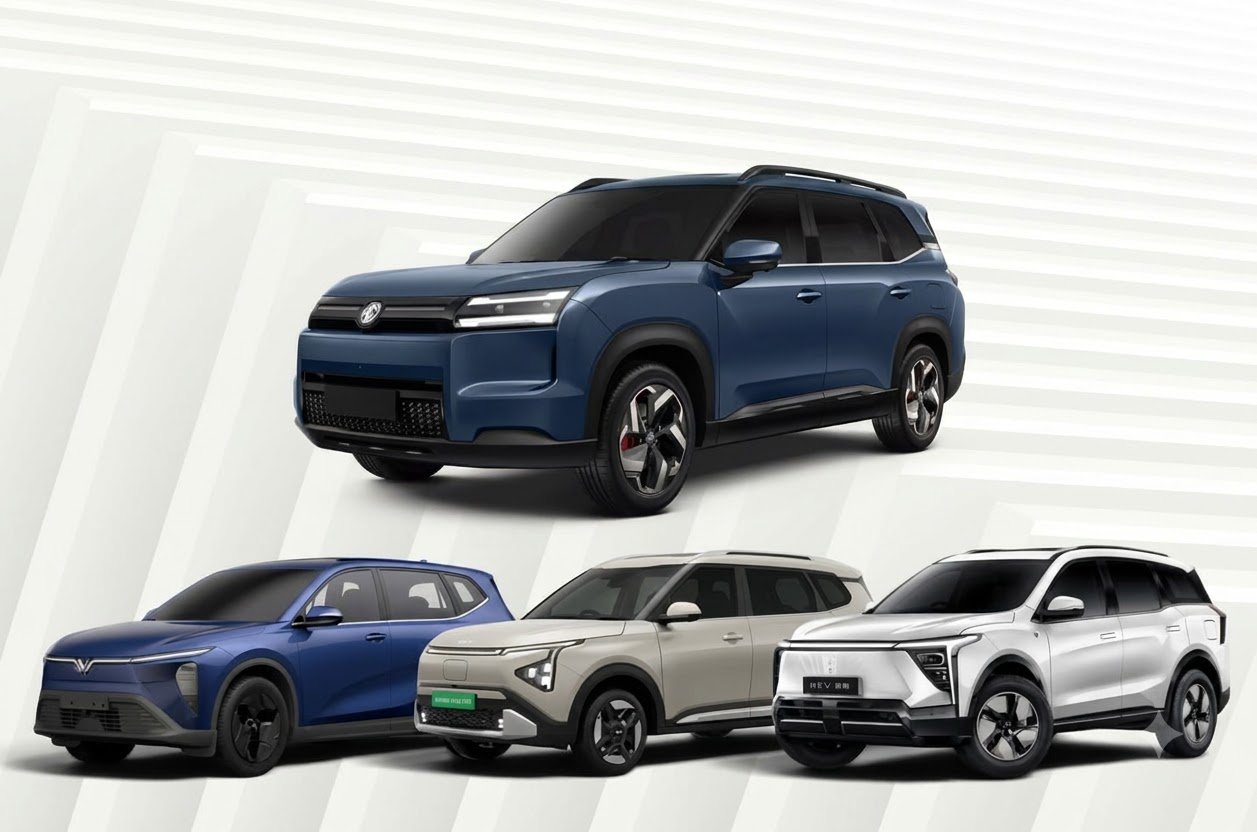
The MG Hector Tomahawk EV has entered India‘s three-row electric-car market with an aggressive price, a large battery and the practicality of seven seats. Launched on August 26, 2026, the electric SUV starts at Rs 19.49 lakh ex-showroom and is also available through MG’s Battery-as-a-Service (BaaS) ownership model, which reduces the upfront price to Rs 13.99 lakh before the battery rental charge.
That puts the Hector Tomahawk EV directly into competition with the Mahindra XEV 9S, Kia Carens Clavis EV, VinFast VF MPV 7 and BYD eMax 7. These cars approach the three-row EV formula differently. Mahindra focuses heavily on range and an SUV-oriented package, Kia takes the value route, VinFast offers an MPV-style alternative, while BYD brings a larger battery option and an established electric MPV format.
The Hector Tomahawk EV itself uses a 69.2kWh LFP battery and a single electric motor producing 201bhp and 310Nm. MG claims a maximum MIDC range of 517km, while the battery can accept up to 90kW DC charging. It is offered in both five- and seven-seat configurations, although the comparison here focuses on the seven-seat versions.
MG Hector Tomahawk EV vs rivals: How do the seven-seaters compare?
On paper, the Hector Tomahawk EV immediately stands out for combining a relatively low starting price with a large battery. Its 69.2kWh pack is considerably larger than the 42kWh battery in the base Kia Carens Clavis EV and bigger than the 60.13kWh unit in the VinFast VF MPV 7.
However, the Mahindra XEV 9S remains the range leader. Depending on the battery version, the XEV 9S offers 521km, 600km or 679km of claimed range, making even its entry battery version slightly better than the Hector Tomahawk EV on paper. The largest 79kWh XEV 9S has a particularly substantial advantage for buyers who regularly undertake long-distance journeys.
The BYD eMax 7 also offers a larger 71.8kWh battery in its Superior version, although its 530km NEDC claim is measured on a different testing cycle from the Hector Tomahawk EV’s 517km MIDC figure. That means the numbers should not be treated as a direct real-world comparison.
| Model | Battery | Claimed range | Power | Seating | Ex-showroom price |
|---|---|---|---|---|---|
| MG Hector Tomahawk EV | 69.2kWh | 517km MIDC | 201bhp | 7 | Rs 19.49 lakh onwards |
| Mahindra XEV 9S | 59kWh / 70kWh / 79kWh | 521km / 600km / 679km | Up to 210kW | 7 | Rs 20.65 lakh onwards |
| Kia Carens Clavis EV | 42kWh / 51.4kWh | 404km / 490km | 99kW / 126kW | 7 | Lower starting price than Hector Tomahawk EV |
| VinFast VF MPV 7 | 60.13kWh | 517km ARAI | 201hp | 7 | Rs 24.49 lakh |
| BYD eMax 7 | 55.4kWh / 71.8kWh | 420km / 530km NEDC | Up to 204hp | 7 | Rs 27.50 lakh onwards |
Dimensions: Hector Tomahawk EV focuses on space
The Hector Tomahawk EV is positioned as a large family SUV, and its dimensions reflect that intention. It is longer and taller than several of the three-row EVs it competes with, giving MG an important advantage in the battle for cabin space.
The VinFast VF MPV 7, however, has a longer wheelbase than the Hector Tomahawk EV, which can be beneficial when packaging three rows of seats. The VinFast measures 4,740mm long, 1,872mm wide and 1,734mm tall, with a 2,840mm wheelbase and 126 litres of boot space with all three rows occupied.
The Hector Tomahawk EV’s 18-inch wheels are also relatively conservative for a vehicle of its size. That could be useful for buyers more concerned with ride comfort and tyre replacement costs than visual appeal.
Boot space is another important consideration in any seven-seater EV. MG claims a useful luggage capacity even with all three rows in place, although direct comparisons are complicated because manufacturers do not consistently publish boot measurements using identical methods.
The Mahindra XEV 9S and Kia Carens Clavis EV also have an advantage in another area: both offer frunk storage. A front trunk can be particularly useful in an EV because the absence of a conventional engine bay can create additional storage space.
Battery and motor: MG sits in the middle of the pack
The Hector Tomahawk EV’s 69.2kWh battery gives it a strong position in this group.
Its battery is larger than the 42kWh and 51.4kWh options offered by the Kia Carens Clavis EV and bigger than the 60.13kWh pack in the VinFast VF MPV 7. It falls just short of the BYD eMax 7’s 71.8kWh top battery and the 79kWh versions of the Mahindra XEV 9S.
MG pairs the battery with a 150kW electric motor producing about 201bhp and 310Nm. The setup is front-wheel drive and MG claims a 0-100kph time of 8.2 seconds.
That gives the Hector Tomahawk EV substantially more power than the Kia Carens Clavis EV, whose larger 51.4kWh version produces 126kW and 255Nm. Kia’s official specifications list the two battery options at 42kWh and 51.4kWh, with claimed ranges of 404km and 490km respectively.
The VinFast VF MPV 7 makes almost identical peak power at 201hp, but its 60.13kWh battery is smaller and its motor produces 280Nm.
The Mahindra is the outlier because the XEV 9S offers multiple battery configurations and higher power outputs. Its 79kWh version produces up to 210kW, while the company lists 170kW for the 59kWh version and 180kW for the 70kWh version.
Range: Mahindra has the biggest advantage
Range is where the Hector Tomahawk EV faces its biggest weakness against the XEV 9S.
MG’s claimed 517km MIDC range is respectable for a seven-seat SUV. It is higher than the 490km claim of the long-range Kia Carens Clavis EV and matches the 517km ARAI claim of the VinFast VF MPV 7.
But the XEV 9S starts at 521km even with its 59kWh battery. Its 70kWh version is rated at 600km, while the 79kWh version reaches 679km.
This is an important distinction for buyers. The Hector Tomahawk EV has a reasonably large battery, but battery size alone does not determine range. Vehicle weight, aerodynamics, drivetrain efficiency, tyre size and energy management all influence how far an EV travels on a charge.
The BYD eMax 7’s Superior version claims 530km under the NEDC cycle, while its smaller 55.4kWh version is rated at 420km. BYD’s official India website lists 420km and 530km NEDC figures for the two battery capacities.
Because the BYD uses NEDC while MG, Mahindra and Kia use Indian testing figures in the comparison, consumers should avoid treating the raw numbers as an exact real-world ranking.
Charging: Hector Tomahawk EV is capable, but not class-leading
The Hector Tomahawk EV supports DC fast charging at up to 90kW. MG says the battery can be charged from 30 to 80 percent in around 35 minutes using a compatible DC charger. With a 7.4kW AC charger, a 10 to 100 percent charge takes around 12.5 hours.
That makes home charging practical overnight, but the Tomahawk EV does not have the highest AC charging capability in this comparison.
The Kia Carens Clavis EV supports 11kW AC charging, with Kia quoting about four hours for the 42kWh battery and 4 hours 45 minutes for the 51.4kWh version. It also supports up to 100kW DC charging, with a claimed 10-80 percent time of 39 minutes.
The XEV 9S has an even stronger fast-charging proposition on selected versions. Mahindra says the 79kWh version can charge from 20 to 80 percent in 20 minutes using a 180kW DC charger.
For buyers who mainly charge at home, these differences may matter less. For families that frequently drive long distances, faster DC charging can make a much bigger difference.
Price: This is where MG becomes especially aggressive
The Hector Tomahawk EV’s biggest weapon may not be its battery or range. It is the price.
The seven-seat Excite variant starts at Rs 19.49 lakh ex-showroom, while the Exclusive seven-seater costs Rs 21.99 lakh. The top-spec Essence seven-seater is priced at Rs 23.49 lakh.
That places the MG below the Mahindra XEV 9S’s current starting price of Rs 20.65 lakh, although the Mahindra offers a much wider range of battery and range options.
The VinFast VF MPV 7 is priced at Rs 24.49 lakh ex-showroom, while the BYD eMax 7 seven-seater ranges from Rs 27.50 lakh for the Premium to Rs 29.90 lakh for the Superior.
The Kia Carens Clavis EV remains the value-oriented alternative because its starting price is below the MG, although the higher-spec Kia narrows the price advantage.
MG’s BaaS plan changes the price equation
MG is also using its Battery-as-a-Service model to make the Hector Tomahawk EV appear significantly cheaper at the point of purchase.
Under BaaS, the entry-level seven-seat model starts at Rs 13.99 lakh, compared with Rs 19.49 lakh for outright purchase. The difference is Rs 5.50 lakh on the base model, while the top seven-seat version is also available with a lower upfront price under the scheme.
But BaaS does not make the battery free. MG charges a battery rental of Rs 4.90 per kilometre.
This means buyers need to look beyond the headline purchase price. Someone who drives very high annual kilometres could accumulate substantial battery-rental costs over time, while a low-mileage user may see the lower initial payment as more attractive.
The correct comparison is therefore not simply “Rs 13.99 lakh versus Rs 19.49 lakh.” Buyers should calculate the expected battery rental over their intended ownership period and compare that figure with the outright-purchase price.
Which seven-seater EV has the strongest case?
There is no single winner on paper because each vehicle prioritises a different requirement.
MG Hector Tomahawk EV: The strongest argument is value. It combines seven seats, a 69.2kWh battery, 517km claimed MIDC range and 201bhp with a starting price below most of its direct three-row EV rivals. The BaaS option makes the initial purchase price even more aggressive.
Mahindra XEV 9S: This is the range and performance specialist. With up to 79kWh and a claimed 679km range, it is substantially ahead of the MG for long-distance EV use. Its rear-wheel-drive architecture also differentiates it from the front-wheel-drive Hector Tomahawk EV.
Kia Carens Clavis EV: Kia’s biggest advantage is accessibility and a lower entry price. Its 51.4kWh version offers 490km of claimed range, while its 11kW AC charging capability is useful for owners with suitable home charging Infrastructure.
VinFast VF MPV 7: The VinFast offers a genuine three-row MPV layout, 60.13kWh battery and 517km ARAI-rated range. It also has the same 201hp headline power figure as the MG, but its 280Nm torque output is lower.
BYD eMax 7: The BYD remains an established electric MPV alternative with 55.4kWh and 71.8kWh battery options. Its Superior seven-seater claims 530km NEDC range and produces 204hp, but its pricing is significantly higher than the MG.
MG Hector Tomahawk EV vs rivals: What matters most for buyers?
The most revealing part of this comparison is that the Hector Tomahawk EV does not dominate every specification. Instead, MG has positioned it around balance.
It has enough battery capacity to compete with substantially more expensive EVs, enough power for a large family SUV, seven seats and a 517km claimed range. More importantly, its starting price puts those specifications within reach of buyers who might otherwise consider a smaller electric vehicle.
The XEV 9S makes more sense for buyers who put maximum range at the top of their list. The Carens Clavis EV can appeal to families looking for a lower-cost entry into three-row electric motoring. The VinFast is a more conventional MPV alternative, while the BYD eMax 7 offers a proven electric MPV package with a larger-battery option.
For the Hector Tomahawk EV, however, the combination of price and size could be the decisive factor.
MG Hector Tomahawk EV vs rivals: The verdict
The MG Hector Tomahawk EV enters the seven-seat electric market at a strategically important price. At Rs 19.49 lakh, it undercuts the XEV 9S, VF MPV 7 and BYD eMax 7 on their current starting prices, while offering a larger battery than the Kia Carens Clavis EV and VinFast VF MPV 7.
It does not beat the Mahindra XEV 9S on range, and its charging specifications are not the strongest in the group. But those shortcomings are offset by the combination of seven-seat practicality, a 69.2kWh battery, 201bhp and a claimed 517km MIDC range.
The BaaS option adds another dimension to the comparison, although buyers need to account for the Rs 4.90-per-kilometre battery rental rather than judging the deal solely by its lower upfront price.
For a family buyer who wants a large three-row EV without immediately moving into the Rs 25 lakh-plus price bracket, the Hector Tomahawk EV is one of the most compelling new options on paper. For those who regularly Travel long distances and have access to fast chargers, the XEV 9S remains harder to beat. And for buyers focused primarily on keeping the initial purchase price down, the Kia continues to be an important alternative.
Ultimately, the Hector Tomahawk EV’s significance is less about winning every specification battle and more about making a large, seven-seat electric SUV considerably more accessible in India’s mass-market EV space.
For breaking news and live news updates, like us on Facebook or follow us on Twitter and Instagram. Read more on Latest Automobile on thefoxdaily.com.


COMMENTS 0