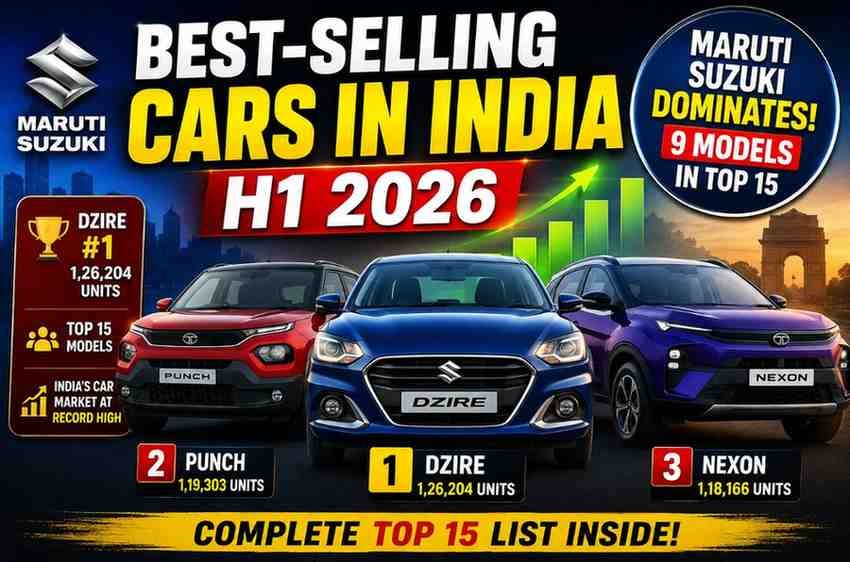
India‘s passenger vehicle market just delivered one of its most competitive half-yearly scorecards in years, and the best-selling cars in India for H1 2026 tell a story that goes well beyond a single winner. The Maruti Suzuki Dzire topped the charts with 1,26,204 units sold between January and June 2026, but the real headline is how thoroughly Maruti Suzuki cornered the rest of the list placing nine of its models among the top 15 best-sellers, a feat no other manufacturer came close to matching. Tata Motors, Hyundai and Mahindra picked up the remaining six spots, with each of the three brands contributing two models apiece. The data, compiled from manufacturer dispatch numbers for January-June 2026, offers a clear read on what Indian car buyers actually wanted in the first half of the year and why.
This wasn’t a runaway race. The top three models Dzire, Nexon and Punch were separated by barely 8,000 units combined, a margin so thin it could shift with a single strong sales weekend. That tightness at the summit, paired with Maruti’s sheer depth across body styles, is what makes this half-year’s numbers worth digging into rather than just reporting.
Why This Data Matters: Reading Between the Sales Numbers
Monthly car sales charts get plenty of attention, but they’re volatile a single fleet order, a festival-linked promotion, or a Supply Chain hiccup can distort a month’s numbers significantly. A six-month aggregate strips out much of that noise and shows genuine demand patterns. When a nameplate crosses the 1-lakh-unit mark over two consecutive quarters, as the Ertiga and WagonR did in H1 2026, it’s not a fluke it reflects a sustained, structural pull with buyers.
It’s also worth situating these model-level numbers against the broader industry backdrop. According to the Society of Indian Automobile Manufacturers (SIAM), India’s passenger vehicle segment has been on a record-breaking run through 2026, with monthly sales repeatedly setting all-time highs. That momentum has been attributed to a mix of tailwinds: a GST rate reduction that improved affordability, personal income tax relief that boosted disposable income, and successive RBI repo rate cuts that made vehicle financing cheaper. SIAM has also flagged a sharp rise in electric passenger vehicle registrations up more than 80% year-on-year as a contributing factor to the overall growth, even though EVs remain a small share of the models featured in this particular top-15 list. In other words, the fight among the Dzire, Nexon, Punch and company isn’t happening in a flat market it’s happening in one of the strongest demand environments the Indian auto industry has seen in years, which makes Maruti’s dominance even more striking: it isn’t just winning share, it’s winning share in a market that’s expanding for everyone.
The Podium: Dzire, Punch and Nexon Separated by a Whisker
The Dzire’s win at the top isn’t new Maruti’s compact sedan has been a perennial favourite in the small-sedan segment for years, largely on the back of its taxi-fleet appeal and low running costs. What’s more interesting is how close Tata Motors came to unseating it. The Nexon finished just 8,038 units behind, and the Punch trailed the Dzire by 6,901 units. Between Tata’s own two models, only 1,137 units separated the Punch from the Nexon practically a rounding error in a market shifting nearly 4.5 lakh vehicles a month.
This three-way scrap says something important about where Indian buyers are putting their money: a budget sedan, a compact SUV, and a micro-SUV are essentially running neck and neck. That’s a meaningful shift from a decade ago, when hatchbacks alone dominated volume charts. It confirms that the SUV/crossover preference isn’t cannibalising sedan demand outright both formats are coexisting near the top, just in more compact, value-focused avatars.
| Rank | Model | Manufacturer | H1 2026 Units Sold |
|---|---|---|---|
| 1 | Dzire | Maruti Suzuki | 1,26,204 |
| 2 | Punch | Tata | 1,19,303 |
| 3 | Nexon | Tata | 1,18,166 |
| 9 | Creta | Hyundai | 91,391 |
| 10 | Scorpio | Mahindra | 89,375 |
| 11 | Brezza | Maruti Suzuki | 88,967 |
| 12 | Victoris | Maruti Suzuki | 73,912 |
| 13 | Eeco | Maruti Suzuki | 71,424 |
| 14 | Venue | Hyundai | 68,964 |
| 15 | Thar | Mahindra | 67,252 |
Maruti’s Six-in-a-Row: The Real Story of H1 2026
The most underappreciated statistic in this dataset isn’t the Dzire’s win it’s that Maruti Suzuki models occupied six consecutive positions from fourth to eighth, led by the Ertiga and WagonR. That’s not a brand having one or two hits; that’s a brand with depth across almost every price point and body style a mass-market Indian buyer might consider a sedan, an MPV, a hatchback (WagonR), a premium hatchback (Baleno), a crossover hatchback (Fronx), and later in the list, a compact SUV (Brezza), a mid-size SUV (Victoris) and even a van (Eeco).
What makes the Ertiga and WagonR crossing the 1-lakh mark particularly notable is their age. Neither nameplate is new both have been on sale in India for the better part of a decade, through multiple facelifts and generational updates. In an industry where buyer attention typically chases the newest launch, sustained demand for older nameplates points to something SUV-obsessed headlines often miss: brand trust, resale value, and low cost of ownership still move more metal in India than novelty does. Maruti’s service network the largest of any carmaker in the country almost certainly plays into this too, since buyers in smaller towns weigh after-sales convenience as heavily as the vehicle itself.
Nine of the fifteen best-selling cars in India during H1 2026 wore a Maruti Suzuki badge a concentration of volume that no rival brand came within striking distance of replicating.
Creta Holds the Midsize SUV Crown, But the Gap Is Closing
The Hyundai Creta finished ninth overall with 91,391 units, retaining its status as India’s best-selling midsize SUV. That’s a title Creta has held for years, but it’s worth noting the competitive context: the segment now includes serious challengers from Kia, Maruti (Victoris), Tata (Curvv) and others, all chasing the same buyer WHO wants a bit more space and road presence than a compact SUV offers without stepping into premium SUV pricing. Creta staying on top despite this crowding suggests strong brand loyalty and consistent feature updates have kept it ahead but the margin over newer entrants like the Victoris is narrower than it would have been a few years ago, when Creta faced far less direct competition.
Scorpio and Thar: Mahindra’s SUV Identity Pays Off
Mahindra placed two models in the top 15 the Scorpio (10th, 89,375 units, combining Scorpio N and Scorpio Classic) and the Thar (15th, 67,252 units, combining the three-door and Thar Roxx). Both figures are aggregated across model variants, which is a reminder that Mahindra has deliberately kept older, cheaper variants (Scorpio Classic, three-door Thar) alive alongside newer, pricier ones rather than discontinuing them. That’s a strategy worth flagging: it lets Mahindra capture budget-conscious SUV buyers and aspirational buyers under the same nameplate, effectively doubling the funnel without diluting the brand’s rugged-SUV identity something few manufacturers manage successfully.
The Brezza’s Quiet Resilience Ahead of a Facelift
The Maruti Brezza finished 11th with 88,967 units a solid number made more interesting by the fact that a facelift was due the same month this data was recorded. Typically, sales of an outgoing model dip in the weeks before a refresh as buyers wait for the updated version. That the Brezza still posted a strong half-year tally suggests either the facelift News hadn’t significantly dented demand yet, or that Brezza buyers are less update-sensitive than buyers in more feature-driven segments likely a mix of fleet, first-time buyer, and value-shopper demand that isn’t waiting around for cosmetic changes.
The Eeco’s Niche Endurance
Perhaps the most surprising entrant on the list is the Eeco, Maruti’s utilitarian van, which finished 13th with 71,424 units. Vans rarely make it into best-seller conversations dominated by SUVs and sedans, but the Eeco’s presence here is a reminder that commercial and semi-commercial demand school vans, small businesses, ambulances, shared mobility remains a meaningful, steady volume driver that consumer-focused coverage tends to overlook entirely.
What This Means for Buyers, Dealers and Rival Automakers
For prospective buyers, the practical takeaway is straightforward: models that dominate volume charts tend to hold resale value better and get faster parts availability, simply because of scale. If you’re chasing long-term ownership costs, the Dzire, Nexon, Punch, Creta and WagonR sitting at the top of this list isn’t a coincidence it’s a self-reinforcing cycle of trust and infrastructure.
For rival automakers, the H1 2026 numbers are a wake-up call on two fronts. First, Tata’s Punch and Nexon prove that a challenger brand can genuinely threaten Maruti at the very top of the charts, not just in single segments. Second, the six-model Maruti sweep from fourth to eighth shows that breadth of lineup not just one hero product is what separates a market leader from a strong performer. Hyundai and Mahindra, despite quality products in the Creta, Venue, Scorpio and Thar, simply don’t have the sheer width of affordable offerings that Maruti fields across body types.
Looking Ahead: What to Watch in H2 2026
A few developments could reshape this list by year-end. The Brezza’s facelift, if well received, could push it higher up the rankings in H2. The Victoris, still finding its footing at 12th place, has room to climb further as Maruti scales up availability. And with SIAM data pointing to accelerating EV registrations industry-wide, it’s worth watching whether an electric model finally cracks this overwhelmingly petrol-and-diesel-driven top 15 by the end of the year something that hasn’t happened yet but looks increasingly likely given the pace of EV adoption reported through 2026.
For now, though, the story of India’s best-selling cars in H1 2026 is unambiguous: Maruti Suzuki’s breadth of lineup, not any single blockbuster launch, is what keeps it comfortably ahead even as Tata Motors’ Punch and Nexon prove the gap at the very top is thinner than the year-end tally might suggest.
For breaking news and live news updates, like us on Facebook or follow us on Twitter and Instagram. Read more on Latest Best of on thefoxdaily.com.




COMMENTS 0