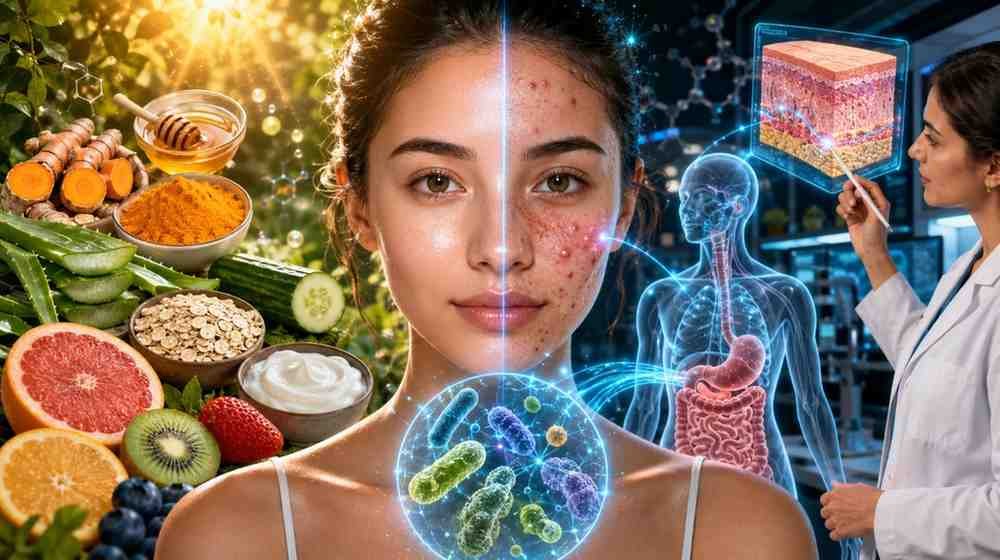
Beyond turmeric and honey here’s what dermatology’s biggest research shift in years reveals about why some kitchen remedies work, why others don’t, and what nobody is telling you about your skin’s hidden ecosystem.
WHO hasn’t reached for a turmeric-and-besan face pack before a wedding, or rubbed a cucumber slice under tired eyes at 11 pm? Home remedies for glowing skin have been a fixture of Indian households for generations, and for good reason many of them genuinely work. But what’s changed in the last two years is why we now believe they work. Dermatology has quietly gone through a research shift that most articles on this topic have completely missed: the discovery that your skin isn’t just a surface to be treated from the outside it’s home to trillions of microorganisms, and it’s in constant conversation with what’s happening in your gut. This piece takes the classic home-remedy list everyone already knows and adds the layer that’s actually new: the science of the skin microbiome, the gut-skin connection, and the diet-acne link that leading dermatology journals only formalized between 2025 and early 2026. What, why, and how these remedies work and where they genuinely fall short is what follows.
The Real Reason Home Remedies Work (And Where They Fail)
For years, the assumption was simple: apply an antioxidant, get a glow. Turmeric’s curcumin, honey’s antibacterial compounds, vitamin C in lemon and orange all of it was framed purely as topical chemistry. That explanation isn’t wrong, but it’s incomplete. Skin Health researchers have spent 2025 and early 2026 mapping something called the gut-skin axis the two-way communication network between the bacteria living in your intestines and the bacteria living on your skin. When your gut microbiome is imbalanced, it can trigger inflammation that shows up on your face as dullness, breakouts, or uneven tone, no matter how many face packs you apply. This explains something Indian households have always intuitively known but never had the science to back: why the same turmeric-milk combination that clears one person’s skin does almost nothing for another. The difference often isn’t the remedy it’s the internal environment the remedy is landing on.
A parallel body of research is homing in on the skin’s own microbiome the community of bacteria such as Staphylococcus epidermidis that naturally lives on your face and acts as a first line of defence against acne-causing bacteria like Cutibacterium acnes. When this balance tips, dermatologists call it dysbiosis, and it’s now linked to acne, eczema, and premature ageing. This is why dermatology clinics have started cautioning against over-washing, harsh scrubs, and aggressive exfoliation (sugar scrubs and baking soda, both called out as “remedies that don’t work” for good reason) they don’t just irritate the skin physically, they can wipe out the very bacterial colonies that protect it. Every time you scrub too hard or use a pH-disrupting soap on your face, you’re not just removing dirt you’re bulldozing a living ecosystem that takes weeks to rebuild.
The Diet-Skin Link Dermatology Finally Proved
Perhaps the most practical update for anyone chasing glowing skin at home is what recent clinical research has confirmed about diet and glycemic load. Multiple randomized controlled trials and systematic reviews completed through 2025 found a statistically significant link between high-glycemic diets white rice, maida, sugary snacks, packaged foods and acne severity, particularly facial acne. The mechanism is now well understood: high-glycemic foods spike insulin, which raises androgen and IGF-1 levels, which in turn pushes the skin’s oil glands into overdrive and speeds up skin cell turnover in a way that clogs pores. Lower-glycemic diets, by contrast, were shown across several 2025 trials to meaningfully reduce lesion counts and acne grading scores within just eight to twelve weeks.
This is where the “balanced diet” tip in most glowing-skin articles undersells itself badly. It’s not just about “eating healthy” in a vague sense it’s specifically about swapping high-glycemic staples (white bread, polished rice, sugary chai, biscuits) for lower-glycemic alternatives (whole grains, millets, legumes, and vegetables). For a country where rice and refined wheat are dietary staples, this single dietary shift may do more for facial clarity over three months than any face pack applied for the same period. Dermatologists increasingly view diet not as a supporting actor but as one of the leading drivers of chronic acne and dull skin a fact that deserves far more attention than it currently gets in home-remedy content.
Where the Classic Kitchen Remedies Actually Stand Today
Ingredients like turmeric, honey, aloe vera, and oats remain genuinely useful, but it’s worth being precise about what they can and can’t do. None of them can fix a gut-driven inflammatory issue or a high-glycemic diet from the outside. What they can do very well is support the skin barrier, calm surface inflammation, and provide gentle exfoliation functions that work best when paired with what’s happening inside the body, not as a replacement for it.
| Remedy | What Science Says Now | Best Paired With |
|---|---|---|
| Turmeric | Curcumin’s anti-inflammatory action is well documented; works on surface redness and pigmentation | A low-sugar diet to address inflammation from within |
| Honey | Genuine antibacterial and humectant properties; supports (not replaces) the skin’s own protective bacteria | Gentle cleansing instead of harsh soap |
| Curd/Yoghurt | Lactic acid exfoliates; live cultures may indirectly support skin-friendly bacterial balance | Adequate hydration and sleep |
| Lemon | Vitamin C is real, but raw citric acid can disrupt the skin’s protective pH and barrier if overused | Diluted use only, ideally dietary vitamin C instead |
| Oats | Beta-glucans genuinely calm irritation and support barrier repair; among the safest options for sensitive skin | Low-glycemic diet for compounding effect |
| Sugar/baking soda scrubs | Now actively discouraged can strip the skin microbiome and damage barrier function | Should be avoided, not paired |
Sleep, Stress, and the Overlooked Skin-Repair Window
Most glowing-skin lists mention sleep as an afterthought “get 7-8 hours” without explaining why timing matters as much as duration. Skin repair, including collagen synthesis and toxin clearance through the lymphatic system, is heavily concentrated in the deep sleep cycles that occur in the first half of the night. Chronic short sleep doesn’t just make skin look tired; it measurably raises cortisol, which much like a high-glycemic diet increases oil production and inflammation. In practice, this means a consistent 10:30 pm to 6:30 am sleep window will likely do more for your complexion than an extra face mask squeezed in at midnight after a late scroll session.
Stress deserves the same reframing. It isn’t just an emotional inconvenience it’s a direct biochemical trigger for breakouts and dullness through the same cortisol-androgen pathway that ties diet to acne. This is precisely why people notice skin flare-ups during exam season, deadline weeks, or family stress, regardless of how disciplined their skincare routine is.
Sun, Pollution, and the Indian Context
Any glowing-skin conversation in India has to reckon with two realities most global skincare content ignores: intense UV exposure for most of the year and high urban Air Pollution in cities. UV damage accelerates collagen breakdown and pigmentation far faster than diet or remedies can compensate for, which is why a daily broad-spectrum sunscreen not featured at all in most home-remedy lists arguably outperforms every kitchen ingredient on this list for long-term glow and even skin tone. Meanwhile, airborne particulate matter has been linked to oxidative stress on skin cells, meaning a simple end-of-day cleanse (not necessarily an elaborate one) to remove pollutant buildup matters more in Delhi, Mumbai, or Kolkata than it does in cities with cleaner air.
A Realistic Prediction for Where Skincare Is Headed
Given the direction of current research, the next few years are likely to bring skincare products explicitly formulated around gut-skin and microbiome science think pre/probiotic-infused face creams and diet-linked skincare plans recommended by dermatologists rather than beauty influencers. Some of this is already visible in dermatology clinics abroad, though robust, large-scale clinical evidence is still catching up to the marketing claims, so a healthy dose of skepticism toward “microbiome-balancing” product claims is warranted for now. The home remedies your grandmother swore by aren’t going anywhere but expect them to increasingly be recommended alongside, not instead of, gut-health and low-glycemic dietary advice.
Conclusion: The Bigger Picture on Natural Glow
The kitchen remedies that have worked for generations turmeric, honey, aloe vera, oats remain legitimate tools, and there’s no need to abandon them. What’s changed is the understanding of why they work and why results vary so much from person to person. Glowing skin in 2026 isn’t just a topical project; it’s the visible outcome of gut health, blood sugar balance, sleep quality, sun protection, and a skin microbiome that’s been protected rather than scrubbed away. The most effective approach going forward combines the tried-and-tested remedies from your kitchen with a low-glycemic plate, a protected sleep window, daily sunscreen, and a gentler hand with exfoliation. That combination not any single remedy is what dermatology’s latest research suggests actually adds up to lasting, healthy glow.
For breaking news and live news updates, like us on Facebook or follow us on Twitter and Instagram. Read more on Latest Best of on thefoxdaily.com.

COMMENTS 0