Adobe is expanding its Artificial Intelligence strategy by bringing agentic AI workflows, popular chatbots and third-party AI agents closer to its creative software. The company is opening its Creative Cloud ecosystem to tools such as OpenAI’s ChatGPT and Google Gemini while introducing local Model Context Protocol (MCP) support across several desktop applications.
The shift represents a move beyond using AI simply to generate images, videos or text. Adobe wants AI agents to handle complex, multi-step creative tasks while allowing professionals to retain control over their projects and make detailed adjustments whenever necessary.
Announced at the company’s annual Adobe MAX event, the updates cover flagship applications including Photoshop, Illustrator, Premiere, After Effects, Lightroom and Acrobat. Adobe is also expanding its Firefly AI platform with new models and creative tools.
Key Highlights
- Adobe is expanding agentic AI workflows across its Creative Cloud applications.
- Native Model Context Protocol support will allow third-party AI agents to connect with supported desktop apps.
- Adobe is strengthening integrations with ChatGPT, Claude and Google Gemini.
- Photoshop, Premiere and Lightroom are receiving new AI-powered creative features.
- Firefly is expanding its model ecosystem, including support for third-party AI models and a new design model.
Adobe Shifts from Generative AI to Agentic Workflows
Adobe has spent years integrating generative AI into its creative products. These tools have helped users generate images, modify photographs, create visual elements and accelerate content production. Its latest strategy takes that approach further by introducing AI agents capable of coordinating several actions to achieve a specific creative outcome.
Unlike a conventional generative AI feature that responds to an individual prompt, an agentic workflow can plan a sequence of tasks, use different tools and carry out multiple steps. This could help professionals complete repetitive editing work without manually performing every operation.
Deepa Subramaniam, Vice President of Product Marketing for Creative Professionals at Adobe, explained that agentic AI can plan steps, coordinate tools and execute work towards a defined result. She also emphasised that creative professionals remain in control of the process.
Adobe’s objective is to make complex workflows faster while preserving the flexibility and precision that professional designers, photographers and video editors require.
Adobe Opens Creative Cloud to Third-Party AI Agents
One of the most significant announcements is the introduction of native Model Context Protocol support across Adobe’s flagship desktop applications, including Illustrator, Premiere and After Effects.
MCP allows AI systems to communicate with external tools and access relevant capabilities through a standardised connection. By opening local MCP endpoints, Adobe aims to let users connect their preferred AI agents directly to supported creative applications and projects.
This approach could reduce the need to move repeatedly between different applications. Instead, an AI assistant could coordinate actions within Adobe software while the creative professional supervises the work.
Adobe says the underlying project elements remain editable. Layers, vectors, video sequences and compositions are not intended to become fixed, flattened outputs simply because an AI agent has worked on them.
ChatGPT, Gemini and Claude Become Part of Adobe’s AI Strategy
Adobe is also expanding the role of third-party chatbots and large language models in creative workflows. Its connector ecosystem is designed to let AI assistants such as ChatGPT, Claude and Gemini work with Adobe’s tools and capabilities.
Rather than requiring users to abandon their preferred AI assistants, Adobe wants to make its creative applications accessible through the services they already use. In this arrangement, the external assistant can coordinate a task while Adobe provides the relevant software tools and skills.
Subramaniam described this model as one in which the assistant handles orchestration while Adobe supplies the capabilities needed to complete the work. The approach gives users more flexibility in choosing how they interact with creative software.
Adobe’s Three-Part Agentic AI Strategy
Adobe’s agentic AI approach is built around three main components that work together to support different types of tasks.
1. Purpose-Built Adobe Agents
The first component consists of specialised agents developed for individual products and workflows. Examples include the Adobe Creative Agent in Firefly and Creative Cloud applications, along with the Adobe Productivity Agent in Acrobat.
These agents are designed to understand the capabilities of their respective applications and assist users with tasks that require product-specific knowledge.
2. Integration with Third-Party AI Assistants
The second component involves connecting Adobe’s tools with popular external AI assistants. ChatGPT, Claude and Gemini can help users coordinate creative tasks through Adobe’s connector ecosystem.
This gives professionals the option to use familiar conversational interfaces while accessing capabilities within Adobe’s applications.
3. Local Model Context Protocol Access
The third component is native MCP access across supported desktop applications. It allows compatible AI agents to connect with Adobe software locally and work with project files.
Adobe says professionals can intervene at any stage, inspect the results and make hands-on adjustments. This is particularly important for creative work, where visual judgement and individual artistic decisions remain central.
Premiere Gets New AI-Powered Video Editing Tools
Adobe Premiere is receiving several updates designed to simplify video editing and improve control over post-production workflows.
A new Color Mode aims to make video grading more streamlined. Colour grading involves adjusting the visual appearance of footage, including colour balance, contrast and exposure, to create a consistent look across a project.
The Generative Media Tool will allow users to generate video content, sound effects and music for their timelines. Adobe is also introducing AI-powered tools for cleaning up and separating different sounds.
Agentic workflows could further reduce repetitive editing tasks. For example, an editor may be able to apply effects across multiple clips, track masked subjects through different frames or adjust colour and exposure using a single instruction.
Photoshop Adds Relight and Generative Restyle
Photoshop is receiving new AI-assisted features intended to give users additional creative options and simplify image editing.
The announced updates include Relight, Generative Restyle and an AI Assisted Editor. Adobe is also improving the Remove Tool and Quick Compare features.
These additions are aimed at helping users modify images, experiment with different visual treatments and refine their results more efficiently. The broader objective is to combine automated assistance with the detailed editing controls that Photoshop users already rely on.
Lightroom Introduces Glow and Open Eyes Features
Adobe Lightroom is also receiving updates focused on photographers who want more precise control over their images.
The new Glow feature is designed to create a soft, cinematic lighting effect in photographs. A one-tap Blemish Removal feature will also make it easier to address minor imperfections during photo editing.
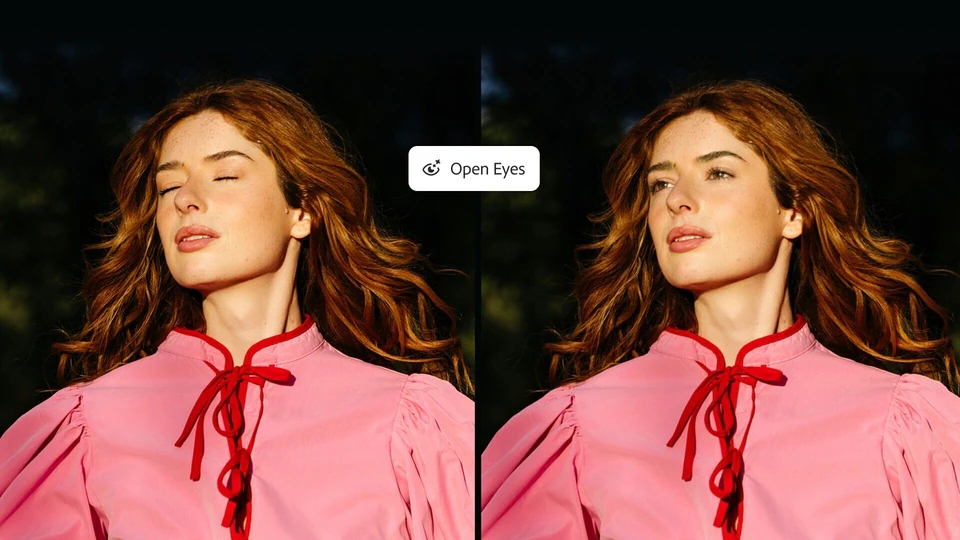
Another notable addition is Open Eyes, which is available in public beta. The feature is designed to help correct photographs in which subjects have blinked at the wrong moment, allowing photographers to improve images that might otherwise be difficult to use.
These updates reflect Adobe’s effort to make AI assistance useful in everyday photography workflows rather than limiting it to experimental image generation.
Firefly Expands with New Models and Design Tools
Adobe is widening the capabilities of Firefly, its generative AI platform, through additional models and creative tools. The Adobe Creative Agent is also being expanded across Firefly and other Adobe applications.
A new Firefly Design model is among the announced additions. Adobe is also developing a Firefly builder, currently in private beta, that can turn text prompts into interactive environments for websites and applications.
Firefly’s third-party model ecosystem is expanding across ideation, content creation and production workflows. The announced integrations include models and tools from several AI developers.
| Company or Platform | Announced Models and Tools |
|---|---|
| OpenAI | GPT-5.1 and GPT-4.1 mini |
| Google DeepMind | Nano Banana Pro and Neo 3.1 |
| Runway | Gen5 and Aleph 2.0 |
| Luma AI | Ray3.14 HDR |
| Topaz | Astra |
By supporting models from multiple providers, Adobe is positioning Firefly as a broader creative environment rather than a platform limited to its own AI models.
Adobe Highlights India’s Growing Creative Economy
Adobe also highlighted India’s importance to its global creative and technology strategy. Abhigyan Modi, Senior Vice President of Document Cloud and Country Manager for Adobe India, described the country as one of the world’s dynamic creator economies.
He also pointed to the contribution of Adobe’s teams in India to the company’s product innovation. The comments underline the importance of both India’s creative community and its technology workforce as Adobe expands its AI-powered services.
Why Adobe’s Agentic AI Strategy Matters
Adobe’s announcements reflect a broader shift in the software industry. AI tools are increasingly moving from standalone features towards systems that can coordinate complete workflows across applications.
For creative professionals, this could mean spending less time on repetitive operations and more time on concept development, storytelling and visual decision-making. Video editors could automate certain sequence-wide adjustments, while designers may use agents to coordinate several steps in a complex project.
Opening its desktop applications to third-party AI agents is also strategically significant. Many professionals already use external chatbots for research, brainstorming and planning. Adobe’s integrations could allow them to connect those existing habits with the company’s established creative tools.
However, the usefulness of these workflows will depend on their reliability, the quality of generated results and the level of control available to users. Creative professionals will still need to review AI-assisted work to ensure that it meets their technical and artistic requirements.
Conclusion
Adobe’s latest announcements signal a major expansion of its AI strategy, with agentic workflows, chatbot integrations and local MCP support becoming central to its creative software ecosystem.
Updates across Photoshop, Premiere, Lightroom and Firefly show how the company plans to bring AI deeper into everyday production tasks. By allowing third-party agents to work with editable creative projects, Adobe is attempting to combine automation with professional control.
The broader direction is clear: Adobe wants creators to choose the AI assistants they prefer while continuing to use its applications as the foundation for creative production. The success of this approach will depend on how effectively these agents handle complex tasks without compromising the precision and flexibility professionals expect.
For breaking news and live news updates, like us on Facebook or follow us on Twitter and Instagram. Read more on Latest Business on thefoxdaily.com.






COMMENTS 0