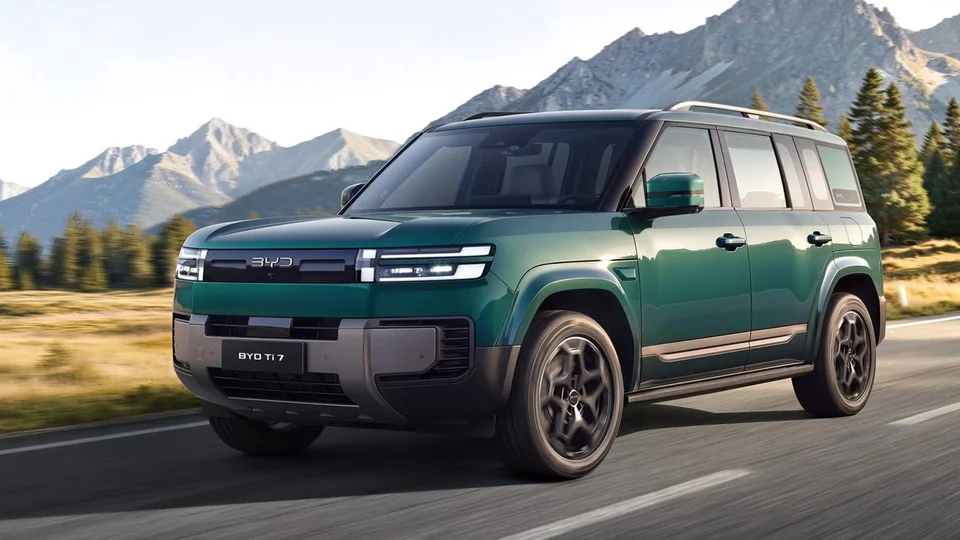
The rapid expansion of Chinese carmakers into Europe is creating a new kind of competition for established automotive brands. Beyond pricing, technology and electric-vehicle performance, the latest dispute is about something far more visible: how cars look. Jaguar Land Rover (JLR) is challenging the design of BYD’s Ti 7 SUV, arguing that the Chinese model copies distinctive elements of its Land Rover Defender. A Dutch court has issued a preliminary injunction restricting the vehicle’s sale across the European Union, giving the British automaker an important early legal victory.
The decision, however, does not establish that every SUV resembling a Defender is illegal. It raises a more complicated question about how intellectual-property law protects vehicle design, particularly when manufacturers use similar shapes, proportions and styling features to appeal to the same customers. For China’s increasingly ambitious car industry, the case could become an important test of how far European brands can go to defend their visual identities.
Why BYD’s Ti 7 Has Become the Centre of the Dispute
The BYD Ti 7 has attracted attention in China as part of the growing market for large, rugged-looking SUVs aimed at buyers interested in outdoor activities and adventure-oriented lifestyles. Its upright proportions, boxy body and darkened pillars have drawn comparisons with the Land Rover Defender, one of JLR’s most recognisable models.
One particularly noticeable feature is the use of blacked-out pillars, which creates the appearance of a floating roof. The Defender has helped popularise this visual treatment alongside a broader design language built around a tall stance, squared-off surfaces and a muscular silhouette. BYD’s Ti 7 combines several elements that have become familiar in the premium off-road SUV category.
JLR argues that the similarities go beyond ordinary competition between vehicles in the same segment. Chief Executive PB Balaji has defended the company’s Intellectual Property, emphasising the engineering and heritage behind its products. The company believes its distinctive design features deserve protection rather than being freely reproduced by competing manufacturers.
BYD rejects that position. The Chinese automaker has said the Ti 7 was developed through its own design process and does not infringe JLR’s rights. It also plans to appeal the Dutch decision, meaning the dispute is far from settled.
What the Dutch Court’s Preliminary Ban Actually Means
The Dutch court’s injunction is significant because it concerns the sale of a complete vehicle rather than a minor component or isolated styling detail. The order is based on JLR’s design-rights arguments, which focus on the appearance of the Defender and the protection available for novel visual features.
Design rights are intended to protect the appearance of products, including their lines, contours, shapes, colours and ornamentation. They do not give a manufacturer ownership over an entire category of vehicle. A company cannot normally prevent competitors from producing every boxy SUV simply because it has sold a successful model with a similar overall shape.
The legal question is whether the disputed vehicle creates an overall impression that is too close to a protected design. Courts must consider the scope of the registered design, the features that are actually protected and the degree of freedom available to designers when creating products in the same category.
The injunction is preliminary, not a final judgment after a complete examination of every argument. A fuller legal process can test the evidence, the validity and scope of the relevant design rights, and BYD’s objections. The automaker’s planned appeal could therefore change the outcome.
Nevertheless, the decision has immediate commercial importance. An EU-wide restriction on selling a vehicle can disrupt launch plans, dealer arrangements, marketing campaigns and customer deliveries. For a manufacturer seeking to establish a new model in a competitive market, even a temporary legal obstacle can create significant uncertainty.
Design Rights and Copyright: Two Different Legal Battles
The dispute also highlights the difference between design protection and copyright. Although both can protect aspects of creative work, they operate under different legal principles and do not automatically cover the same features.
How design rights protect a vehicle’s appearance
Registered design rights can protect the visual appearance of a product when the design meets requirements such as novelty and individual character. In the Automotive Industry, this can include distinctive exterior features and the overall appearance of a vehicle, depending on the registration and the applicable law.
Protection is limited in duration and scope. It is not a permanent monopoly over a particular style of SUV. Other manufacturers remain free to develop vehicles with comparable practical characteristics, provided their designs do not unlawfully reproduce protected elements.
This distinction matters because certain features are common in off-road vehicles for functional and commercial reasons. High ground clearance, upright bodywork, large wheel arches and strong visual proportions can be useful or desirable across the segment. Their presence alone does not prove that one manufacturer copied another.
Why copyright is harder to establish
Copyright generally protects original creative expression rather than product ideas or broad design trends. Its application to industrial products such as cars can be difficult because judges must distinguish artistic creativity from features shaped by engineering, manufacturing requirements and commercial demands.
In the Netherlands, a separate copyright case involving the Ti 7 has added another legal front to JLR’s challenge. The dispute is particularly important because copyright can last substantially longer than registered design protection. Under European rules, copyright protection generally extends for the creator’s lifetime plus 70 years, subject to the applicable legal conditions.
That longer period does not mean a manufacturer can automatically claim copyright over an entire vehicle shape. The company must establish that the relevant design qualifies as an original creative work and that the allegedly copied elements fall within the protection granted by copyright law.
The distinction between the two cases could prove decisive. JLR may have a stronger argument under one form of intellectual-property protection than the other, depending on the specific design elements and evidence presented to the courts.
Why the Defender Has Faced Copycat Accusations Before
This is not the first time JLR has tried to use intellectual-property law to challenge a vehicle resembling the Defender. The company has previously confronted Chinese manufacturers over designs that it believed borrowed too heavily from its distinctive styling.
One of the best-known disputes involved the Landwind X7, a Chinese SUV that attracted widespread comparisons with the Range Rover Evoque. In 2019, JLR secured a legal victory in China when a court ordered the manufacturer to stop producing and selling the vehicle. The court found that the similarities could confuse consumers.
However, that victory did not establish that every JLR vehicle design automatically qualified for copyright protection. The court did not accept that the Land Rover design met the creative threshold required for copyright, illustrating how difficult it can be to protect the overall appearance of a mass-produced vehicle.
JLR also faced a setback in the United Kingdom. The UK Intellectual Property Office declined to grant the Defender the design protection the company sought, finding that its shape was not sufficiently distinctive for the requested registration. That decision helped clear the way for Ineos to bring the Grenadier to market.
The Ineos Grenadier was openly inspired by the traditional off-road formula associated with the original Defender. Its existence illustrates an important distinction in automotive law: drawing inspiration from a vehicle’s broad concept is not necessarily the same as unlawfully reproducing a protected design.
Why Similar-Looking SUVs Are Not Automatically Illegal
Modern car design is shaped by a combination of engineering requirements, consumer preferences, manufacturing constraints and changing fashion. These pressures can lead manufacturers in different countries to develop vehicles with similar proportions and styling features without necessarily copying one another.
Off-road SUVs provide a clear example. Their tall bodies, upright windscreens, squared-off wheel arches and high ground clearance are closely connected to the type of vehicle they are designed to be. Buyers also increasingly associate rugged styling with adventure, durability and an outdoor lifestyle, encouraging brands to adopt similar visual themes.
Brian Gu, vice chairman of Chinese electric-vehicle manufacturer XPeng, has argued that similarities should not be treated as proof of copying. He has emphasised the need to examine individual design details rather than assume that a bulky or sporty vehicle must have been copied from an established European brand.
That argument reflects a genuine challenge for courts. If manufacturers could claim exclusive ownership over broad styling trends, established brands might gain an unfair ability to restrict competition. On the other hand, if distinctive designs receive no meaningful protection, companies could find it difficult to defend the investment and creative work behind their products.
The legal assessment therefore depends on more than whether two vehicles look similar in a photograph. Judges may examine the overall impression created by the designs, the distinctive features involved, the protection already registered and the extent to which technical or commercial requirements limit a designer’s choices.
China’s Automakers Are Becoming More Important in Europe
The dispute is unfolding as Chinese manufacturers rapidly expand their presence in Europe. Their growth is being driven by competitive pricing, electric-vehicle technology, plug-in hybrids and an increasingly broad range of models that appeal to buyers across different market segments.
According to the figures cited in the market analysis, six Chinese automakers collectively accounted for 14.8% of the European market in October, compared with 9% in the same month a year earlier. That increase highlights how quickly competition is changing in a region where domestic manufacturers have historically held strong positions.
Chinese companies are also benefiting from pressure in their home market. Competition among domestic brands has become intense, with manufacturers fighting for customers in a crowded market. Expanding overseas offers an opportunity to find new buyers and reduce dependence on sales in China.
For European manufacturers, the challenge is particularly serious because Chinese brands are no longer competing only at the budget end of the market. They are moving into premium SUVs, sophisticated hybrids and electric vehicles that target customers who might previously have considered German or British brands.
The political response has also become more pronounced. European governments and industry groups are debating how to protect local manufacturing while maintaining access to competitive vehicles and international markets. Beijing’s agreement to cap shipments of hybrids to the European Union is part of a wider effort to manage trade tensions between the two sides.
Some analysts believe Chinese automakers may have underestimated the political and commercial resistance their rapid expansion would generate. Intellectual-property disputes add another dimension to that resistance, giving European manufacturers a legal route to challenge specific products rather than relying exclusively on trade measures.
JLR Is Under Pressure in Its Own Home Market and China
JLR’s decision to challenge BYD also comes at a difficult time for the British automaker. Its position in China, once a major source of growth, has come under pressure as domestic manufacturers strengthen their brands and take customers away from foreign competitors.
Chinese buyers are increasingly attracted to local manufacturers that offer modern technology, competitive pricing and vehicles designed around changing consumer expectations. This has made it harder for established premium brands to maintain their previous market positions.
JLR announced plans to cut around one-tenth of its global workforce and subsequently reduced its annual profit guidance. These developments underline the financial pressure facing the company as it attempts to compete in a rapidly changing automotive market.
Protecting the Defender’s design identity is therefore more than a question of brand pride. The model carries considerable recognition and forms part of the company’s wider premium positioning. If customers begin associating its signature appearance with lower-priced alternatives, JLR could face a challenge in defending the distinction that supports its pricing strategy.
However, legal action cannot replace the need to build competitive vehicles. Even if JLR wins its dispute with BYD, other manufacturers can continue developing rugged SUVs that appeal to the same buyers, provided their designs stay within the boundaries of intellectual-property law.
Why the UK Is a Separate Challenge for JLR
The Dutch ruling has an important geographical limitation: it does not prevent BYD’s British subsidiary from selling the Ti 7 in the United Kingdom. The court declined to exercise jurisdiction over BYD (U.K.) Co. Limited, meaning the EU injunction does not automatically extend to the British market.
This is commercially significant because the UK is an important market for JLR, and BYD had already planned to introduce the seven-seat Ti 7 there. The company has announced a starting price of £47,995, with customer deliveries expected from January 2027. That positions the SUV below comparable premium Defender configurations, giving it an opportunity to attract buyers looking for a large, rugged-looking vehicle at a lower price.
British consumers have also shown a willingness to consider Chinese brands. The success of Chery’s Jaecoo 7, which has attracted comparisons with the Range Rover and earned the nickname “Temu Range Rover,” demonstrates how quickly newer brands can gain attention in the UK market.
JLR has not pursued the same kind of legal action against Chery, with which it has a joint venture in China. That relationship adds a commercial complication to any broader attempt to challenge vehicles that resemble its designs.
The difference between the EU and UK outcomes also illustrates why intellectual-property rights must be examined jurisdiction by jurisdiction. A company may hold protection in one market but lack equivalent rights in another. Even when the underlying design is the same, the legal outcome can differ because of registration rules, jurisdiction and the evidence presented.
The Separate Copyright Hearing Could Change the Picture
The design-rights ruling is only one part of JLR’s wider legal strategy. The company has also brought a separate case in the Netherlands alleging copyright infringement and unfair imitation, known in Dutch legal terminology as slavish imitation.
A hearing in that case is scheduled for November 25, 2026, at a different Dutch court. It will examine legal arguments that are distinct from the design-rights dispute decided in The Hague. The outcome could determine whether JLR can secure additional protection based on the creative character of the Defender’s appearance or other legal grounds.
Copyright could offer a longer period of protection than registered design rights, but that advantage comes with a demanding test. The company must establish that the relevant features represent original creative expression rather than simply functional choices or familiar elements of SUV design.
The court will also need to consider the difference between copying a particular design and producing a vehicle that follows a popular market trend. That distinction is central to the wider debate over whether Chinese automakers are independently responding to consumer demand or taking unfair advantage of the visual identities developed by European manufacturers.
BYD’s Other Defender-Like SUV Shows the Limits of One Legal Victory
Even a successful outcome against the Ti 7 would not remove every vehicle that attracts comparisons with the Defender. BYD’s wider portfolio includes other rugged SUVs, including the Denza Bao 5, which also drew attention for its muscular proportions and off-road-inspired appearance when displayed at the Goodwood Festival of Speed.
The Bao 5 demonstrates why a single lawsuit cannot settle the broader question of automotive design imitation. Each model has its own appearance, technical characteristics and potentially relevant intellectual-property issues. A ruling against one vehicle does not automatically establish infringement by another.
JLR would need to assess each disputed model against the specific rights it holds and decide whether a legal challenge is justified. That can involve considerable expense, time and uncertainty, particularly when manufacturers are launching new models across several countries.
For Chinese automakers, the lesson is equally important. As their international ambitions grow, design originality and intellectual-property compliance will become increasingly significant parts of entering established markets. A vehicle that succeeds commercially in China may face a very different legal assessment in Europe.
When Does a Look-Alike SUV Become an Illegal Copycat?
The central issue is not whether two SUVs share a boxy shape, a high stance or an adventurous appearance. It is whether the similarities reproduce protected design features or original creative elements closely enough to violate the relevant intellectual-property rights.
A manufacturer can take inspiration from a competitor, follow a popular design trend or build a vehicle for the same type of customer. What it cannot do is assume that commercial success in one market gives it permission to reproduce another company’s legally protected design in a market where those rights apply.
The Dutch court’s preliminary decision gives JLR a significant advantage in its dispute with BYD, but the case is not the final word on the Ti 7 or the wider Chinese automotive industry. BYD intends to appeal, the separate copyright proceedings remain important, and the UK market is outside the scope of the EU injunction.
The larger question facing the global car industry is how to balance design protection with competition. European manufacturers want to defend the distinctive identities built over decades, while Chinese companies argue that similar styling can emerge naturally from shared engineering demands and changing customer preferences.
As Chinese brands expand across Europe, courts will increasingly be asked to decide where legitimate inspiration ends and unlawful imitation begins. The Ti 7 dispute could become an important reference point in that debate, but its ultimate significance will depend on how the legal proceedings develop and whether the preliminary ruling survives further scrutiny.
For breaking news and live news updates, like us on Facebook or follow us on Twitter and Instagram. Read more on Latest Business on thefoxdaily.com.





COMMENTS 0