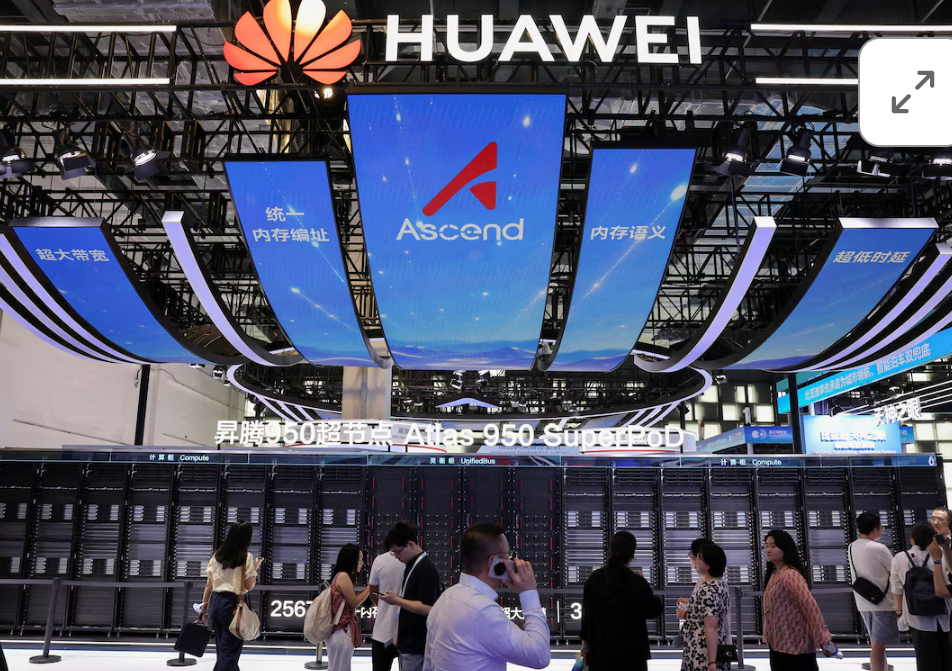
Huawei AI chips are set for another major expansion as the Chinese technology company prepares to launch two new artificial-intelligence semiconductors in 2027. The move highlights Huawei’s growing ambition to build a domestic AI computing ecosystem capable of competing with Nvidia while U.S. export restrictions continue to limit China’s access to some of the world’s most advanced AI hardware.
Huawei rotating chairman David Wang said the company plans to launch the 960DT in the first quarter of 2027, followed by the Ascend 960PR in the third quarter. Beyond individual processors, Huawei is also developing technology designed to connect very large numbers of AI chips so they can operate together as a much larger computing system.
The strategy reflects a broader shift in China’s AI infrastructure. With access to leading foreign chips constrained by export controls, Chinese technology companies are increasingly looking at how domestic processors can be combined, connected and scaled to deliver greater computing capacity.
Huawei Plans Two New AI Chips in 2027
Huawei has outlined a two-chip launch schedule for 2027. The company plans to introduce the 960DT during the first quarter and the Ascend 960PR during the third quarter.
The announcement comes as China and the United States continue competing over the technologies that support modern artificial intelligence, including semiconductors, data centres and software.
For Huawei, the development of new AI processors is not simply about producing another generation of chips. The company is attempting to establish an integrated computing platform that can combine processors, networking technology and software into large-scale AI systems.
| Huawei AI chip/system | Planned timing or status | Purpose |
|---|---|---|
| 960DT | First quarter of 2027 | Next-generation AI semiconductor |
| Ascend 960PR | Third quarter of 2027 | Next-generation AI semiconductor |
| UnifiedBus | Under development and deployment | Connects large numbers of AI processors |
| Supernodes | Already shipped | Linked AI-chip systems for shared computing workloads |
| Superclusters | Next-generation large systems | Designed to support very large numbers of AI processors |
Why Huawei Is Focusing on Connecting More Chips
One of the most important parts of Huawei’s strategy is its emphasis on connecting processors rather than relying only on the performance of a single chip.
Modern AI models can require enormous amounts of computing power. A single processor may not be sufficient for demanding workloads, particularly when companies train or operate increasingly complex AI systems. Large computing clusters therefore combine many processors and allow them to work on the same workload.
Huawei says its UnifiedBus technology will play a key role in its next generation of large AI systems. The technology is intended to allow processors to exchange information efficiently, helping many chips function as part of a larger computing architecture.
This becomes especially important when a company cannot freely access the most powerful foreign processors. Instead of relying entirely on one extremely capable accelerator, a system can potentially combine a larger number of domestically available chips.
However, simply adding more processors does not automatically produce proportional performance gains. The interconnection between chips must be fast and efficient, while software must be capable of distributing workloads effectively across the system.
Huawei Says UnifiedBus Could Support Massive AI Systems
According to Wang, Huawei has developed 11 semiconductors based on UnifiedBus technology for use in its large AI systems.
Huawei’s largest linked systems, which the company calls superclusters, can support as many as 1 million AI processors, according to Wang.
The scale of that figure illustrates the direction of Huawei’s AI infrastructure strategy: increasing total computing capability by connecting large numbers of processors into coordinated systems.
The company has also shipped more than 1,000 supernodes to over 370 customers. Huawei did not disclose the identities of those customers or provide a detailed breakdown of the number of chips contained in each system.
A supernode is essentially a system that connects multiple AI processors so they can work together on computing tasks. It sits between an individual accelerator and much larger AI computing infrastructure.
What Are Huawei Supernodes and Superclusters?
Supernode
A supernode combines multiple AI chips into a single computing system. Instead of treating every processor as an isolated unit, the system allows the processors to cooperate on the same workload.
Supercluster
A supercluster represents a much larger architecture in which potentially enormous numbers of AI processors are linked together. Huawei says its largest systems can support up to one million AI processors.
The distinction matters because AI computing is increasingly becoming a systems-level challenge. Chip performance remains important, but networking, memory, software and workload management can determine how efficiently thousands or millions of processors operate together.
US Export Controls Are Shaping Huawei’s AI Strategy
The development of Huawei AI chips is closely connected to the technology competition between Washington and Beijing.
The United States has imposed export restrictions affecting China’s access to certain advanced computing chips and semiconductor manufacturing equipment. These restrictions have made it more difficult for Chinese companies to obtain some of the most advanced foreign AI hardware.
As a result, China has increased its focus on domestic alternatives. Huawei has emerged as one of the prominent Chinese companies developing AI processors for this domestic ecosystem.
The restrictions have also increased the importance of technologies that allow domestic chips to be combined into larger systems. If individual processors cannot match the performance of the most advanced foreign accelerators, connecting more processors efficiently becomes one potential way to increase overall system capacity.
That strategy, however, depends heavily on interconnect performance and software optimisation. Poor communication efficiency between chips can reduce the benefits of adding more processors.
Nvidia Remains the Major Competitive Benchmark
Huawei is entering a market where Nvidia has an established global position. Nvidia’s AI hardware is widely used by developers, cloud providers and data-centre operators, while its software ecosystem has become a major part of the AI development stack.
This creates a challenge that goes beyond semiconductor manufacturing.
For Huawei to compete effectively, customers need not only capable hardware but also software tools, developer support, libraries, frameworks and reliable system infrastructure. Developers often prefer platforms that allow them to move existing AI applications into production with minimal changes.
Huawei is therefore building its own developer ecosystem alongside its processors and computing systems.
Huawei’s Developer Ecosystem Is Growing
Wang said Huawei’s AI chip ecosystem had 5,270 monthly active developers.
Developer adoption is an important metric for any AI hardware platform because software compatibility can determine whether customers actually use a processor after purchasing it.
A strong hardware platform needs tools that allow developers to build, optimise and deploy AI applications efficiently. The larger the developer community becomes, the greater the potential for software compatibility and application availability.
Huawei’s challenge is that Nvidia has spent years developing a mature global software ecosystem around its AI processors. Closing that gap requires sustained investment in developer tools, documentation, frameworks and technical support.
Why Chip Interconnect Technology Matters in AI
AI computing increasingly depends on distributed processing. Large models can contain enormous numbers of parameters, while training and inference workloads can require multiple processors to communicate continuously.
When processors work together, they need to exchange data quickly. If communication between chips becomes a bottleneck, additional processors may not deliver their full theoretical computing capacity.
This is why technologies such as Huawei’s UnifiedBus are strategically important. The objective is not simply to connect chips physically, but to create a communication architecture that allows them to function efficiently as a unified computing resource.
The same principle applies to large AI data centres around the world. As computing systems scale, networking and interconnect technologies become increasingly important alongside the processors themselves.
| AI infrastructure layer | Why it matters |
|---|---|
| AI processors | Provide the core computing capacity required for AI workloads |
| Interconnect | Allows processors to exchange data and coordinate workloads |
| Memory | Supports the movement and storage of data required by AI models |
| Software ecosystem | Allows developers to build and optimise AI applications |
| Data-centre systems | Combine chips, networking, cooling, power and software at scale |
Huawei’s AI Chip Strategy Is About More Than One Processor
The 960DT and Ascend 960PR launches should be viewed within Huawei’s broader AI computing strategy rather than as isolated semiconductor announcements.
The company is simultaneously developing processors, interconnect technology, supernodes and larger superclusters. This suggests that Huawei is attempting to compete at the system level.
That approach could become increasingly important in China because domestic AI infrastructure may need to work with a different mix of hardware from systems commonly deployed in the United States and other markets.
Instead of replicating Nvidia’s products exactly, Chinese companies can develop alternative combinations of processors, networking technology and software designed around domestic supply chains.
Key Challenges for Huawei
Semiconductor manufacturing
Producing advanced AI processors at scale remains a major technical and supply-chain challenge. Access to advanced semiconductor manufacturing equipment is also affected by international export restrictions.
Software compatibility
Hardware performance alone does not guarantee adoption. Huawei needs developers to build applications and optimise AI workloads for its platform.
Large-system efficiency
Connecting thousands or millions of processors creates additional complexity. Network performance, power consumption, cooling and workload scheduling become increasingly important as systems grow.
Customer adoption
Huawei has reported more than 1,000 supernode shipments to over 370 customers, but the company has not disclosed customer names or detailed system configurations. The scale and durability of commercial adoption will therefore remain an important area to monitor.
Huawei vs Nvidia: The Competitive Landscape
The competition between Huawei and Nvidia illustrates two different approaches to the global AI semiconductor market.
Nvidia benefits from a large international developer ecosystem and extensive experience supplying AI accelerators for data centres. Huawei, meanwhile, is benefiting from strong demand for domestic alternatives within China and is building an integrated ecosystem around its own processors and networking technologies.
The U.S.-China technology restrictions add another layer to the competition. Export controls have reduced the availability of some advanced foreign AI hardware in China, while simultaneously increasing incentives for Chinese companies to develop domestic technologies.
As a result, Huawei’s progress could have significance beyond the performance of individual chips. It could influence how quickly China develops a more self-reliant AI computing infrastructure.
What to Watch in Huawei’s 2027 AI Chip Roadmap
- 960DT launch: Whether Huawei delivers the processor according to its planned first-quarter 2027 schedule.
- Ascend 960PR: Whether the second chip arrives in the third quarter as currently planned.
- UnifiedBus adoption: How widely Huawei deploys the interconnect technology across large AI systems.
- Supernode shipments: Whether the company can significantly expand its customer base beyond the more than 370 customers already cited.
- Developer growth: Whether Huawei can increase its 5,270 monthly active developers and strengthen software support.
- System performance: How effectively large clusters of Huawei processors perform against competing AI infrastructure.
- Export restrictions: Whether changes in U.S. technology controls affect Huawei’s access to manufacturing equipment and other critical components.
Huawei AI Chips 2027: Why the Next Phase Matters
Huawei’s planned 2027 chip launches demonstrate how China’s AI semiconductor strategy is moving toward increasingly large and interconnected computing systems.
The 960DT and Ascend 960PR are expected to strengthen Huawei’s processor lineup, while UnifiedBus is intended to address one of the central challenges of large-scale AI: enabling huge numbers of processors to communicate and work together efficiently.
Huawei says it has already shipped more than 1,000 supernodes to over 370 customers and is developing supercluster architectures capable of supporting up to one million AI processors. The company also has thousands of developers working within its AI chip ecosystem.
Whether that progress can translate into a genuinely competitive alternative to Nvidia will depend on several factors, including chip performance, manufacturing scale, networking efficiency, software support and customer adoption.
The broader significance is clear: as restrictions reshape access to advanced AI hardware, China is investing heavily in domestic computing alternatives. Huawei’s 2027 roadmap will provide an important measure of how far that strategy has progressed and whether large-scale domestic AI infrastructure can increasingly operate without relying on the most advanced foreign processors.
For breaking news and live news updates, like us on Facebook or follow us on Twitter and Instagram. Read more on Latest Business on thefoxdaily.com.






COMMENTS 0