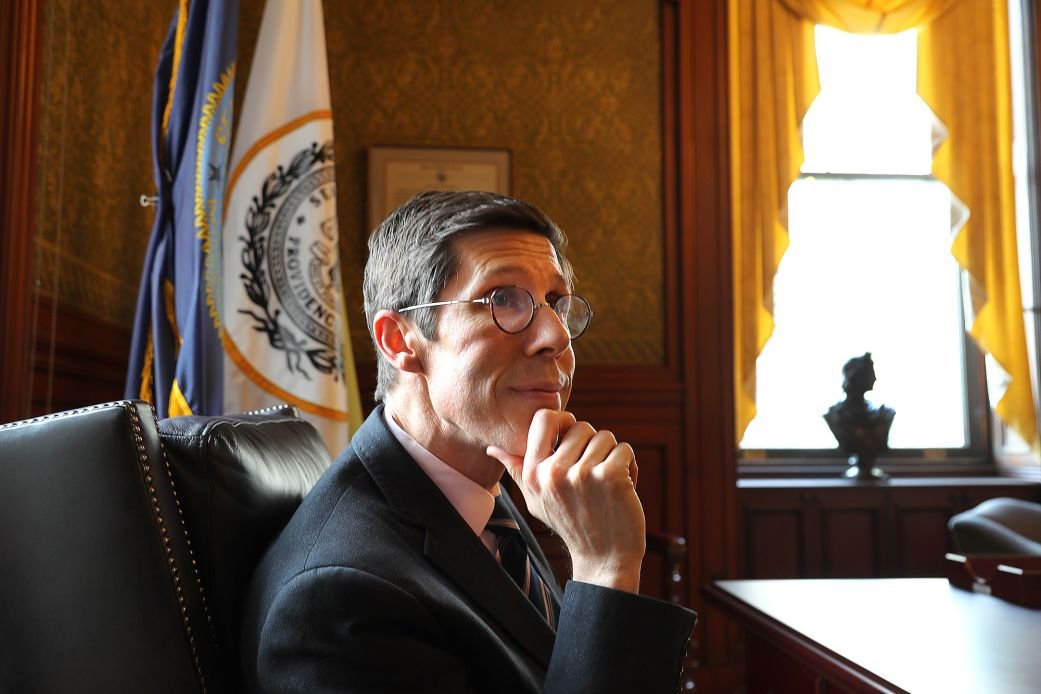
Providence Mayor Brett Smiley lost his re-election bid after taking a firm stand against rent control, a policy that has gained support among voters struggling with rising housing costs. Despite the defeat, Smiley maintains that rent control would have worsened the city’s housing affordability problems by discouraging new construction and limiting the supply of rental homes.
Smiley, who was elected mayor in 2022, had focused on increasing housing construction and reducing regulatory barriers in Rhode Island’s capital. His administration worked with city and state leaders to relax restrictive zoning rules and cut red tape, helping encourage a development boom. Providence added more apartments in its latest fiscal year than in any year in two decades, with 40% classified as affordable.
However, his refusal to support rent control became a major political liability during a closely contested campaign against Democratic socialist David Morales. In April, Smiley vetoed a rent control bill passed by the Providence City Council, placing himself at odds with a policy strongly supported by many progressive voters.
“I believe it is a false promise,” Smiley said in a phone interview earlier this month. “But it’s good, cheap, easy politics.”
Smiley ultimately lost the Democratic primary in September, becoming the first mayor in Providence’s history to lose at that stage of an election. Morales, a 27-year-old state lawmaker and member of the Democratic Socialists of America (DSA), defeated him after criticising the veto as “absolutely shameful.” Morales has pledged to sign rent control legislation within his first 100 days if elected mayor.
Why Rent Control Became a Central Election Issue
The Providence election reflects a broader political debate over how cities should respond to rising rents and housing shortages. Across the United States, tenants facing higher housing costs are increasingly demanding immediate relief, while some policymakers argue that expanding the supply of homes is a more sustainable way to improve affordability.
Rent control has become a prominent issue in cities including New York and Los Angeles, as well as smaller municipalities such as Portland, Maine, and St. Paul, Minnesota. Supporters argue that limits on rent increases can provide stability for tenants who might otherwise struggle to remain in their homes.
Morales campaigned on a proposal to cap annual rent increases at 4%, arguing that residents needed greater protection against rapidly rising housing costs.
“I’ve been unapologetically supportive of capping rent hikes at 4% a year because I believe our neighbors deserve that basic stability,” Morales said in an interview.
He also framed the proposal as a question of whose interests city government should prioritise, saying Providence residents wanted a mayor who looked after their interests rather than those of corporate donors.
The bill included exemptions intended to preserve incentives for housing construction. Landlords who lived in one of their properties would receive partial exemptions from the rent increase caps, while new apartments would be exempt for up to 20 years. Existing apartments also would not become subject to the rent limits until five years after they were built.
Morales argued that these provisions would help maintain developers’ incentives to build new housing while providing greater protection for tenants in regulated properties.
Providence Faces a Longstanding Housing Shortage
The dispute over rent control comes against the backdrop of a prolonged housing shortage in Rhode Island. The state has lagged behind other parts of the country in residential construction since its building activity peaked in the 1980s. Between 2008 and 2015, builders received fewer than 1,000 housing permits annually across the state.
Providence has faced additional pressure from college students and higher-income residents relocating from Boston, Connecticut and New York. Brenda Clement, executive director of HousingWorks RI, a research and policy organisation at Roger Williams University, said these population pressures had contributed to stress in the city’s rental market.
The age of Providence’s housing stock presents another challenge. Many buildings are old, and some apartments have become unlivable, reducing the number of homes available for rent. Limited supply can intensify competition among tenants, particularly when demand increases faster than new housing can be built.
Providence was ranked the least affordable metropolitan area for renters in the previous year, according to the supplied report. Median rents have risen 40% since 2020, adding to the financial pressure on households.
For renters dealing with these increases, rent control offers the prospect of more predictable housing costs. For policymakers concerned about long-term supply, however, the central question is whether limiting rent increases could discourage landlords from maintaining existing properties or developers from constructing new ones.
Smiley’s Argument Against Rent Control
Smiley argued that Providence needed to encourage housing construction rather than introduce rules that could make development less attractive. Because the proposed law would have made Providence the only city in Rhode Island with rent control, he feared that developers might choose to build in neighbouring communities without similar restrictions.
He refused to negotiate with the City Council over the issue, maintaining that rent control would undermine the city’s efforts to address its housing shortage.
Smiley’s approach relied on increasing supply through zoning reform and reducing the regulatory hurdles that can slow housing projects. While new construction can take years to affect the rental market, supporters of this strategy argue that adding more homes can help ease competition and reduce upward pressure on rents over time.
However, that longer-term approach offers less immediate relief to tenants already struggling with housing costs. The political challenge for Smiley was that many residents wanted protection from rising rents while the effects of additional construction remained uncertain.
Smiley said his team had studied rent control policies in other cities and spoken with local leaders before reaching its conclusion.
He remained convinced that the policy would “perversely would exacerbate our affordability challenges” in Providence.
His position reflects a wider disagreement among housing policymakers over how to balance immediate tenant protection with incentives to maintain and expand the housing supply.
Portland and St. Paul Offer Different Lessons on Rent Control
Providence’s proposed rent control policy drew comparisons with measures adopted in Portland, Maine, and St. Paul, Minnesota. The experiences of the two cities illustrate the differing outcomes and concerns associated with rent regulation.
Portland’s Experience With Rent Caps
In 2020, Portland voters approved limits on annual rent increases tied to inflation. New home construction has continued to grow since the caps took effect, showing that rent regulation does not necessarily lead to an immediate halt in development.
However, Portland’s mayor has expressed concerns that rent control has made it more difficult for landlords to maintain existing apartments. Such concerns highlight a potential tension between keeping rents manageable for tenants and ensuring that property owners can afford repairs and upkeep.
Portland’s experience has therefore offered both a point of reference for supporters of rent regulation and a reminder that the effects can extend beyond the amount tenants pay each month.
St. Paul’s Construction Slowdown
St. Paul adopted a different approach in 2022, capping annual rent increases at 3% for most apartments. Following the introduction of the policy, new construction plunged and rents increased, according to the supplied report.
The city has since begun rolling back parts of the law. Its experience has strengthened concerns among opponents of strict rent limits that regulations can affect investment and the supply of new housing.
However, housing markets differ from city to city, and the results of one policy cannot automatically predict what would happen elsewhere. Local construction costs, housing demand, exemptions and the design of rent regulations can all influence the outcome.
Smiley’s team examined these examples before deciding that rent control would be unsuitable for Providence. Morales, meanwhile, maintained that the exemptions in his proposed legislation would help protect incentives for new development.
Can Rent Control Make Housing More Affordable?
The debate over Providence’s proposed law reflects two competing approaches to housing affordability. Rent control seeks to limit increases for tenants covered by the rules, while policies focused on supply aim to make more homes available through construction and regulatory reform.
Rent limits can provide immediate protection for people living in regulated apartments by making housing costs more predictable. That stability can be particularly valuable for households facing sudden increases in rent or struggling to keep up with living expenses.
However, rent control does not necessarily benefit everyone in the same way. People living in regulated properties may be protected from some rent increases, while those seeking a new home may still face high prices in a market with limited availability. Depending on the design of a policy, landlords may also have less incentive to maintain properties or developers may reconsider new projects.
Expanding housing supply can address shortages over the longer term, but the process takes time. New homes must move through planning, financing and construction before they become available to renters. As a result, supply-focused policies may not provide immediate relief to people already facing unaffordable rents.
The policy challenge for Providence is how to provide near-term stability for tenants without undermining the longer-term goal of adding homes. The city’s election has highlighted how difficult it can be to balance those objectives when housing costs become a central concern for voters.
Rent Control Debate Shapes Providence’s Political Future
Smiley’s defeat demonstrates the political risks of opposing a policy that has become a priority for many voters. His administration had pursued housing construction and zoning reform, and the city recorded a substantial increase in apartment additions during his tenure. Yet those efforts did not prevent rent control from becoming a defining issue in the mayoral campaign.
Morales presented the rent cap as a way to provide greater stability to residents who were struggling with housing costs. His pledge to introduce rent control within his first 100 days helped distinguish his approach from Smiley’s emphasis on increasing housing supply.
Morales was expected to be strongly positioned in the general election the following month, according to the supplied report. His proposal would place Providence at the centre of the debate over whether rent regulation can protect tenants without discouraging new development.
Smiley, a former chief of staff to Rhode Island Governor Gina Raimondo, has not indicated what work he will pursue after leaving office. He has also said he will not endorse Morales.
Smiley expressed concern about the Democratic Socialists of America becoming more influential within the Democratic Party, comparing the potential impact to that of the Tea Party movement on the political right in earlier years.
His comments suggest that the disagreement over rent control is part of a broader ideological divide about the direction of the Democratic Party, as well as a dispute over the most effective way to tackle housing affordability.
What Providence’s Housing Debate Means for Other Cities
Providence’s experience offers a case study for other cities wrestling with rising rents, limited housing supply and pressure to provide immediate assistance to tenants. Rent control can be politically attractive because it promises a direct limit on housing cost increases, while expanding supply requires sustained investment and often takes years to produce results.
The experiences of Portland and St. Paul show why policymakers must consider the details of a proposed law rather than assume that rent control will produce the same outcome everywhere. Exemptions for new construction, rules governing annual increases and provisions for property maintenance can affect how landlords and developers respond.
At the same time, the sharp increase in Providence’s median rents since 2020 underscores the urgency of the affordability problem. A strategy focused only on future construction may leave current tenants struggling, while strict rent limits without measures to expand supply may fail to address the underlying shortage.
The central question for Providence and other cities is how to combine policies that protect existing renters with measures that make housing more available over time. Smiley’s election defeat shows the political difficulty of that task, while the debate surrounding Morales’s proposal will test whether rent control can deliver the stability supporters seek without creating new obstacles to development.
For breaking news and live news updates, like us on Facebook or follow us on Twitter and Instagram. Read more on Latest Business on thefoxdaily.com.






COMMENTS 0