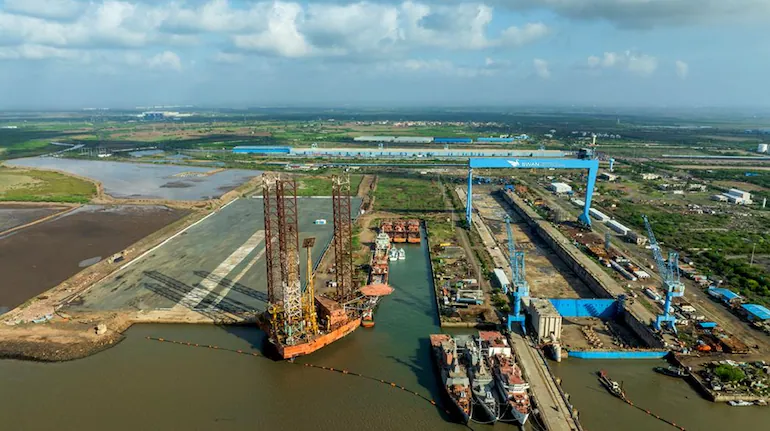
South Korea‘s Samsung Heavy Industries (SHI) is exploring investment opportunities in India’s shipbuilding sector as its domestic shipyards face capacity constraints and remain booked for the next three years, according to a Mint report citing a senior company official.
The company is considering India as an alternative manufacturing base to accommodate overflow orders from its South Korean facilities and serve growing demand from international and domestic customers. Its plans could involve expanding an existing partnership with Swan Defence and Heavy Industries Ltd (SDHI) at the Pipavav shipyard in Gujarat.
SHI is also exploring greenfield shipbuilding opportunities in India’s proposed maritime clusters and a possible partnership with state-run Cochin Shipyard Ltd for a ship block fabrication facility in Kerala, the report said.
The potential investment comes as global demand for commercial vessels creates pressure on established shipbuilding centres. For SHI, expanding its manufacturing footprint in India could provide additional capacity while giving the Indian shipbuilding industry access to international expertise, engineering capabilities and specialised vessel construction opportunities.
Key Highlights of Samsung Heavy Industries’ India Plans
- Investment interest: Samsung Heavy Industries is exploring opportunities to invest in India’s shipbuilding sector.
- Capacity constraints: Its South Korean shipyards are reportedly booked for the next three years.
- Pipavav partnership: SHI may deepen its existing relationship with Swan Defence and Heavy Industries at its Gujarat shipyard.
- Potential vessels: Proposed manufacturing opportunities include tankers, gas carriers, container ships and specialised vessels.
- Kerala opportunity: SHI is exploring a possible partnership with Cochin Shipyard for a proposed ship block fabrication facility.
- Investment structure: The existing licence-led arrangement could potentially develop into a joint investment agreement.
Why Samsung Heavy Industries Is Looking at India
According to the Mint report, SHI’s domestic shipyards are operating with limited available capacity, with existing orders occupying their production schedules for the next three years. This makes it difficult for the company to accept additional orders while meeting delivery commitments to global customers.
Shipbuilding is a capacity-intensive industry. Constructing large commercial vessels requires specialised facilities, skilled workers, engineering systems, equipment and long production schedules. When shipyards are heavily booked, companies may struggle to accommodate new orders without expanding their facilities or finding additional manufacturing partners.
India could offer SHI another production base to address this challenge. The company is examining opportunities to use local shipbuilding infrastructure to handle additional work while maintaining its presence in international markets.
A manufacturing footprint in India could also help SHI participate more directly in the country’s maritime development. Domestic demand for commercial vessels and specialised ships may provide opportunities alongside orders from international customers.
A senior SHI official told Mint that the company would be interested in investing in an Indian shipbuilding facility to create additional manufacturing capacity and serve growing demand from both international and Indian customers.
Samsung May Expand Its Partnership With SDHI at Pipavav
One of the main opportunities under consideration is an expanded partnership with Swan Defence and Heavy Industries Ltd at its Pipavav shipyard in Gujarat.
SHI and SDHI already have a strategic memorandum of understanding to explore commercial shipbuilding and heavy engineering projects. According to the Mint report, the existing arrangement could be converted into an investment agreement that would allow the companies to jointly manufacture large vessels.
The proposed expansion could focus on building tankers, gas carriers, container ships and other specialised vessels for international customers.
For SHI, the partnership could provide access to an additional manufacturing location without requiring the company to establish an entirely new shipyard immediately. For SDHI, working with an established South Korean shipbuilder could bring access to technical knowledge, designs and engineering support.
However, the proposed investment remains under consideration. The report does not disclose the potential investment amount, ownership structure, production capacity or a confirmed timeline for a final agreement.
How the Existing SHI-SDHI Partnership Works
According to Mint, SHI currently follows a licence-led partnership model with SDHI. Under this arrangement, Samsung Heavy Industries provides vessel designs, engineering expertise and material packages, while SDHI undertakes the construction work.
This structure allows the two companies to divide responsibilities according to their respective capabilities. SHI contributes technical knowledge and design-related inputs, while the Indian partner provides the shipyard infrastructure and carries out construction.
The arrangement could serve as an initial stage before a deeper investment relationship develops. The SHI official indicated that an equity investment could follow the successful execution of initial projects.
This approach would allow the companies to assess operational performance and project execution before committing to a larger financial partnership. It could also help establish the commercial viability of building large vessels at the Pipavav facility.
Any transition from a licensing arrangement to an equity partnership would require further decisions on investment terms, responsibilities, financing and production planning.
SDHI’s Existing Shipbuilding Orders at Pipavav
Swan Defence and Heavy Industries already has several commercial shipbuilding projects in its order pipeline, providing a potential foundation for expanded cooperation with SHI.
According to the report, SDHI is executing orders for six chemical tankers from Norway-based Rederiet Stenersen and four Kamsarmax bulk carriers from NEO Fund.
The company has also emerged as the lowest bidder for a contract involving four dual-fuel-ready medium-range product tankers. The contract is associated with a joint venture led by Shipping Corporation of India Ltd.
These projects cover different vessel categories and highlight the range of commercial shipbuilding work being pursued at Pipavav.
Chemical tankers are designed to transport liquid chemicals, while Kamsarmax bulk carriers are used to move dry commodities such as agricultural products and minerals. Medium-range product tankers transport refined petroleum products and related cargoes.
Dual-fuel-ready vessels are designed with the potential to operate using more than one type of fuel, subject to the required technical arrangements. Their development reflects the shipping industry’s interest in vessels that can adapt to changing fuel choices and environmental requirements.
For SDHI, successful delivery of existing orders could strengthen its position in discussions with international shipbuilders. For SHI, the projects may provide an opportunity to assess the Indian facility’s ability to support more complex commercial vessel construction.
Samsung Also Explores Greenfield Shipbuilding Opportunities
SHI’s interest in India is not limited to the existing Pipavav facility. The company is also exploring greenfield shipbuilding opportunities in proposed maritime clusters across the country, Mint reported.
A greenfield project generally involves developing a new facility rather than expanding an existing shipyard. Such an investment could provide a company with greater control over infrastructure, production planning and long-term capacity.
India’s proposed maritime clusters could offer a framework for bringing shipbuilding, repair, logistics and related industrial activities closer together. However, the specific locations, investment requirements and development timelines of the opportunities being examined by SHI have not been disclosed.
Developing a new shipbuilding facility would require significant planning. Companies would need to assess land availability, port connectivity, access to materials, workforce requirements, infrastructure costs and the availability of long-term orders.
For SHI, the decision between expanding through an existing partner and developing a new facility will likely depend on the cost, timing and operational advantages of each option.
Possible Partnership With Cochin Shipyard in Kerala
Another opportunity being explored involves a possible partnership with state-run Cochin Shipyard Ltd for its proposed ship block fabrication facility in Kerala.
Ship blocks are large prefabricated sections that are assembled during the construction of a vessel. These sections are manufactured separately and later joined together to form the ship’s hull and other structural components.
A dedicated ship block fabrication facility can support the broader shipbuilding process by allowing major vessel sections to be produced before final assembly. Such facilities can help organise production and support larger construction programmes.
A partnership with Cochin Shipyard could therefore provide SHI with another route to participate in India’s shipbuilding supply chain. It could also create opportunities for technical cooperation between an established South Korean shipbuilder and a major Indian shipyard.
However, the reported discussions do not amount to a confirmed agreement. Details about the proposed collaboration, investment structure, production responsibilities and project schedule have not been announced.
What the Move Could Mean for India’s Shipbuilding Industry
Potential investment by Samsung Heavy Industries could be significant for India’s ambition to expand its shipbuilding capabilities. International partnerships can help domestic shipyards access specialised designs, engineering processes and manufacturing practices developed through years of experience in global markets.
India’s shipbuilding sector has opportunities across several categories, including commercial vessels, tankers, bulk carriers, container ships, offshore support vessels and ship repair. Expanding production capacity could help local companies compete for a wider range of domestic and international orders.
Partnerships with foreign shipbuilders may also support the development of a broader industrial ecosystem. Shipbuilding relies on suppliers of steel, machinery, propulsion systems, electrical equipment, navigation technology and other components. Greater production activity could create opportunities for companies operating across these supply chains.
However, attracting investment alone will not guarantee a stronger position in the global market. Indian facilities will also need reliable infrastructure, skilled labour, competitive production costs, efficient logistics and the ability to deliver vessels on schedule.
Large commercial ships are complex products, and delays can affect both shipyard finances and customer relationships. Consistent project execution will therefore be important if Indian shipyards want to secure repeat orders from international buyers.
Why Capacity Constraints in South Korea Matter
South Korea is one of the world’s established shipbuilding centres, with major companies serving international customers across commercial and specialised vessel categories. When shipyards in the country reach high levels of capacity utilisation, additional orders can become difficult to accommodate within existing delivery schedules.
For a company such as SHI, using facilities in another country could help spread production activity across multiple locations. This may provide additional flexibility when managing orders and delivery commitments.
Such a strategy can also reduce dependence on a single manufacturing base. However, operating across different countries introduces its own challenges, including supply-chain coordination, quality control, regulatory requirements and the transfer of technical expertise.
The success of any Indian expansion will depend on whether the company can maintain the engineering and quality standards expected by international shipowners while managing production across different facilities.
What Happens Next?
The immediate focus will be on whether SHI moves beyond exploratory discussions and reaches a formal investment arrangement with Indian shipbuilding partners.
The potential conversion of the SHI-SDHI memorandum of understanding into an investment agreement will be an important development to watch. Successful execution of initial projects could provide a basis for deeper cooperation, including a possible equity investment.
Further clarity is also needed on the company’s greenfield plans and the potential partnership with Cochin Shipyard. Investment commitments, project locations, production capacity and implementation timelines will determine the scale of SHI’s proposed expansion in India.
For now, the discussions indicate that India is being considered as an additional manufacturing base by a major South Korean shipbuilder facing capacity constraints at home. Whether the interest translates into new shipbuilding facilities and long-term industrial partnerships will depend on the commercial terms and execution of the proposed projects.
Outlook: India Could Gain From a Global Shipbuilding Partnership
Samsung Heavy Industries’ interest in expanding its presence in India highlights the growing importance of manufacturing capacity in the global shipbuilding industry. With its South Korean facilities reportedly booked for the next three years, the company is examining alternative ways to accommodate demand and maintain delivery schedules.
The Pipavav partnership with SDHI, possible greenfield investments and discussions involving Cochin Shipyard offer different routes for SHI to establish a larger manufacturing presence in India.
For India’s shipbuilding industry, the potential collaboration could bring technical expertise, additional project opportunities and stronger links with international customers. However, the actual benefits will depend on formal investment decisions, project execution and the development of supporting infrastructure.
The next major milestone will be whether the existing discussions lead to binding agreements and confirmed investments. Until then, SHI’s plans remain exploratory, but they point to a potential opportunity for India to play a larger role in the global commercial shipbuilding market.
For breaking news and live news updates, like us on Facebook or follow us on Twitter and Instagram. Read more on Latest Business on thefoxdaily.com.






COMMENTS 0