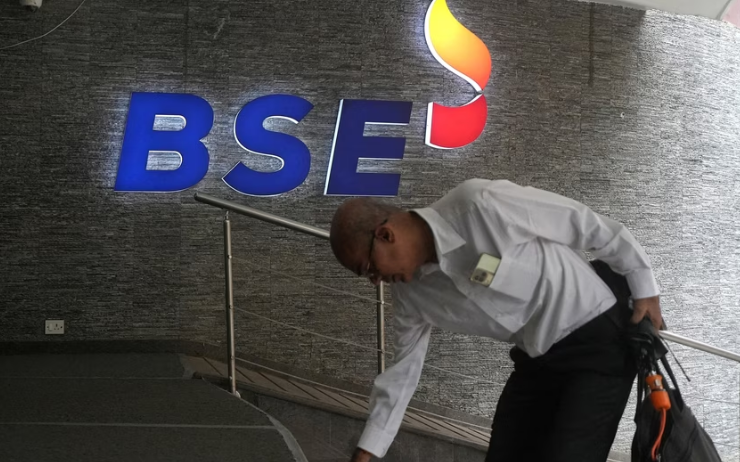
Indian equity markets opened largely flat on Thursday, September 10, as elevated crude oil prices and continued Middle East tensions kept investors cautious. The focus remained on developments around the Strait of Hormuz, foreign fund flows and upcoming US economic data ahead of the Federal Reserve’s policy meeting next week.
At 9:17 am, the BSE Sensex stood at 74,805.07, gaining 40.84 points, or 0.05%. The NSE Nifty was at 23,435.80, up 4.30 points, or 0.02%. The muted opening followed a difficult session on Wednesday, when both benchmark indices closed at three-month lows.
Sensex and Nifty Start Thursday on a Cautious Note
The Indian stock market showed little movement at the start of Thursday’s trading session. Investors appeared reluctant to take aggressive positions as crude oil prices remained above the psychologically important $100-a-barrel level.
The Nifty and Sensex have declined in seven of the past eight sessions, losing around 3.1% each during that period. This recent weakness reflects a combination of geopolitical uncertainty, higher energy costs, global interest-rate concerns and continued foreign investor selling.
GIFT Nifty futures were trading at 23,489.50 at 7:44 am, indicating that the domestic market was likely to see a subdued start. The previous Nifty close was 23,431.50, keeping investors focused on whether the index could stabilize after its recent decline.
Why Crude Oil Above $100 Is a Major Concern for India
Crude oil has become one of the most important variables for Indian equities because India imports a large majority of its crude oil requirements. When international oil prices rise sharply, the impact can spread from fuel costs to inflation, transportation, corporate margins and the country’s import bill.
The latest escalation around the Strait of Hormuz has increased concerns about the security of global oil shipments. Iran said it had attacked 10 ships near the strategic waterway after the US sank five Iranian oil tankers. The incidents represent a major escalation in shipping-related risks during the ongoing conflict.
The Strait of Hormuz is particularly important because it is a major route for energy shipments from the Gulf region. Any prolonged disruption can raise the risk premium attached to crude, even when actual global supply has not yet fallen by the same amount.
Higher Oil Prices Can Hit Multiple Indian Sectors
Higher crude prices do not affect every company equally. Businesses with significant fuel, transportation or petrochemical-related costs can face margin pressure if they cannot fully pass higher expenses to customers.
Rajeev Sharan, head of research at Brickwork Ratings, said that costlier crude could squeeze margins in oil-sensitive sectors such as aviation, paints, tyres, chemicals, logistics and parts of the FMCG industry.
This is important for stock-market investors because an increase in crude prices can affect both company profitability and broader economic expectations at the same time.
- Aviation: Higher jet fuel costs can increase operating expenses.
- Paints: Several raw materials are linked directly or indirectly to crude derivatives.
- Tyres: Synthetic rubber and other petroleum-linked inputs can become more expensive.
- Chemicals: Energy and petroleum-based feedstocks can raise production costs.
- Logistics: Higher diesel and transportation costs can increase operating expenses.
- FMCG: Companies may face higher transportation and packaging costs.
Middle East Conflict Keeps Investors on Edge
The biggest immediate uncertainty for global markets remains the possibility that the conflict could further affect oil production, transportation or infrastructure in the Middle East.
Markets generally react not only to the amount of oil actually removed from supply but also to the possibility of future disruption. This is why geopolitical events can cause crude prices to rise even before a large physical shortage appears.
For India, the situation is especially important because a sustained period of expensive crude can increase the country’s import expenditure. It can also put pressure on inflation and reduce the amount of money available for other areas of economic activity.
Fed Policy Expectations Add Another Layer of Uncertainty
Indian markets are also watching upcoming US economic data closely. The data could influence expectations about the Federal Reserve’s next policy decision, scheduled for September 16.
Higher oil prices can complicate the inflation outlook. If energy costs remain elevated for a prolonged period, investors may become more concerned about inflation staying higher than expected.
That creates a difficult situation for central banks. A weaker economy may support lower interest rates, but persistent inflation can limit the ability to ease monetary policy aggressively.
According to Rajeev Sharan, higher crude prices could increase inflation risks and strengthen the case for the US Federal Reserve to maintain a hawkish stance or potentially raise interest rates at its September meeting.
Why US Interest Rates Matter for Indian Stocks
US interest-rate expectations influence global capital flows. When US yields become more attractive, foreign investors may reduce exposure to emerging markets and shift money toward dollar-denominated assets.
That can create additional pressure on Indian equities, particularly when domestic markets are already dealing with weak sentiment and expensive crude oil.
Foreign Investors Continue to Sell Indian Equities
Foreign portfolio investors remained net sellers in Indian equities on Wednesday. According to provisional NSE data, FPIs sold shares worth ₹583 crore.
Domestic institutional investors provided some support by buying shares worth ₹1,509 crore. This difference highlights the important role played by domestic institutional money in cushioning the impact of foreign outflows.
However, domestic buying alone may not immediately reverse a broader market decline if global risk appetite remains weak.
Three Stocks to Watch on September 10
Hindustan Zinc
Hindustan Zinc signed a six-year transportation agreement with MFL India for the deployment of 30 electric trucks. The development is relevant to the company’s logistics operations and reflects the growing use of electric vehicles in industrial transportation.
Wipro
Wipro and CrowdStrike launched a CISO command centre designed to transform enterprise cybersecurity operations. The initiative highlights the increasing importance of cybersecurity as companies manage larger digital infrastructures and increasingly sophisticated cyber threats.
Coal India
Coal India’s subsidiary Northern Coalfields reported an improvement in production and dispatches as monsoon conditions receded. The update could attract attention because production and dispatch trends remain important indicators for the coal sector.
Sensex and Nifty: Key Market Factors to Watch
| Factor | Potential Market Impact |
|---|---|
| Crude oil above $100 | Negative for oil-sensitive sectors and inflation outlook |
| Middle East tensions | Higher geopolitical risk and market volatility |
| FPI selling | Can add pressure to benchmark indices |
| DII buying | Provides support against foreign outflows |
| US economic data | May influence global interest-rate expectations |
| Fed meeting on September 16 | Potential trigger for global equity and currency markets |
| Strait of Hormuz disruption | Could increase the global oil risk premium |
What Could Decide the Next Move for Indian Markets?
The direction of the Sensex and Nifty in the coming sessions will depend on whether the current geopolitical shock remains contained or develops into a longer-lasting energy disruption.
If crude prices remain above $100 for an extended period, investors may increasingly focus on the earnings impact on companies with high fuel and raw-material costs. At the same time, concerns about inflation could influence interest-rate expectations across major economies.
On the other hand, any signs of de-escalation in the Middle East or improvement in oil transportation could quickly reduce the geopolitical premium in crude prices. Such a development could provide relief to global equities, including Indian stocks.
Why the ₹100 Crude Level Matters for the Stock Market
The $100 crude level is important partly because it acts as a psychological benchmark. Crossing it can influence expectations about inflation, corporate earnings and central-bank policy even before the economic damage becomes visible in official data.
For India, the key question is therefore not simply whether crude is above $100 today. Investors will be watching how long prices stay elevated and whether supply disruptions become more widespread.
A short-lived spike may be manageable for businesses and the economy. A prolonged period of expensive crude, however, could create a much larger challenge by simultaneously raising costs, inflation risks and pressure on consumer demand.
Sensex, Nifty Outlook: Volatility Likely to Remain High
Thursday’s flat opening does not necessarily signal a reversal of the recent market trend. The benchmarks are coming off three-month lows and have fallen in seven of the last eight sessions.
Investors are likely to remain highly sensitive to crude oil movements, developments around the Strait of Hormuz, foreign fund flows and US economic indicators.
The near-term market environment could therefore remain volatile. Domestic institutional buying may provide a cushion, but a sustained recovery is likely to require greater clarity on geopolitical risks and global monetary policy.
Bottom Line
The Sensex and Nifty opened almost flat on September 10 as investors balanced domestic market weakness against ongoing geopolitical and global economic risks. Sensex gained 0.05% while Nifty rose 0.02% shortly after the opening bell.
The biggest concern remains crude oil above $100 a barrel. Because India depends heavily on imported crude, sustained high oil prices can increase the import bill, pressure inflation and squeeze corporate margins.
With the Federal Reserve’s September 16 meeting approaching, US economic data will also remain a key market trigger. Until there is greater clarity on oil supply risks and interest-rate expectations, investors should expect heightened sensitivity and volatility across Indian equities.
For breaking news and live news updates, like us on Facebook or follow us on Twitter and Instagram. Read more on Latest Business on thefoxdaily.com.






COMMENTS 0