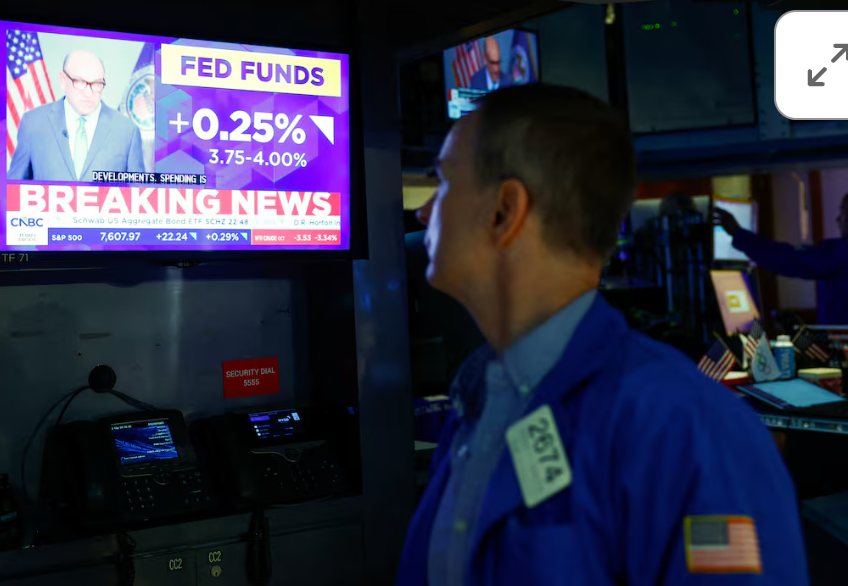
Wall Street was positioned for a stronger opening on Thursday, September 17, 2026, as falling oil prices reduced some of the inflation pressure that had unsettled investors. Futures for the major U.S. stock indexes moved sharply higher after the Federal Reserve raised interest rates for the first time under Chair Kevin Warsh.
The combination of a fresh rate hike, a decline in crude prices and lower Treasury yields helped investors reassess risk. Technology stocks were among the early beneficiaries, while several artificial-intelligence infrastructure companies also advanced in premarket trading.
However, the market’s recovery remains vulnerable to further developments in energy prices, Middle East shipping disruptions and the possibility of additional Federal Reserve tightening. Investors are therefore balancing renewed appetite for growth stocks against an uncertain interest-rate outlook.
Wall Street Futures Rise Across Major Indexes
U.S. stock futures pointed to a broad-based gain before Thursday’s opening bell. At 8:29 a.m. ET, Dow E-minis were up 1.13%, S&P 500 E-minis had gained 1.21%, and Nasdaq 100 E-minis were higher by 1.58%.
| Index | Premarket Move |
|---|---|
| Dow E-minis | +1.13% |
| S&P 500 E-minis | +1.21% |
| Nasdaq 100 E-minis | +1.58% |
The stronger move in Nasdaq futures indicated that technology and growth-oriented shares were receiving particular attention. Nvidia and Amazon were both up nearly 2% in premarket trading.
The gains come after a difficult start to September for U.S. equities. The S&P 500 had declined about 1.7% during the month through the previous session, making Thursday’s advance important for investors assessing whether the recent weakness could stabilize.
Fed Rate Hike Gives Investors More Clarity
The Federal Reserve’s latest interest-rate decision was an important factor behind the improvement in sentiment. The central bank raised rates on Wednesday under new Chair Kevin Warsh, while signaling that additional increases could still be required if inflation remains persistent.
For investors, the significance was not simply the size of the rate move. The decision also provided greater clarity after weeks of uncertainty surrounding inflation, crude oil and the future path of monetary policy.
Chris Zaccarelli, chief investment officer at Northlight Asset Management, said the Fed’s approach had managed to address the competing concerns surrounding inflation and economic conditions. Kim Forrest, chief investment officer at Bokeh Capital Partners, similarly suggested that investors were not necessarily facing a repeat of the aggressive tightening cycle seen during 2022 and 2023.
That distinction matters for stock valuations. A gradual approach to interest rates can give companies and investors more time to adjust, while a rapid sequence of increases can place greater pressure on borrowing costs, corporate investment and equity valuations.
October Fed Rate Hike Expectations Increase
Despite Thursday’s positive market reaction, investors have not ruled out another Federal Reserve rate increase. CME FedWatch data indicated that traders saw nearly a 53% probability of another hike at the central bank’s October meeting, up from approximately 44% a day earlier.
This means the latest rally should not be interpreted as the end of monetary-policy uncertainty. The Federal Reserve has made clear that future decisions will depend on incoming economic and inflation data.
| Factor | Current Market Implication |
|---|---|
| September Fed hike | Provides greater policy clarity |
| October hike probability | Near 53% according to CME FedWatch |
| 10-year Treasury yield | Declined, reducing pressure on equities |
| Oil prices | Falling, easing some inflation concerns |
| Middle East conflict | Continues to create supply and shipping risks |
The key question for markets is therefore whether the Fed will need to continue raising rates or can pause after the latest move. Persistent inflation would increase pressure for further tightening, while signs of easing price pressures could give policymakers more flexibility.
Oil Prices Fall and Ease Inflation Concerns
Crude oil prices provided another important source of relief for investors. Brent crude futures fell more than 3% to around $102.28 a barrel, while U.S. West Texas Intermediate crude moved below $100.
The decline was significant because oil had recently become one of the biggest sources of inflation anxiety. Brent prices had climbed above $100 as the conflict involving Iran and regional groups disrupted energy infrastructure and shipping routes.
Lower crude prices can reduce pressure on headline inflation, transportation costs and energy-intensive businesses. They can also make it easier for central banks to assess underlying inflation without an additional energy shock complicating the outlook.
However, oil remains well above levels that would normally be considered comfortable for many consumers and businesses. A sustained decline would be more meaningful for inflation expectations than a single daily move.
Middle East Conflict Remains a Major Market Risk
The improvement in oil prices does not eliminate supply concerns. The conflict has expanded into Yemen, creating additional risks for shipping through the Red Sea.
At the same time, disruption to Saudi Arabia’s East-West Pipeline has raised concerns about the ability of producers to move crude to export markets without relying on routes affected by the broader conflict.
This creates a complicated situation for financial markets. Oil prices can decline on expectations of improved supply or weaker demand, but a new attack on energy infrastructure or shipping could quickly reverse that move.
For equity investors, the energy market therefore remains closely connected to monetary policy. A renewed oil rally could increase inflation expectations and potentially strengthen the case for additional interest-rate increases.
Technology Stocks Regain Investor Attention
Technology shares were among the strongest performers before the opening bell. Nvidia and Amazon each gained nearly 2%, reflecting renewed demand for large technology companies after the recent market pressure.
The decline in Treasury yields also helped growth stocks. Higher bond yields can reduce the relative attractiveness of equities, particularly companies whose expected earnings are further in the future. When yields retreat, some of that valuation pressure can ease.
The technology sector is also closely tied to the artificial-intelligence investment cycle. Companies involved in semiconductors, cloud computing, data centers and AI infrastructure have benefited from substantial spending by major technology companies.
Thursday’s moves suggest investors were willing to return to these popular areas after the immediate uncertainty surrounding the Fed decision diminished.
Neocloud Stocks Jump in Premarket Trading
AI-focused neocloud companies also attracted strong buying interest. Nebius shares rose about 10% in premarket trading, while IREN gained roughly 6%.
Neocloud companies provide specialized computing infrastructure and services that can support demanding AI workloads. Their performance has become increasingly connected to expectations for continued spending on GPUs, data centers and high-performance computing.
However, the group also illustrates the risks within the AI infrastructure trade. CoreWeave initially moved higher but later reversed and was down more than 3% after announcing plans to raise capital through stock and convertible bond offerings.
Capital raising can provide companies with additional resources for expansion, but issuing new securities can also affect existing shareholders through dilution or increase financial complexity.
Fluence Energy Falls After Revenue Forecast Cut
Not every growth-oriented stock participated in the premarket rally. Fluence Energy dropped more than 22% after lowering its revenue forecast for fiscal 2026.
The sharp decline demonstrates that company-specific fundamentals can outweigh broader market optimism. Even when indexes are rising, investors may react aggressively when a company reduces its expectations for sales or future growth.
It also highlights the difference between a broad market rally and individual stock performance. Monetary-policy relief can improve overall sentiment, but companies still need to demonstrate sufficient demand and financial performance to maintain investor confidence.
Why Treasury Yields Matter for Stocks
The 10-year U.S. Treasury yield also moved lower on Thursday, offering another source of support for equities.
Treasury yields are important because government bonds provide investors with a relatively low-risk alternative to stocks. When yields rise substantially, investors may demand greater potential returns from equities, putting pressure on stock valuations.
Lower yields can therefore provide some relief, particularly for technology and other growth companies whose valuations depend heavily on future earnings.
But the relationship is not automatic. If yields fall because investors expect a significant economic slowdown, stock prices can still come under pressure. The reason behind the yield movement is therefore as important as the movement itself.
September Remains a Challenging Month for Equities
Thursday’s expected gains come during a historically difficult period for U.S. equities. The S&P 500 had already fallen 1.7% during September before the latest session.
Investors are therefore watching whether the latest advance can stabilize the market or whether it represents a temporary response to the Federal Reserve decision and softer crude prices.
The answer will depend on several factors, including upcoming inflation data, Treasury yields, corporate earnings expectations, oil prices and developments in the Middle East.
What Investors Will Watch Next
- Federal Reserve guidance: Future comments from policymakers will help determine whether additional rate increases remain likely.
- October rate expectations: Market pricing around the next Fed meeting could change quickly with incoming economic data.
- Oil prices: A sustained decline could ease inflation concerns, while another supply shock could reverse the trend.
- Treasury yields: The direction of long-term yields remains important for technology and growth-stock valuations.
- AI spending: Investors will continue monitoring whether major technology companies maintain their large infrastructure investments.
- Corporate guidance: Forecast revisions, such as Fluence Energy’s revenue reduction, could create significant differences between individual stocks.
- Red Sea and Saudi supply routes: Any additional disruption could affect global energy prices and inflation expectations.
Wall Street Outlook: Relief, but Risks Remain
The expected Wall Street rebound on Thursday reflects a combination of factors rather than a single development. The Federal Reserve’s rate decision removed some immediate uncertainty, oil prices declined, Treasury yields eased and technology shares regained momentum.
At the same time, the Fed has left open the possibility of further tightening, while Middle East disruptions continue to threaten global energy supply. Those risks could keep both stocks and bonds volatile even if Thursday’s opening gains hold.
The market’s next phase will therefore depend heavily on whether inflation continues to moderate despite elevated energy prices. If oil remains under pressure and price growth shows signs of cooling, investors may receive additional relief. If energy prices rebound and inflation proves persistent, expectations for further Fed tightening could return quickly.
Conclusion
Wall Street was set for a higher opening on September 17 as falling oil prices and lower Treasury yields helped offset concerns about the Federal Reserve’s tightening cycle. Dow, S&P 500 and Nasdaq futures all pointed to substantial gains, while Nvidia, Amazon and several AI infrastructure companies advanced in premarket trading.
Still, the recovery faces important tests. The possibility of another Fed rate increase, elevated crude prices, disruptions around the Red Sea and Saudi energy infrastructure, and uneven corporate guidance remain key sources of uncertainty.
For markets, the central issue is whether the recent oil-driven inflation shock begins to fade or develops into a more persistent pressure on prices and interest rates. That distinction could determine whether the current improvement in sentiment develops into broader stabilization or remains sensitive to the next economic and geopolitical headline.
For breaking news and live news updates, like us on Facebook or follow us on Twitter and Instagram. Read more on Latest Business on thefoxdaily.com.






COMMENTS 0