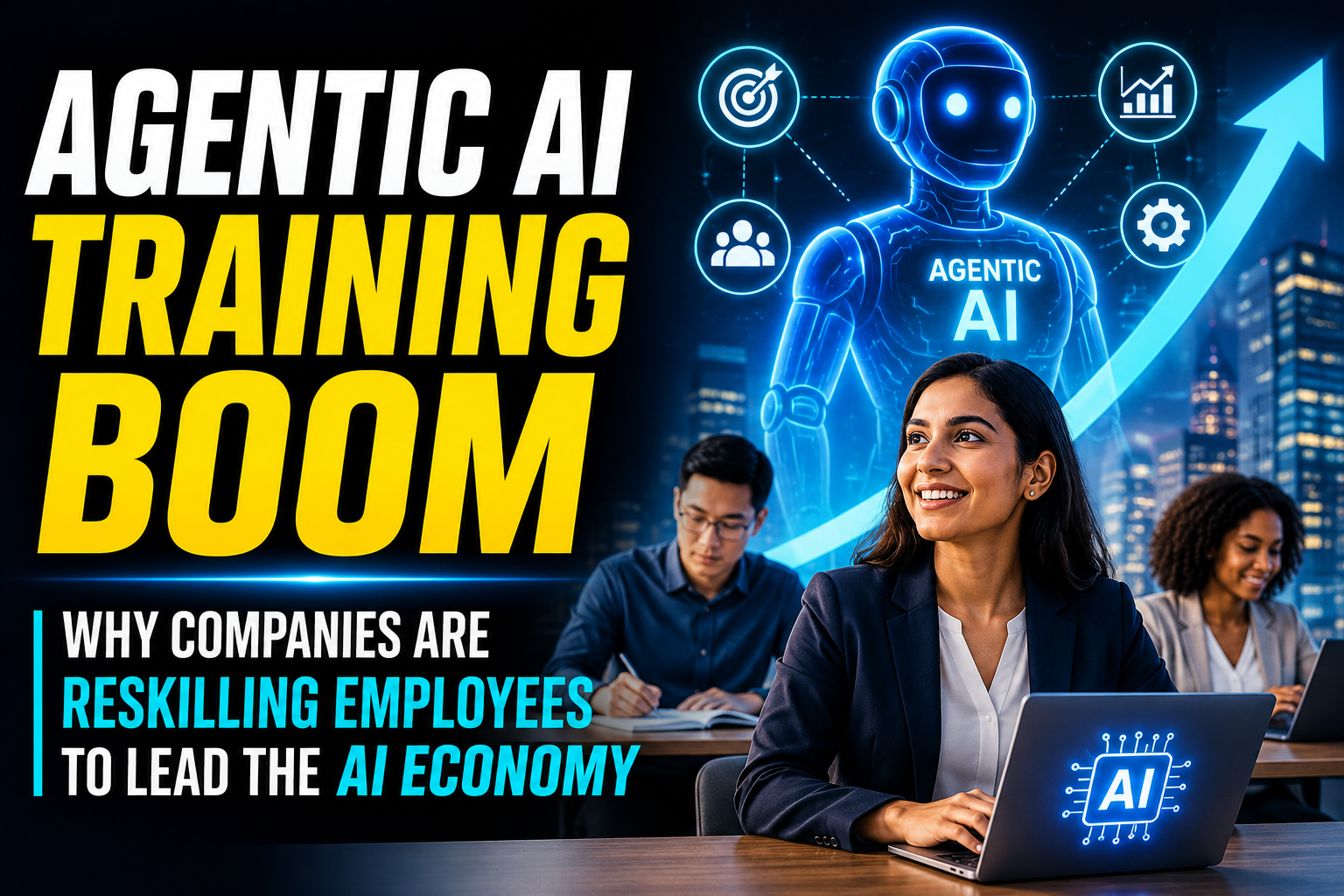
Artificial Intelligence has moved beyond experimentation. Across industries, organisations are investing heavily in preparing employees for a workplace increasingly shaped by intelligent systems. Rather than treating AI as a standalone technology upgrade, businesses are now approaching it as a full-scale transformation of operations, decision-making, and workforce capability.
A major indicator of this shift is the rapid growth in Agentic AI training. Enterprise learning patterns show a sharp rise in employees enrolling in programs that teach how AI systems can assist, automate, coordinate, and improve business processes at scale.
This transition signals something larger than a technology trend—it marks the beginning of a workforce redesign where technical knowledge, leadership capability, cloud infrastructure understanding, and cybersecurity awareness become interconnected skills.
What Is Agentic AI and Why Does It Matter?
Agentic AI refers to intelligent systems designed to execute tasks with higher levels of autonomy compared with traditional software automation.
Unlike standard AI tools that respond only to direct prompts, Agentic systems can complete sequences of actions, evaluate outcomes, adapt to changing conditions, and support business workflows with minimal human intervention.
Examples include:
- Customer service automation that resolves complex requests
- Business analytics systems generating strategic recommendations
- AI assistants coordinating cross-functional workflows
- Operational platforms automating repetitive decisions
As organisations deploy these capabilities, employees must learn how to manage, supervise, improve, and collaborate with AI systems rather than simply operate software.
The Enterprise Learning Shift: From AI Curiosity to Business Execution
Companies are moving beyond pilot projects and isolated innovation experiments.
The newest wave of enterprise learning shows a stronger emphasis on implementation skills—the practical knowledge needed to deploy and maintain AI-powered environments.
This shift is visible across multiple training categories:
| Learning Category | Growth Trend | Strategic Business Role |
|---|---|---|
| Agentic AI | Fastest-growing | Automation and intelligent execution |
| Cloud Computing | Strong increase | Infrastructure for AI deployment |
| DevOps | Continued expansion | Scalable delivery and operations |
| Cybersecurity | Rapid acceleration | Protection of AI and digital systems |
| Leadership Development | Major growth area | Managing organisational change |
| Certification Programs | Growing adoption | Validation of workforce capability |
Together, these categories reveal a clear message: businesses are investing in ecosystems of capability rather than isolated technical skills.
Why AI Training Alone Is Not Enough
Many early AI initiatives failed to create measurable business outcomes because organisations underestimated one critical factor—people.
Installing AI software does not automatically improve productivity.
Successful adoption depends on:
- Employee confidence in using AI tools
- Clear governance and accountability
- Reliable infrastructure
- Secure deployment environments
- Leadership support
- Continuous skill development
This explains why cloud computing, DevOps, and cybersecurity learning are rising alongside AI programs.
Cloud Infrastructure Is Becoming the Foundation of AI Growth
AI applications require large-scale computing resources, data processing environments, and reliable deployment pipelines.
Cloud platforms enable organisations to:
- Train and run AI models efficiently
- Scale workloads quickly
- Reduce infrastructure costs
- Improve collaboration across teams
- Deploy updates faster
Without cloud readiness, enterprise AI often becomes difficult to scale beyond small experiments.
Cybersecurity Has Become a Business Priority in the AI Era
As businesses integrate AI into operations, security risks become more complex.
AI systems process larger volumes of sensitive data and introduce new operational dependencies.
Organisations are increasingly prioritising:
- Identity management
- Data governance
- Infrastructure protection
- AI security controls
- Risk monitoring frameworks
Training employees in cybersecurity is becoming essential because human decisions remain one of the largest sources of operational risk.
The Rise of Certification-Based Learning
Another major shift in enterprise learning is the growing importance of professional certifications.
Companies increasingly want measurable proof that employees possess practical and relevant capabilities.
Certification-led learning provides:
- Standardised skill validation
- Faster internal mobility
- Better hiring benchmarks
- Improved confidence in project execution
Employees also benefit because recognised credentials strengthen career resilience in rapidly changing markets.
Leadership Is Becoming an AI Skill
One of the most overlooked developments in enterprise transformation is leadership education.
Technology adoption rarely succeeds through technical teams alone.
Executives and managers increasingly require capabilities in:
- Change management
- AI decision frameworks
- Cross-functional collaboration
- Digital transformation planning
- Workforce communication
Modern leaders are expected to guide adoption rather than delegate it.
How Businesses Are Redefining Workforce Value
The traditional hiring model rewarded static expertise.
The emerging model rewards adaptability.
Employers increasingly value workers who can:
- Learn continuously
- Work alongside AI systems
- Understand data-driven workflows
- Operate across multiple disciplines
The strongest future teams may not be those with the most automation—but those with the highest learning velocity.
A Comparison: Traditional Digital Transformation vs AI Transformation
| Traditional Digital Transformation | AI Transformation |
|---|---|
| Software implementation | Capability development |
| Department-focused | Organisation-wide |
| Process automation | Decision augmentation |
| Technology ownership | Shared human-AI collaboration |
| Periodic upgrades | Continuous learning cycles |
What Happens Next? The Future of Enterprise Learning
The next phase of workforce development will likely move toward personalised learning environments powered by analytics and AI.
Employees may receive adaptive learning pathways based on project needs, capability gaps, and organisational goals.
Companies that integrate learning directly into daily work could gain stronger productivity, faster innovation cycles, and improved competitiveness.
The real advantage may not come from owning the most advanced AI tools—but from building teams capable of turning those tools into measurable outcomes.
Conclusion
The rapid expansion of Agentic AI learning reflects a deeper shift in how organisations think about growth.
AI adoption is no longer viewed as an isolated technology initiative. It is becoming a business-wide transformation that combines infrastructure, security, leadership, certification, and workforce capability.
Organisations that invest early in people—not just platforms—are positioning themselves to adapt faster, scale more effectively, and compete in a future where continuous learning becomes one of the most valuable business advantages.
For breaking news and live news updates, like us on Facebook or follow us on Twitter and Instagram. Read more on Latest Careers on thefoxdaily.com.

COMMENTS 0