Artificial intelligence is no longer just transforming workplaces—it is fundamentally changing what students study, how universities design courses, and how governments prepare their workforces for the future.
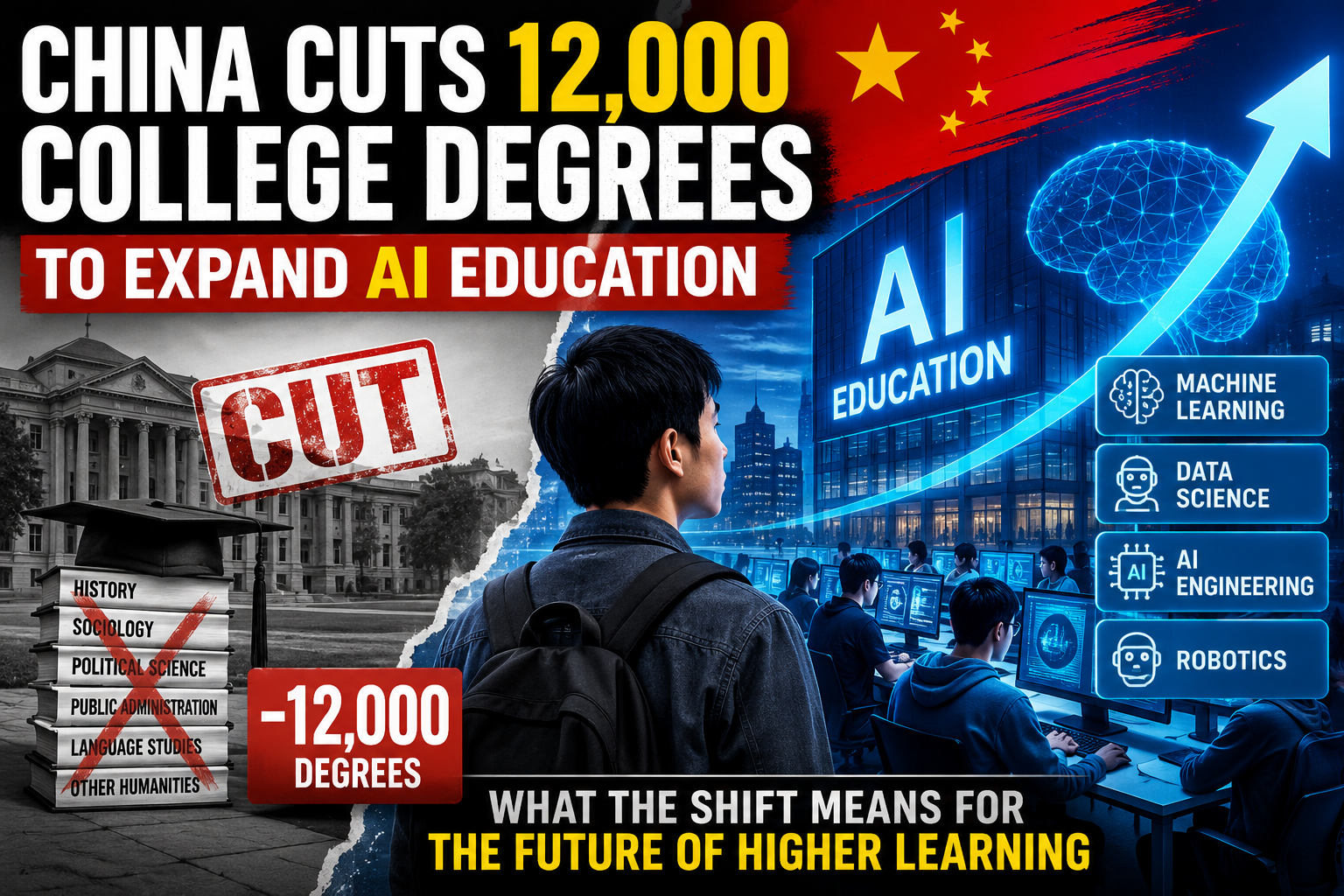
China has taken one of the boldest steps yet in this direction. Between 2021 and 2025, Chinese universities revoked or suspended approximately 12,200 undergraduate programmes while introducing more than 10,200 new courses focused on emerging technologies.
The move reflects a broader national strategy: align higher education with economic priorities, reduce the mismatch between degrees and employment opportunities, and build a workforce capable of competing in industries such as artificial intelligence, robotics, semiconductor manufacturing, and advanced computing.
However, the sweeping reforms have also sparked an important debate. Is China prioritising AI at the expense of arts and humanities, or is it simply adapting its education system to a rapidly changing world?
The answer is more complex than it first appears.
Why China Is Restructuring University Degrees
China’s higher education overhaul is driven by two powerful forces: economic transformation and employment pressure.
The country is producing a record number of university graduates each year, but many young people are struggling to secure jobs that match their qualifications.
At the same time, artificial intelligence is changing the skills employers value.
Routine tasks in fields such as finance, marketing, management, customer service, and data processing are increasingly being automated. Employers are now seeking graduates with expertise in machine learning, data science, robotics, cloud computing, and interdisciplinary problem-solving.
For policymakers, the challenge is clear: universities must evolve quickly enough to prepare students for jobs that may not even exist today.
Rather than allowing higher education to lag behind technological change, China is attempting to proactively reshape its academic ecosystem.
The Numbers Behind China’s Education Overhaul
The scale of the changes is unprecedented.
| Education Reform Metric | 2021-2025 Data |
|---|---|
| Undergraduate programmes revoked or suspended | 12,200 |
| New programmes introduced | 10,200 |
| University courses adjusted | More than 30% |
| Primary focus areas | AI, robotics, advanced manufacturing, embodied intelligence |
| Fields facing the largest cuts | Arts, humanities, foreign languages, management studies |
These figures reveal a significant shift in priorities.
Instead of viewing universities primarily as institutions for broad academic learning, policymakers increasingly see them as engines of economic competitiveness and technological innovation.
What Is Embodied Intelligence and Why Does It Matter?
One of the fastest-growing areas in China’s university system is embodied intelligence, a field that combines artificial intelligence with physical machines such as robots.
Unlike traditional AI applications that operate exclusively in digital environments, embodied intelligence focuses on enabling machines to perceive, learn, and interact with the physical world.
Examples include:
- Humanoid robots used in manufacturing facilities.
- Autonomous delivery systems.
- AI-powered healthcare assistants.
- Smart warehouse automation.
- Industrial robotics for advanced manufacturing.
At least nine Chinese universities have already launched dedicated programmes in this field, signalling the country’s intention to lead the next wave of industrial automation.
Why Arts and Humanities Are Facing Pressure
The reduction in arts, humanities, foreign language, and management programmes has fuelled concerns that universities are placing too much emphasis on technical disciplines.
However, the issue is not necessarily a rejection of these subjects.
Many universities argue that certain programmes have become oversaturated, producing more graduates than the labour market can absorb.
At the same time, demand for technology-focused skills continues to outpace supply.
This creates a difficult balancing act for policymakers.
While technical expertise is essential for economic growth, employers increasingly value uniquely human capabilities such as critical thinking, creativity, communication, ethics, and cultural understanding.
Ironically, these are precisely the skills that arts and humanities programmes often develop.
As AI becomes more capable, human-centred skills may become more valuable—not less.
The Global Race for AI Talent
China’s education reforms are part of a broader international competition for technological leadership.
Countries around the world are investing heavily in artificial intelligence research, infrastructure, and talent development.
The nation that produces the most skilled AI workforce could gain significant advantages in economic growth, national security, and industrial innovation.
China’s approach reflects a long-term strategy to reduce reliance on foreign technology and strengthen domestic capabilities in critical industries.
Universities are expected to play a central role in achieving these objectives.
| Country | AI Education Strategy |
|---|---|
| China | Large-scale restructuring of university programmes |
| United States | Expansion of AI research funding and interdisciplinary courses |
| India | Growing focus on AI skills and digital education initiatives |
| European Union | Emphasis on ethical AI and regulatory frameworks |
The competition extends beyond technology companies. Universities have become strategic assets in the global AI race.
Will Degrees Become Obsolete Faster?
One of the most significant challenges highlighted by China’s reforms is the rapidly shrinking lifespan of academic programmes.
Many of the degrees now being phased out were introduced only a few years ago.
This raises an important question: can traditional four-year degree structures keep pace with technological change?
Experts increasingly argue that universities must shift away from rigid academic pathways and embrace more flexible learning models.
Future education systems may prioritise:
- Modular courses that can be updated regularly.
- Micro-credentials and certifications.
- Interdisciplinary learning.
- Industry partnerships.
- Lifelong learning opportunities.
In the age of AI, learning may become a continuous process rather than a one-time qualification.
What Students Should Learn in the AI Era
The most successful professionals of the future are unlikely to be those who focus exclusively on technical skills or exclusively on human skills.
Instead, they will combine both.
Students entering university today should consider developing expertise across multiple domains.
| Technical Skills | Human Skills |
|---|---|
| Data analysis | Critical thinking |
| AI literacy | Communication |
| Programming | Creativity |
| Digital tools | Leadership |
| Cybersecurity awareness | Ethical decision-making |
The future job market will reward individuals who understand how to work alongside AI rather than compete directly against it.
The Risk of Chasing Trends
While adapting education to technological change is necessary, there is a risk in overreacting to short-term trends.
History shows that rapidly expanding a field can sometimes lead to oversupply.
If every university aggressively increases AI-related programmes without considering future demand, today’s high-value skills could become tomorrow’s crowded job market.
Experts caution that universities should focus on building adaptable graduates rather than training students for specific technologies that may evolve quickly.
The goal should not be producing AI specialists alone but creating learners who can continuously acquire new skills throughout their careers.
What China’s Education Overhaul Means for the World
China’s decision to reshape thousands of university programmes signals a broader shift in global higher education.
Universities everywhere are facing similar questions:
- Which skills will remain valuable in an AI-driven economy?
- How often should academic programmes be updated?
- What balance should exist between technical and human-centred education?
- How can institutions prepare students for jobs that do not yet exist?
Countries that answer these questions effectively may gain a significant economic advantage over the coming decades.
China’s reforms may be among the largest, but they are unlikely to be the last.
Conclusion
China’s decision to cut more than 12,000 university programmes while introducing thousands of AI-focused courses reflects a profound transformation in higher education.
The reforms are driven by economic priorities, technological disruption, and the urgent need to improve graduate employability.
However, the shift also highlights a broader truth: success in the AI era will require more than technical expertise alone.
While artificial intelligence may reshape industries, uniquely human skills such as creativity, communication, adaptability, and ethical judgment will remain indispensable.
The future of education is unlikely to be a choice between AI and the arts.
Instead, the most resilient education systems will find ways to combine both—preparing students not just for the jobs of today, but for the uncertainties of tomorrow.
For breaking news and live news updates, like us on Facebook or follow us on Twitter and Instagram. Read more on Latest Careers on thefoxdaily.com.

COMMENTS 0