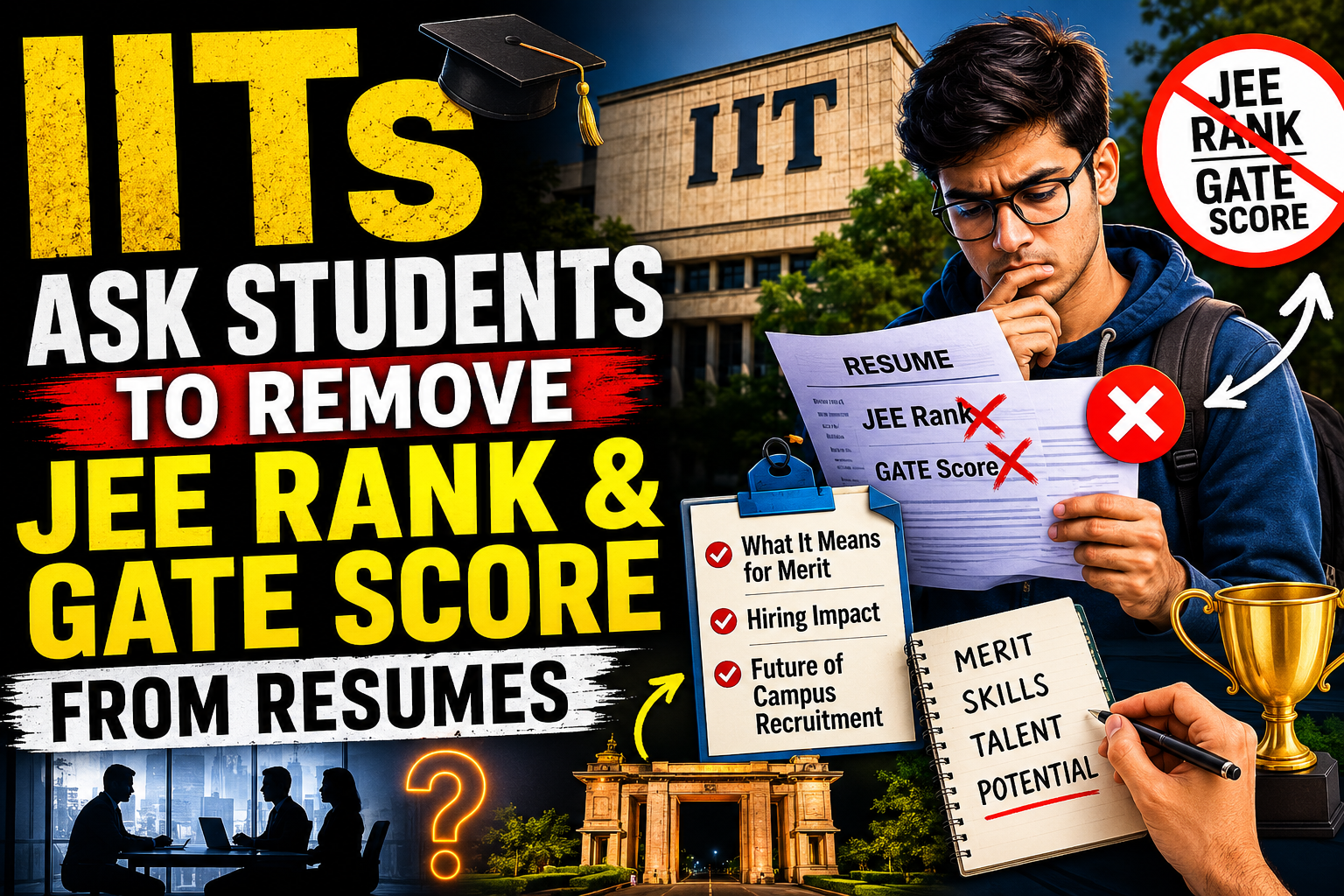
For generations of engineering aspirants in India, a JEE rank represented more than admission into a premier institute. It symbolised years of discipline, competition, and academic achievement. Similarly, GATE scores often served as a recognised indicator of technical ability for postgraduate students.
Now, that long-standing culture is facing one of its biggest changes.
The decision by IITs to ask students not to include JEE ranks, GATE scores, percentiles, and similar entrance examination credentials in resumes for placements and internships signals a larger shift in how merit may be defined in higher education and hiring.
The move has triggered intense discussion because it touches multiple questions at once: What should employers evaluate? Do entrance exams predict workplace success? Should admission performance influence job opportunities years later?
What Exactly Has Changed?
Under revised placement guidance across IITs, students participating in campus recruitment are being instructed to remove entrance examination rankings from resumes submitted through placement channels.
Students may continue presenting:
- Academic performance during IIT education
- Cumulative Performance Index (CPI)
- Research work
- Projects and technical achievements
- Internships
- Leadership experience
- Competition wins
- Real-world problem-solving work
The change applies to standard placement documentation and internship applications facilitated through institutional channels.
If employers specifically request entrance exam details separately, those may still be shared.
Why IITs Introduced This Policy
The central argument behind the policy is straightforward: recruitment should measure who students became during their education—not the score that helped them enter.
Entrance examinations measure performance at one point in time.
Higher education is expected to transform students over multiple years through academics, projects, internships, collaboration, and practical experience.
The placement framework now appears to prioritise outcomes over entry credentials.
Supporters argue this approach creates stronger alignment between educational goals and employment evaluation.
The Hidden Concern: Can Entrance Scores Reveal Student Background?
One of the most debated aspects behind the move is the concern that recruiters may infer admission categories through entrance examination ranks.
Since opening and closing admission ranges for programs are publicly discussed each year, some believe recruiters could indirectly draw conclusions unrelated to candidate capability.
The revised approach attempts to reduce that possibility and encourage evaluation based on current performance.
The broader objective appears to be creating a hiring process that reduces assumptions and encourages direct assessment.
Does JEE Rank Actually Predict Career Success?
This question sits at the centre of the debate.
Entrance examinations are designed to measure preparation, academic strength, and competitive performance.
However, professional success usually depends on a broader set of capabilities:
- Technical execution
- Communication skills
- Creativity
- Leadership
- Teamwork
- Adaptability
- Learning speed
- Business understanding
A top exam rank may open opportunities—but long-term outcomes often depend on what happens afterward.
A Comparison: Entrance Merit vs College Achievement
| Entrance Examination Success | Performance During IIT Education |
|---|---|
| Measures preparation before admission | Measures development over several years |
| Single examination outcome | Continuous performance |
| Focus on academic competition | Focus on applied capability |
| Snapshot of achievement | Evidence of growth |
| Standardised testing | Multiple dimensions of evaluation |
Why Some Students and Alumni Support the Decision
Supporters believe the move modernises campus recruitment.
They argue that employers hiring from IITs already know candidates cleared highly competitive admission processes.
Once students enter the institution, future evaluation should focus on:
- Academic growth
- Project outcomes
- Internship experience
- Research contribution
- Technical depth
- Leadership potential
From this perspective, removing exam ranks encourages recruiters to assess recent achievements instead of historical labels.
Why Critics Believe the Policy Is Controversial
Critics raise an entirely different concern.
Many students invest years preparing for JEE and GATE under intense pressure and competition.
For them, high ranks are earned accomplishments—not personal background information.
Some argue removing these details limits a student’s ability to showcase achievements they worked hard to obtain.
Others question whether employers truly rely on ranks when interviews, coding rounds, case studies, assessments, and GPA already provide stronger indicators.
The criticism reflects a larger philosophical question:
Should merit be defined by where a student started—or by what they achieved afterward?
How Campus Hiring Is Changing Globally
The IIT decision reflects broader shifts visible in global recruitment.
Many employers increasingly prioritise:
- Portfolio work
- Practical projects
- Problem-solving ability
- Internships
- Communication skills
- Demonstrated outcomes
In several sectors, employers now focus less on historical credentials and more on measurable capability.
This does not eliminate academic achievement—but changes its relative importance.
The Bigger Impact: IIT Placements May Become More Skill-Centric
If implemented consistently, the policy could gradually reshape student behaviour.
Students may invest more effort into:
- Research publications
- Open-source contributions
- Product building
- Internship performance
- Entrepreneurship
- Cross-disciplinary learning
Recruitment conversations may shift from “What was your rank?” to “What have you built?”
That transition could redefine the meaning of achievement inside elite institutions.
What Recruiters Are Likely to Focus on Instead
| Traditional Signals | Emerging Hiring Signals |
|---|---|
| Entrance exam rank | Project quality |
| Percentile | Internship outcomes |
| Past academic labels | Technical interviews |
| Exam performance | Problem-solving ability |
| Admission competitiveness | Practical execution |
Conclusion
The IIT decision to remove JEE and GATE ranks from placement resumes represents more than an administrative guideline—it reflects changing ideas about merit, fairness, and professional evaluation.
Supporters view it as an opportunity to judge students by growth and capability developed during education.
Critics see it as reducing visibility for hard-earned accomplishments.
Whether the policy becomes a lasting model or remains controversial, one outcome is already clear: campus hiring conversations are moving beyond entrance scores toward a broader definition of potential, achievement, and career readiness.
For breaking news and live news updates, like us on Facebook or follow us on Twitter and Instagram. Read more on Latest Careers on thefoxdaily.com.

COMMENTS 0