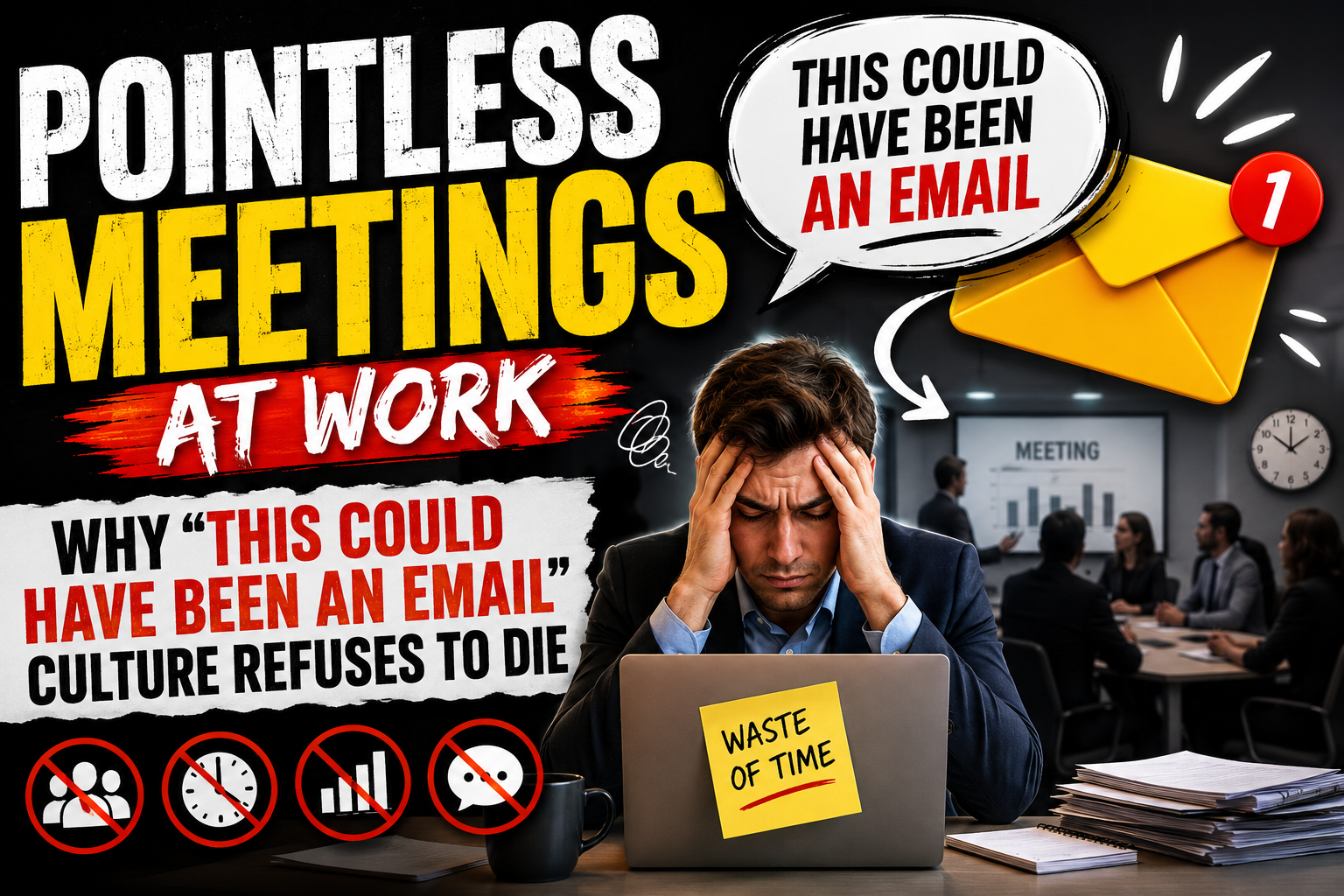
There are few workplace frustrations as universal as joining a meeting and immediately wondering why it exists. Whether employees work in technology, healthcare, finance, education, sales, or administration, many share the same experience: calendar invites for discussions that produce little clarity, few decisions, and no meaningful outcomes.
The phrase “This could have been an email” has become more than a workplace joke. It reflects a growing concern about how organizations use time, manage communication, and measure productivity. While meetings are designed to improve collaboration and alignment, employees often view many of them as interruptions that slow progress rather than accelerate it.
The debate raises an important question: If workers consistently complain about pointless meetings, why do organizations continue scheduling them? The answer lies in the complex relationship between communication, accountability, leadership, and workplace culture.
The Growing Problem of Meeting Overload
Meetings are intended to bring people together to solve problems, make decisions, share updates, and coordinate projects. In principle, they are essential tools for teamwork. However, many organizations have gradually shifted from using meetings strategically to relying on them as a default communication method.
As companies expanded and workplaces became increasingly digital, the number of recurring meetings grew dramatically. Weekly check-ins, daily standups, project reviews, stakeholder discussions, alignment sessions, and status updates now occupy significant portions of employees’ schedules.
What was once a tool for collaboration has often become a routine obligation.
This phenomenon is commonly referred to as meeting overload, where employees spend so much time discussing work that they have limited time left to complete the work itself.
How Pointless Meetings Damage Productivity
The impact of unnecessary meetings extends far beyond the time spent inside the meeting room or video call.
Many employees report that meetings disrupt concentration and break the flow of deep work. Tasks that require analysis, creativity, strategic thinking, coding, writing, or problem-solving often demand uninterrupted focus.
When a meeting interrupts that focus, productivity losses continue even after the discussion ends. Employees frequently need additional time to regain momentum and return to their previous level of concentration.
Several factors commonly contribute to unproductive meetings:
- Meetings without a clear agenda.
- Discussions that end without decisions.
- Status updates that could be communicated through email.
- Large meetings where only a few participants contribute.
- Recurring meetings that continue simply because they have always existed.
- Conversations that drift away from the original objective.
These issues create a perception that attendance is often more important than actual contribution.
Why Meetings Continue Despite Employee Frustration
If unnecessary meetings are so widely disliked, why do managers keep scheduling them?
The answer is that meetings serve purposes that extend beyond information sharing. From a management perspective, meetings provide visibility into ongoing work, allow teams to remain aligned, and create opportunities to identify problems before they become larger issues.
Leaders often use meetings to:
- Track project progress.
- Coordinate across departments.
- Clarify responsibilities.
- Resolve misunderstandings.
- Improve team engagement.
- Support accountability.
- Ensure everyone receives the same information.
For managers overseeing multiple projects and teams, meetings can offer reassurance that work is moving in the right direction.
Employees, however, frequently experience the same meetings as interruptions that reduce their ability to produce meaningful results.
This difference in perspective helps explain why the conflict continues.
The Psychology Behind Corporate Meeting Culture
The persistence of unnecessary meetings is not simply a scheduling problem. It is also a psychological and cultural issue.
Many organizations equate visibility with productivity. Employees who attend meetings, provide updates, and remain highly visible may appear more engaged than colleagues quietly producing results behind the scenes.
This perception creates pressure to schedule discussions even when written communication would be sufficient.
Managers may also fear missing important information. As a result, additional meetings are added as a safeguard against uncertainty.
Over time, these habits become part of organizational culture.
Once a recurring meeting is established, removing it can be surprisingly difficult. Teams continue attending because “that’s how things have always been done,” even when the original purpose no longer exists.
The Hidden Cost of Unnecessary Meetings
While employees often focus on lost time, the true cost of pointless meetings is significantly larger.
| Impact Area | Effect of Excessive Meetings |
|---|---|
| Productivity | Reduces time available for focused work. |
| Employee Morale | Creates frustration and disengagement. |
| Decision-Making | Slows progress through excessive discussion. |
| Innovation | Limits uninterrupted creative thinking. |
| Burnout Risk | Increases stress and workload pressure. |
| Operational Efficiency | Consumes resources without generating value. |
When multiplied across dozens or hundreds of employees, even a single unnecessary weekly meeting can result in significant productivity losses.
Organizations that fail to address meeting overload often find themselves struggling with slower execution, reduced employee satisfaction, and higher levels of workplace fatigue.
When a Meeting Is Actually Worth Having
Not all meetings are bad. In fact, many are essential for organizational success.
The difference lies in whether the meeting creates value that justifies the time invested by everyone attending.
A productive meeting typically achieves at least one of the following goals:
- Solves a problem.
- Facilitates a decision.
- Removes obstacles.
- Provides critical information.
- Aligns stakeholders on priorities.
- Creates a clear action plan.
If none of these outcomes are achieved, the meeting likely should not have occurred.
Before scheduling a meeting, leaders should ask three simple questions:
- What decision needs to be made?
- Who genuinely needs to participate?
- Can this be handled through email, messaging, or a shared document?
These questions can eliminate many unnecessary discussions before they ever reach the calendar.
The Remote Work Effect on Meeting Habits
Remote and hybrid work arrangements have transformed how organizations communicate.
Video conferencing platforms made collaboration easier across locations, but they also contributed to meeting inflation.
Because virtual meetings can be scheduled instantly, organizations often default to calls instead of considering alternative communication methods.
This trend led to what many workers describe as “calendar saturation,” where back-to-back meetings leave little room for focused work.
Ironically, technology designed to improve flexibility sometimes created new barriers to productivity.
Forward-thinking companies are now responding by implementing meeting-free days, asynchronous communication policies, and stricter guidelines regarding when meetings should occur.
How High-Performing Organizations Reduce Meeting Fatigue
Some organizations have successfully reduced meeting overload without sacrificing collaboration.
Common strategies include:
- Requiring agendas before meetings are approved.
- Limiting attendee lists to essential participants.
- Ending meetings once objectives are achieved.
- Replacing routine updates with written reports.
- Creating designated focus time blocks.
- Regularly reviewing recurring meetings for relevance.
These practices help ensure that meetings remain purposeful rather than becoming automatic calendar events.
The most effective organizations recognize that communication quality matters more than communication quantity.
A New Workplace Metric: Outcomes Over Attendance
One of the most significant shifts occurring in modern workplaces is the move toward measuring outcomes instead of activity.
For decades, visibility often served as a proxy for productivity. Employees who attended meetings, responded quickly, and remained constantly available appeared highly engaged.
Today, many organizations are beginning to focus on measurable results rather than meeting participation.
This shift encourages teams to communicate more efficiently and reserve meetings for situations where genuine collaboration is required.
As a result, businesses can maintain alignment while giving employees more time to focus on meaningful work.
What the Future of Workplace Meetings May Look Like
The future of workplace communication is unlikely to eliminate meetings entirely. Human interaction remains essential for collaboration, relationship-building, and decision-making.
However, organizations are increasingly recognizing that not every discussion requires a conference room or video call.
Advances in collaboration tools, project management platforms, and asynchronous communication methods are making it easier to share information without disrupting productivity.
Companies that successfully balance communication with focused work will likely gain competitive advantages in efficiency, employee satisfaction, and innovation.
The organizations that thrive in the future may not be the ones holding the most meetings, but the ones holding the most effective meetings.
Conclusion
The complaint that a meeting “could have been an email” has endured for years because it reflects a genuine workplace challenge. Employees are not opposed to collaboration, accountability, or communication. What they object to are meetings that consume valuable time without producing meaningful outcomes.
Pointless meetings persist because organizations rely on them for coordination, visibility, and reassurance. Yet when discussions fail to provide clarity, solve problems, or support decisions, they become expensive interruptions rather than productive tools.
As workplace expectations continue evolving, companies face increasing pressure to respect employees’ time and prioritize effectiveness over tradition. The future of productive work will depend not on eliminating meetings entirely, but on ensuring every meeting has a purpose, a clear outcome, and a reason to exist.
Until then, millions of employees will continue opening calendar invites, joining conference calls, and quietly wondering whether the conversation could have been handled with a simple email.
For breaking news and live news updates, like us on Facebook or follow us on Twitter and Instagram. Read more on Latest Careers on thefoxdaily.com.

COMMENTS 0