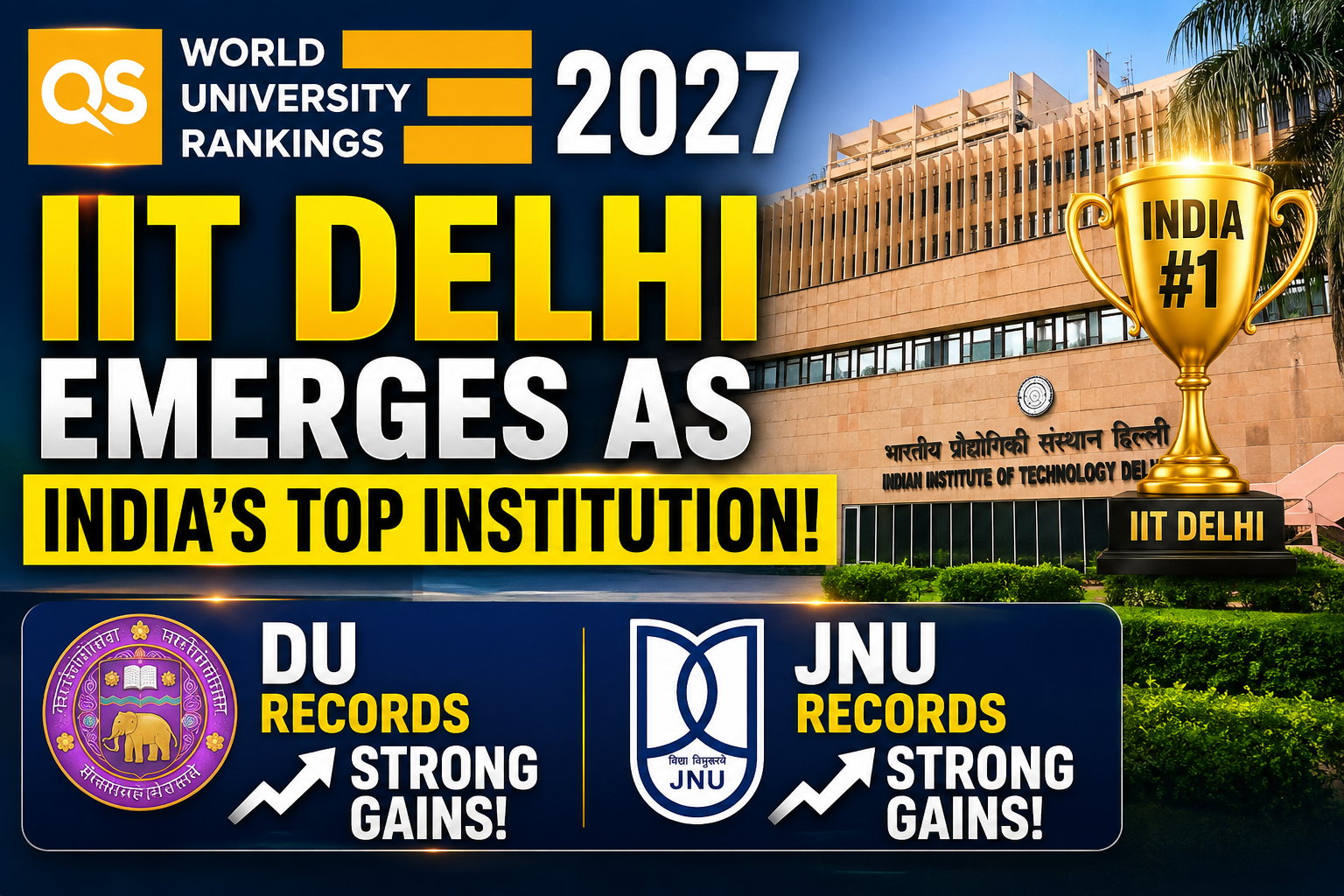
The QS World University Rankings 2027 highlight a significant shift in India’s Higher Education ecosystem, with established institutions strengthening their global reputation and several emerging universities recording impressive gains.
For the second consecutive year, Indian Institute of Technology (IIT) Delhi has secured the top spot among Indian institutions, climbing to 118th globally from 123rd in the previous edition. The improvement reflects growing international recognition of the institute’s academic quality, research output, and employability outcomes.
While IIT Delhi consolidated its lead, several non-IIT institutions, including the University of Delhi (DU), Jawaharlal Nehru University (JNU), Vellore Institute of Technology (VIT), and Birla Institute of Technology and Science (BITS) Pilani, recorded notable improvements, signaling a broader transformation in India’s higher education landscape.
QS World University Rankings 2027: India’s Top 20 Institutions
| National Rank | Global Rank 2027 | Global Rank 2026 | Institution |
|---|---|---|---|
| 1 | 118 | 123 | IIT Delhi |
| 2 | 134 | 129 | IIT Bombay |
| 3 | 170 | 180 | IIT Madras |
| 4 | 205 | 215 | IIT Kharagpur |
| 5= | 221 | 222 | IIT Kanpur |
| 5= | 221 | 219 | Indian Institute of Science (IISc) Bangalore |
| 7 | 322 | 328 | University of Delhi |
| 8 | 335 | 339 | IIT Roorkee |
| 9 | 349 | 334 | IIT Guwahati |
| 10 | 452 | 503 | Shoolini University |
| 11 | 470 | 465 | Anna University |
| 12 | 510 | 566 | IIT BHU Varanasi |
| 13 | 526 | 575 | Chandigarh University |
| 14 | 546 | 556 | IIT Indore |
| 15 | 555 | 558 | Jawaharlal Nehru University |
| 16 | 575 | 668 | BITS Pilani |
| 17 | 588 | 664 | IIT Hyderabad |
| 18 | 597 | 691 | Vellore Institute of Technology |
| 19 | 655 | 696 | Symbiosis International University |
| 20 | 686 | 761–770 | Jamia Millia Islamia |
How IIT Delhi Strengthened Its Global Position
IIT Delhi’s rise to 118th position globally is not the result of a single metric but reflects improvements across several key indicators used by QS.
The institute recorded a significant jump in employer reputation, moving up 11 places to secure the 39th position globally. Its performance in the employment outcomes category also improved substantially, rising by 60 positions.
These gains indicate growing confidence among employers in the quality of IIT Delhi graduates and the institute’s ability to produce industry-ready talent.
Strong industry partnerships, expanding research collaborations, startup incubation initiatives, and increased focus on innovation have helped IIT Delhi maintain its leadership position among Indian institutions.
IIT Bombay Slips While Other IITs Gain Momentum
Although IIT Bombay remains India’s second-highest-ranked institution, it slipped from 129th to 134th globally. The decline follows an 11-position drop in the previous edition, highlighting the intense competition among top global universities.
Meanwhile, several other IITs improved their rankings.
- IIT Madras climbed from 180th to 170th.
- IIT Kharagpur improved from 215th to 205th.
- IIT Kanpur maintained a strong position at 221st.
- IIT BHU Varanasi jumped from 566th to 510th.
- IIT Hyderabad rose significantly from 664th to 588th.
The results demonstrate that excellence within the IIT ecosystem is becoming more evenly distributed rather than concentrated among a few campuses.
Beyond IITs: Non-Engineering Institutions Make Their Mark
One of the most important takeaways from the QS World University Rankings 2027 is the rise of non-IIT institutions.
The number of ranked non-IIT institutions has increased from just seven in 2017 to 43 in 2027, highlighting the growing diversity of India’s higher education system.
Among the standout performers:
- University of Delhi improved to 322nd globally.
- Jawaharlal Nehru University climbed to 555th.
- Shoolini University entered India’s top 10 with a rank of 452nd.
- BITS Pilani surged 93 positions to 575th.
- Vellore Institute of Technology rose by 94 positions to 597th.
- Jamia Millia Islamia achieved one of its best performances, reaching 686th globally.
This broader distribution of high-performing institutions suggests that quality higher education in India is no longer limited to a handful of elite engineering institutes.
What Factors Determine QS Rankings?
The QS World University Rankings assess universities using multiple performance indicators designed to measure academic quality, research impact, employability, and global engagement.
Key parameters include:
- Academic reputation
- Employer reputation
- Faculty-to-student ratio
- Citations per faculty
- International faculty ratio
- International student ratio
- Sustainability initiatives
- Employment outcomes
Universities that perform consistently across these indicators tend to secure stronger positions in the rankings.
How NEP 2020 May Be Influencing India’s Global Performance
The latest rankings suggest that reforms introduced under the National Education Policy (NEP) 2020 may be contributing to improved outcomes.
Since the policy’s introduction, 29 Indian universities have achieved their highest-ever rankings. Increased emphasis on multidisciplinary education, research funding, industry partnerships, international collaboration, and institutional autonomy appears to be yielding positive results.
Notably, 13 of the 18 institutions that achieved all-time highs this year are non-IIT universities.
This indicates that India’s higher education growth story is expanding beyond traditional centres of excellence.
Employment Outcomes Emerge as a Key Strength
Indian institutions continue to perform particularly well in employability-related indicators.
The University of Mumbai, for instance, climbed 70 places to secure the 25th position globally in the employment outcomes category.
This reflects increasing industry confidence in Indian graduates and highlights the growing alignment between university curricula and evolving workforce demands.
The future of Indian higher education will likely be defined not just by academic excellence, but by the ability of institutions to deliver strong research output, global partnerships, and meaningful career outcomes.
Conclusion
The QS World University Rankings 2027 underscore India’s growing influence in global higher education. While IIT Delhi has strengthened its leadership position among Indian institutions, the most significant story lies in the broader rise of non-IIT universities.
With more institutions improving their global standing, stronger employment outcomes, and the continued impact of education reforms, India appears to be building a more diverse and competitive higher education ecosystem.
For students, the rankings offer an important reminder that quality education opportunities now extend beyond a handful of traditional institutions, providing a wider range of choices across disciplines and regions.
For breaking news and live news updates, like us on Facebook or follow us on Twitter and Instagram. Read more on Latest Careers on thefoxdaily.com.






COMMENTS 0