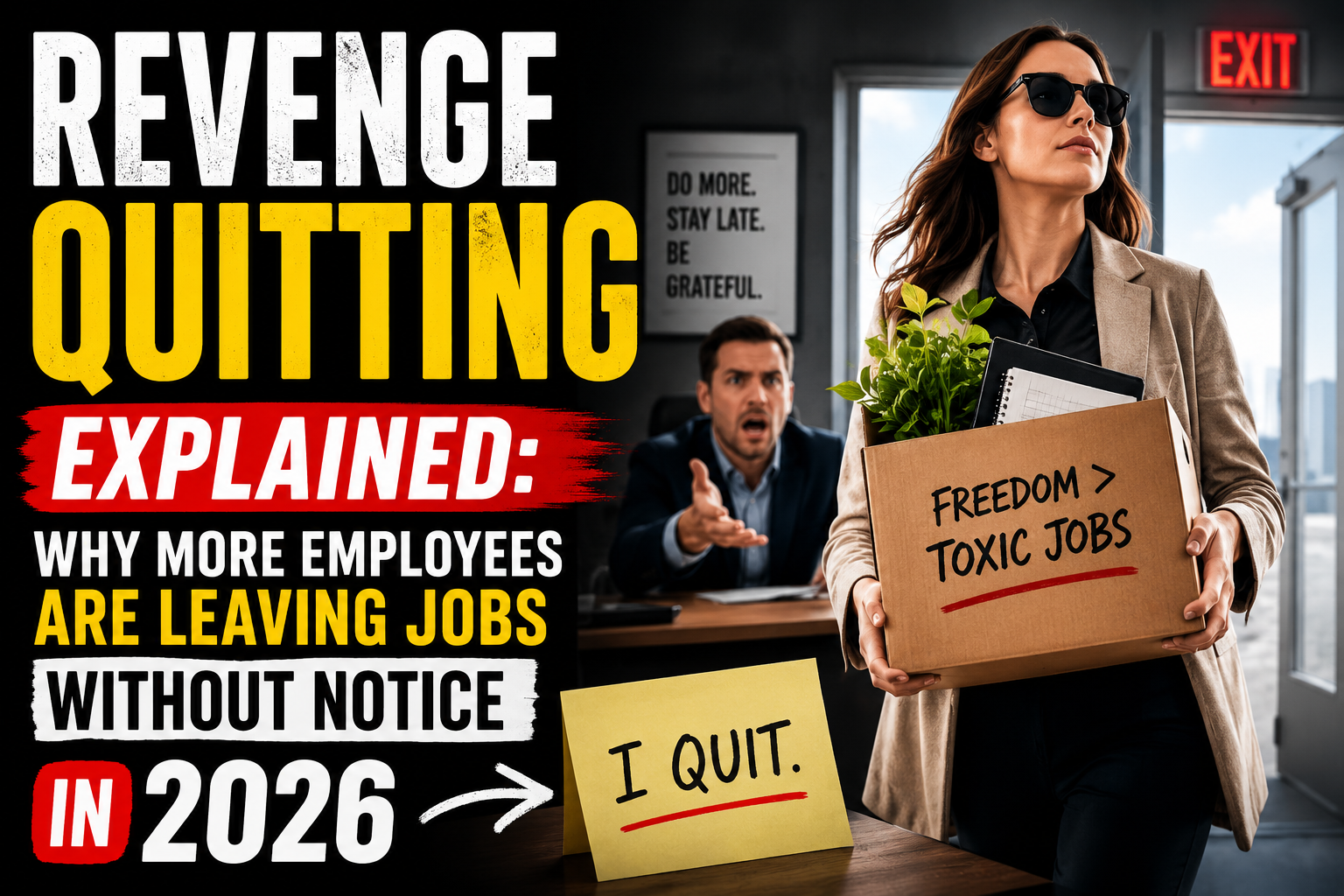
One day, an employee is attending meetings, responding to messages, and managing deadlines. The next day, they are gone.
No farewell email. No exit interview. No lengthy notice period. Just silence.
This growing workplace phenomenon, known as revenge quitting or rage quitting, is reshaping how organisations think about employee engagement and retention. While the term may sound dramatic, experts say these sudden departures rarely happen overnight.
Instead, revenge quitting is often the result of months or even years of accumulated frustration caused by burnout, toxic management, lack of recognition, and broken trust.
As employees increasingly prioritise mental well-being and personal values over traditional notions of workplace loyalty, abrupt resignations are emerging as a warning sign that many organisations can no longer afford to ignore.
What Is Revenge Quitting?
Revenge quitting refers to employees leaving their jobs abruptly, often without serving a notice period or following conventional resignation practices, as a response to prolonged dissatisfaction or perceived mistreatment.
Unlike traditional resignations motivated by higher salaries or better career opportunities, revenge quitting is often driven by emotion. It is less about moving toward something new and more about walking away from a situation that feels unsustainable.
For many employees, the decision represents a final attempt to regain control, protect their well-being, or send a clear message about workplace conditions.
Revenge quitting is rarely impulsive. What appears sudden to employers is often the culmination of unresolved frustrations that have been building quietly over time.
Why Revenge Quitting Is Rising in India and Globally
The workplace has undergone a significant transformation over the past few years. Remote work, hybrid schedules, economic uncertainty, and changing employee expectations have redefined the relationship between workers and employers.
Today’s workforce, particularly younger professionals, increasingly values flexibility, purpose, recognition, and psychological safety.
Employees are no longer willing to tolerate unhealthy work environments simply because previous generations considered it normal.
At the same time, access to professional networks, online job platforms, and freelance opportunities has reduced the risks traditionally associated with leaving a job.
As career paths become more flexible, employees are placing greater importance on their mental health and quality of life.
| Traditional Workplace Mindset | Modern Employee Expectations |
|---|---|
| Long-term loyalty to one employer | Career mobility and flexibility |
| Endure difficult work environments | Prioritise mental well-being |
| Success measured by job stability | Success measured by fulfilment and growth |
| Work comes before personal life | Healthy work-life balance matters |
| Limited career alternatives | Multiple career pathways available |
The Numbers Behind the Trend
The rise of revenge quitting reflects a broader decline in workplace engagement.
According to the Gallup State of the Global Workplace Report, only a small percentage of Indian employees describe themselves as thriving at work, while many report experiencing stress, disengagement, or dissatisfaction.
Meanwhile, a survey conducted by Monster in 2025 involving more than 3,600 workers found that nearly half of respondents had left a job abruptly without notice to express frustration.
More than half also reported witnessing a colleague do the same.
Perhaps most notably, many employees who quit suddenly had been with their organisations for more than two years, indicating that revenge quitting is often the result of long-term dissatisfaction rather than impulsive behaviour.
Seven Reasons Employees Are Revenge Quitting
1. Chronic Burnout
Excessive workloads, unrealistic deadlines, and constant pressure can gradually drain employees emotionally and physically.
When stress becomes a permanent feature of work rather than a temporary challenge, employees may begin to view quitting as the only path to recovery.
Burnout is no longer limited to high-pressure industries. It now affects professionals across sectors, from technology and healthcare to education and finance.
2. Toxic Leadership and Poor Management
Micromanagement, favouritism, public criticism, inconsistent expectations, and a lack of empathy can severely damage employee morale.
The saying that people do not leave companies—they leave managers—continues to hold true.
Employees who feel unsupported or disrespected by their leaders are far more likely to disengage and eventually leave.
3. Feeling Unheard and Undervalued
When employees repeatedly raise concerns that go unaddressed, frustration begins to accumulate.
Over time, a lack of meaningful communication can create the perception that their contributions are invisible or unimportant.
Feeling unheard often erodes trust faster than disagreements themselves.
4. Limited Career Growth Opportunities
Ambitious professionals want opportunities to learn, develop new skills, and progress in their careers.
When promotions stall and development opportunities disappear, employees may lose motivation and begin exploring alternatives.
Career stagnation can be especially frustrating for high performers who feel their potential is being overlooked.
5. Broken Trust
Trust is one of the most valuable assets in any workplace relationship.
Unfulfilled promises, unexpected policy changes, inconsistent communication, and perceived unfairness can quickly undermine employee confidence.
Once trust breaks down, even competitive salaries may not be enough to retain talent.
6. Poor Work-Life Balance
The expectation of being constantly available has blurred the boundaries between professional and personal life.
Late-night emails, weekend meetings, and unrealistic responsiveness expectations can leave employees feeling exhausted and disconnected from their personal lives.
Work-life balance is no longer viewed as a perk. For many professionals, it is a non-negotiable requirement.
7. Lack of Recognition
Employees who consistently deliver results without receiving appreciation or constructive feedback often feel taken for granted.
Recognition does not always require financial rewards. Simple gestures such as acknowledging achievements, offering encouragement, and celebrating milestones can significantly improve engagement.
When recognition disappears, motivation often follows.
What Revenge Quitting Reveals About Workplace Culture
Revenge quitting is not the problem itself—it is a symptom of deeper organisational issues.
Sudden resignations often indicate gaps in communication, ineffective leadership, weak feedback systems, and cultures that prioritise productivity at the expense of employee well-being.
Organisations that view revenge quitting as an isolated incident risk missing larger patterns that may be affecting entire teams.
The real question employers should ask is not why an employee left abruptly, but why they felt unable to express their concerns before reaching that point.
How Employers Can Prevent Revenge Quitting
Preventing abrupt resignations requires more than competitive salaries or workplace perks.
- Conduct regular employee feedback sessions.
- Train managers to lead with empathy and transparency.
- Create clear career development pathways.
- Recognise employee contributions consistently.
- Encourage healthy work-life boundaries.
- Address workplace conflicts promptly.
- Build a culture of trust through honest communication.
Companies that actively listen to employees and act on feedback are more likely to retain talent and foster long-term engagement.
Will Revenge Quitting Become the New Normal?
While abrupt resignations are unlikely to replace traditional notice periods entirely, the trend highlights a fundamental shift in workplace expectations.
Employees today are increasingly willing to walk away from environments that compromise their mental health, personal values, or sense of dignity.
As competition for skilled talent intensifies, organisations that fail to adapt may face higher turnover rates and greater challenges in attracting future employees.
The companies that succeed will be those that treat employee well-being as a strategic priority rather than an afterthought.
Conclusion
Revenge quitting may appear sudden, but it is rarely spontaneous.
Behind every abrupt resignation is often a story of burnout, unmet expectations, strained relationships, or broken trust.
The rise of this workplace trend serves as a reminder that employee loyalty is no longer guaranteed—it must be earned through respect, transparency, recognition, and meaningful support.
In an era where professionals increasingly prioritise well-being over tradition, organisations that listen carefully to their employees will be better positioned to retain talent and build healthier workplaces.
Because sometimes, the most powerful resignation is not the one announced with a farewell speech. It is the one that happens without a word.
For breaking news and live news updates, like us on Facebook or follow us on Twitter and Instagram. Read more on Latest Careers on thefoxdaily.com.

COMMENTS 0