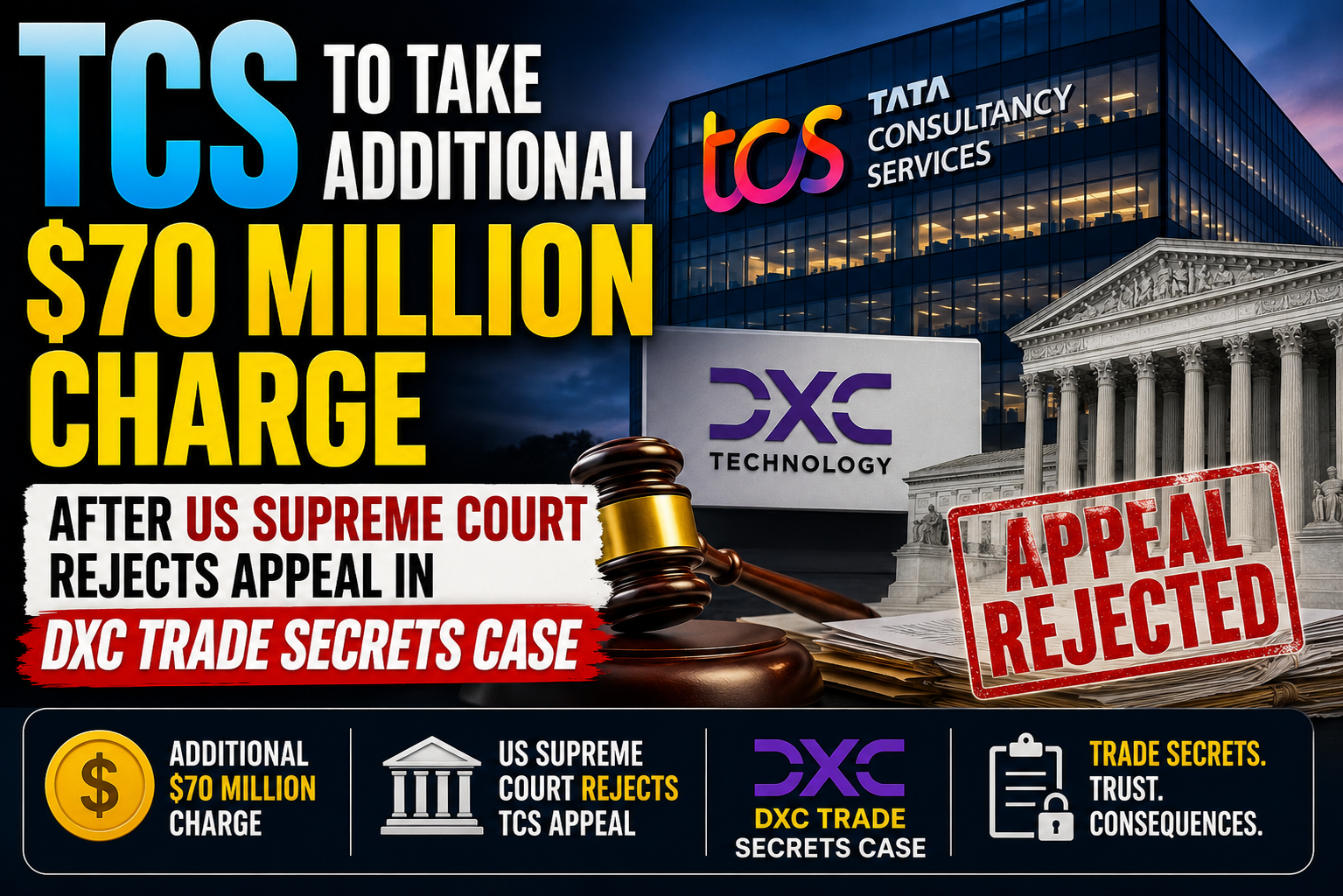
Tata Consultancy Services (TCS), India’s largest IT services company, will record an additional one-time charge of $70 million in the first quarter of FY27 after the United States Supreme Court refused to hear its appeal in a long-running trade secrets dispute with DXC Technology.
The decision effectively leaves intact a lower court ruling that upheld a $168 million damages award against TCS, bringing one of the most closely watched legal battles in the global IT outsourcing industry closer to a final resolution.
For investors, clients, and the broader technology sector, the case underscores the growing legal and financial risks associated with intellectual property disputes, talent migration, and software development in an increasingly competitive market.
Why TCS Is Taking an Additional $70 Million Charge
In a regulatory filing, TCS confirmed that the US Supreme Court had denied its petition for a writ of certiorari, meaning the country’s highest court will not review the judgment previously issued by the United States Court of Appeals for the Fifth Circuit.
The company stated that it had already set aside $150 million in earlier financial periods to cover potential liabilities related to the case.
With the Supreme Court declining to intervene, TCS will now recognize the remaining $70 million as an exceptional expense during the first quarter of FY27.
The additional provision will cover:
- Outstanding damages
- Accrued interest
- Legal expenses
The total financial impact now aligns with the final court-approved award of $168 million.
Quick Snapshot: TCS-DXC Legal Dispute
| Key Detail | Information |
|---|---|
| Case Filed | 2019 |
| Plaintiff | Computer Sciences Corporation (now part of DXC Technology) |
| Defendant | Tata Consultancy Services |
| Core Allegation | Misappropriation of life-insurance software trade secrets |
| Initial Jury Award | $210 million |
| Reduced Award | $168 million |
| Previously Provisioned by TCS | $150 million |
| Additional Q1 FY27 Charge | $70 million |
| Latest Development | US Supreme Court declined to review the case |
How the Dispute Began
The origins of the case trace back to 2019, when Computer Sciences Corporation (CSC), which later became part of DXC Technology, filed a lawsuit against TCS.
CSC alleged that TCS hired approximately 2,200 employees from insurance company Transamerica and used their access to CSC’s proprietary systems to gain insights into sensitive software and business processes.
According to the lawsuit, TCS improperly leveraged this information to build and enhance a competing life-insurance platform.
The claims centered on allegations of trade secret misappropriation rather than direct software copying, making the case particularly significant for the IT services industry.
Trade secrets can include confidential algorithms, workflows, customer data structures, software architecture, pricing models, and other proprietary business information that provide a competitive advantage.
TCS Maintained Its Innocence Throughout the Proceedings
TCS consistently denied all allegations and argued that the information at the heart of the dispute was neither confidential nor improperly obtained.
The company maintained that it accessed the software lawfully and that the claims lacked merit.
During the appeals process, TCS challenged the damages award on multiple grounds, arguing that DXC failed to demonstrate actual financial losses and that the punitive damages imposed were excessive.
TCS also contended that the damages calculation relied heavily on the concept of “unjust enrichment” rather than concrete evidence of economic harm.
However, both the district court and the appellate court rejected these arguments.
The Legal Journey: From Jury Verdict to Supreme Court
The case has passed through several judicial stages over the past seven years.
2023: Jury Recommends $210 Million Award
A US jury concluded that TCS had willfully misappropriated trade secrets and recommended damages totaling $210 million.
2024: District Court Reduces the Award
US District Judge Brantley Starr reduced the damages to $168 million, comprising:
- $56 million in compensatory damages
- $112 million in punitive damages
2025: Fifth Circuit Upholds the Judgment
The United States Court of Appeals for the Fifth Circuit affirmed the lower court’s decision, leaving the revised damages award intact.
2026: Supreme Court Declines Review
With the US Supreme Court refusing to hear the case, the appellate court ruling remains the final word on the matter.
Why This Case Matters Beyond TCS
While the financial impact is manageable for a company of TCS’s scale, the broader implications extend far beyond a one-time charge.
The ruling sends a clear message about the importance of intellectual property governance in the global technology industry.
As IT services firms increasingly compete to build industry-specific software solutions, they often recruit talent from clients and competitors with deep domain expertise.
This creates a delicate balance between legitimate employee mobility and the protection of proprietary information.
The TCS-DXC case highlights how disputes can emerge when companies believe former employees bring confidential knowledge into new organizations.
Growing Importance of Trade Secret Compliance
Unlike patents, trade secrets do not require formal registration. Their value depends on maintaining confidentiality.
As a result, companies worldwide are investing more heavily in:
- Employee training on intellectual property rules
- Access controls for sensitive information
- Non-disclosure agreements
- Internal compliance frameworks
- Digital monitoring systems
- Legal audits during talent acquisitions
For multinational technology firms, robust compliance measures are becoming as important as technical expertise.
Future legal disputes may increasingly focus on data access, knowledge transfer, and the responsibilities of employers when hiring talent from competitors or clients.
Will the Charge Affect TCS Financial Performance?
Although $70 million represents a significant amount in absolute terms, analysts are likely to view it as a one-time exceptional expense rather than an indicator of operational weakness.
TCS generates billions of dollars in annual revenue and maintains a strong balance sheet.
Because the company had already provisioned $150 million for the case, much of the financial impact had already been anticipated by investors.
However, the additional charge could marginally affect quarterly profitability and operating margins in Q1 FY27.
Market attention is expected to remain focused on TCS’s core business performance, including client spending trends, demand for artificial intelligence services, and global economic conditions.
What Happens Next?
With the Supreme Court declining to intervene, the litigation is effectively nearing its conclusion.
TCS is expected to complete the necessary accounting adjustments in its FY27 first-quarter results and move forward without further significant legal avenues in this case.
For DXC Technology, the decision represents a major legal victory after years of litigation.
For the wider technology sector, the outcome serves as a reminder that intellectual property disputes can carry substantial financial, operational, and reputational consequences.
Conclusion
The TCS-DXC trade secrets dispute illustrates how legal battles over intellectual property can evolve into high-stakes financial events, even for the world’s largest technology companies.
While the additional $70 million charge is unlikely to materially alter TCS’s long-term growth trajectory, the case reinforces the importance of strong compliance practices, clear boundaries around proprietary information, and rigorous oversight when hiring talent from clients or competitors.
As software becomes more specialized and data-driven, protecting trade secrets will remain a critical priority across the global technology landscape.
The Supreme Court’s decision not to review the case closes a significant chapter in this dispute—but its lessons for the IT industry are likely to resonate for years to come.
For breaking news and live news updates, like us on Facebook or follow us on Twitter and Instagram. Read more on Latest Careers on thefoxdaily.com.

COMMENTS 0