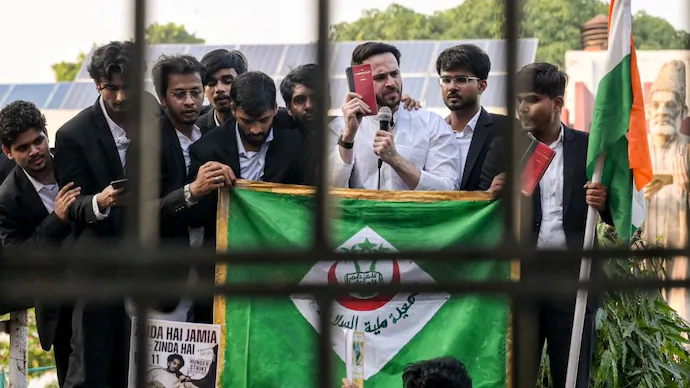
Jamia Millia Islamia has announced plans to resume student union elections after nearly 20 years, but protesting students have rejected the university administration’s latest notice, arguing that it fails to address their key demands. The students have vowed to continue their agitation, citing the absence of a clear election schedule and any mention of the Proctor’s resignation.
The announcement follows sustained protests demanding the restoration of an elected student representative body at the New Delhi university. In an order issued on Monday, the administration said elections would take place 15 days after approval of the students’ union constitution. However, the notice does not specify when that approval will be granted, leaving the election timeline uncertain.
The dispute centres on student representation, the university’s response to the ongoing agitation and demands raised by protesters. Although the administration has sought to persuade students to end their protest, the students say the latest assurance does not provide a sufficiently clear commitment to resolve the issues.
Jamia Announces Student Union Elections After Nearly Two Decades
In its Monday order, Jamia Millia Islamia stated that student union elections would be held 15 days after the students’ union constitution receives approval.
“The Jamia Millia Islamia Students’ Union Election will be held after 15 days, from the date of approval of the constitution of the Students’ Union of Jamia Millia Islamia,” the order stated.
The announcement marks a potential step towards restoring an elected student representative body after a gap of nearly 20 years. According to the information provided, the university administration dissolved the students’ union in 2006.
Since then, students have been demanding the restoration of an elected body that can represent their concerns and interests on campus. Their current agitation has focused on securing a clearer commitment from the administration regarding the return of student union elections.
While the university’s order outlines the period between approval of the constitution and the election, it leaves a crucial step unresolved: the date on which the constitution itself will be approved. Students argue that without a deadline for this process, the announcement does not establish when voting will actually take place.
Registrar Holds Talks With Protesters in the Early Morning
Jamia Millia Islamia Registrar Mahatab Alam Rizvi arrived at around 4:30 am to hold talks with protesting students as the agitation continued. He brought an official notice and shared the administration’s order with the protesters.
During the interaction, the Registrar urged the students to call off their protest, maintaining that their demands had been addressed through the university’s announcement.
However, the students did not accept the notice as a satisfactory resolution. They argued that the order did not provide an unambiguous assurance about the restoration of the students’ union because it made the election dependent on a constitutional approval process without specifying when that process would be completed.
The disagreement highlights the gap between the administration’s stated commitment to hold elections and the protesters’ demand for a definite timeline. For the university, the order sets out a condition and a 15-day period for conducting the election after approval. For the students, the absence of a date for the initial approval leaves the process open-ended.
The Registrar’s appeal to end the agitation therefore failed to secure the protesters’ acceptance of the notice, according to the account of the talks.
Why Students Rejected the University’s Notice
The protesting students identified two major shortcomings in the administration’s announcement: the lack of a clear timeline for approving the students’ union constitution and the absence of any reference to the Proctor’s resignation.
No definite date for approving the constitution
The university’s order says elections will be held 15 days after approval of the constitution, but it does not state when that approval will take place. Students have argued that this omission prevents the notice from providing a definitive election schedule.
Although the administration has outlined what should happen after the constitution is approved, the students want clarity on the preceding stage as well. Without a specified approval date, the 15-day period cannot be tied to a confirmed calendar date.
This distinction is central to the disagreement. The announcement signals an intention to conduct elections, but the protesters say an intention alone does not resolve their demand for a clear and reliable timetable.
No mention of the Proctor’s resignation
The students also objected to the notice because it did not mention the resignation of the Proctor, which they said was another demand raised during the agitation.
The administration’s order focused on the students’ union election process. According to the supplied account, it did not address the demand concerning the Proctor. The protesters therefore maintained that the announcement left part of their demands unanswered.
The absence of a reference to the resignation became another reason for rejecting the university’s attempt to bring the protest to an end. Students said they would not accept the election announcement as a complete resolution while their other concerns remained unaddressed.
Students Say the Agitation Is About Democratic Representation
The protesters have described their agitation as an effort to secure democratic rights and meaningful student representation on campus. They want an elected body through which students can raise concerns and represent their interests within the university.
The restoration of student union elections is therefore the central issue in the current dispute. The university’s announcement has raised the possibility of elections returning after nearly two decades, but the students say the process must be supported by clear commitments rather than an incomplete timetable.
The disagreement also reflects different expectations about what is needed to resolve the protest. The administration has presented its order as evidence that the students’ demands have been addressed and has asked them to call off their agitation. The students, meanwhile, argue that the notice does not provide enough certainty about the election process and does not address the demand concerning the Proctor.
As a result, the announcement has not ended the confrontation. The protesters have said they will continue their agitation until the administration responds more clearly to their demands.
What Happens Next in the Jamia Student Union Dispute?
The next key step is the approval of the students’ union constitution, since the university has linked the election schedule to that decision. Under the order, voting is to take place 15 days after approval. However, the notice, as described in the available information, does not give a date for the approval itself.
For the administration’s announcement to provide a more definite timetable, students are seeking clarity on when the constitutional process will be completed. Their response also indicates that the election schedule alone may not be enough to resolve the agitation unless the demand concerning the Proctor is addressed.
The university has announced a framework for holding elections, but the immediate dispute remains unresolved. The students have rejected the notice and vowed to continue protesting, while the administration has urged them to end the agitation on the grounds that their demands have been met.
Whether the announcement leads to the restoration of an elected student union will depend on the next steps in the approval process and how the administration responds to the protesters’ remaining concerns. For now, the gap between the university’s conditional election commitment and the students’ demand for clearer assurances continues to drive the standoff.
For breaking news and live news updates, like us on Facebook or follow us on Twitter and Instagram. Read more on Latest Education on thefoxdaily.com.






COMMENTS 0