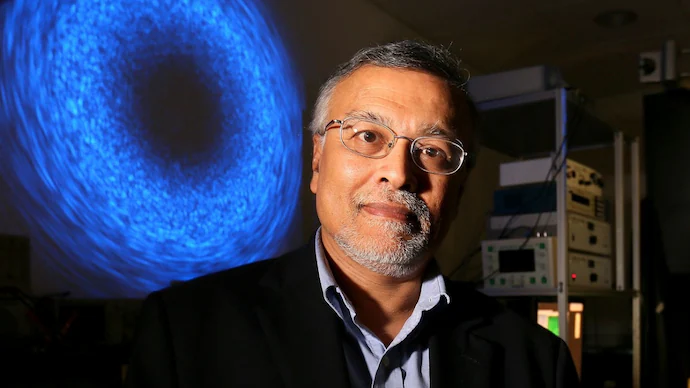
Nearly five decades ago, an engineering graduate from IIT Kanpur took an academic path that connected two seemingly different disciplines: electrical engineering and Neuroscience. Professor Mriganka Sur, who completed his BTech in Electrical Engineering in 1974, went on to build an internationally recognised research career studying how the brain develops, processes information and adapts to experience.
Born in Kolkata, Sur pursued postgraduate and doctoral studies in the United States before moving into neuroscience through academic positions at Vanderbilt University, Stony Brook University and Yale University. His journey eventually brought him to the Massachusetts Institute of Technology (MIT), where he became one of the prominent researchers investigating the organisation and plasticity of the cerebral cortex.
His work has attracted recognition from leading academic institutions, including his election as a Fellow of the Royal Society. He also maintains an association with India through IIT Madras, where he holds the NR Narayana Murthy Distinguished Chair in Computational Brain Research.
Sur’s career offers an example of how knowledge acquired in one discipline can contribute to discoveries in another. His transition from electrical engineering to neuroscience was not a departure from his original training but an expansion of how engineering principles could be applied to understand the brain.
From Kolkata to IIT Kanpur: The Beginning of an Academic Journey
Professor Mriganka Sur’s academic journey began in India, where he developed an interest in scientific and technical subjects. He later joined IIT Kanpur, one of the country’s leading engineering institutions, and graduated with a Bachelor of Technology degree in Electrical Engineering in 1974.
At the time, electrical engineering and neuroscience were not commonly viewed as closely connected academic paths. Engineering focused on systems, circuits and the movement of information, while neuroscience examined the biological structures and processes responsible for perception, memory and behaviour.
However, the two fields share important conceptual questions. Both involve understanding how complex systems process information, establish connections and respond to changing inputs. Sur’s subsequent research career would bring these areas together through the study of neural circuits and brain organisation.
His education at IIT Kanpur provided the foundation for his move to the United States, where he continued studying electrical engineering at Vanderbilt University in Nashville, Tennessee.
Higher Studies at Vanderbilt University
After graduating from IIT Kanpur, Sur joined Vanderbilt University for advanced studies. He completed his master’s degree in 1975 and earned a PhD in Electrical Engineering in 1978.
His early academic training remained firmly rooted in engineering. The discipline offered tools for examining complex systems, analysing signals and understanding how different components work together. These concepts would later become relevant to his research into the brain, where networks of interconnected neurons process sensory information and support behaviour.
Following his doctorate, Sur continued at Vanderbilt as a postdoctoral associate from 1978 to 1980. This period formed part of his transition from formal engineering education towards a research career that increasingly focused on biological systems.
Rather than treating neuroscience and engineering as separate areas of knowledge, Sur’s work demonstrated how methods developed in one discipline could help investigate questions in another. This interdisciplinary approach would become a defining feature of his academic career.
Moving Towards Neuroscience at Stony Brook
After his postdoctoral work at Vanderbilt, Sur joined the State University of New York at Stony Brook, working in the Department of Neurobiology and Behavior.
This marked an important stage in his professional development. His research increasingly focused on the cerebral cortex, the outer region of the brain involved in functions such as sensory perception, movement, memory and higher-level information processing.
One of the central questions in this area of research concerns how the brain develops its specialised regions and neural connections. Scientists have long investigated the relationship between genetic instructions and environmental experiences in shaping the organisation of the nervous system.
The brain is not simply a fixed network established at birth. Its connections develop over time, and sensory experiences can influence how different neural circuits function. Understanding this relationship between development and experience became a major focus of Sur’s work.
How Sur’s Research Explored the Brain’s Ability to Reorganise
One of the most important themes in Sur’s research is neuroplasticity, the ability of the brain to change its structure and function in response to development, learning and experience.
Different regions of the cerebral cortex are normally associated with particular functions. For example, areas involved in processing visual information are organised differently from regions that handle sound. However, researchers have investigated whether these functional identities are permanently fixed or whether they can be influenced by the signals received by developing neural circuits.
Sur’s laboratory explored this question through experiments examining how sensory pathways could influence the development of cortical regions.
In one notable experiment, researchers rerouted the optic nerve of newborn ferrets towards the auditory cortex, a region normally associated with processing sound. The nerve carries information from the eyes to the brain, and changing its destination allowed scientists to investigate how the receiving brain tissue responded to a different type of sensory input.
The cells in the affected region subsequently developed characteristics associated with visual processing and responded to visual information. The findings provided important evidence that the developing brain has a capacity to reorganise its circuits in response to the signals it receives.
The experiment helped advance scientific understanding of cortical plasticity. It suggested that the development of specialised brain regions involves more than a predetermined genetic blueprint and that incoming sensory information can influence how neural circuits become organised.
This does not mean that every brain region can freely take on any function. Brain development is shaped by a combination of biological constraints, genetic influences and experience. Nevertheless, research into sensory pathway changes has helped scientists better understand the flexibility of developing neural networks.
Joining Yale University and Moving to MIT
Sur’s academic career progressed through appointments at major American research institutions. In 1983, he joined Yale University School of Medicine as an Assistant Professor.
Three years later, in 1986, he moved to the Massachusetts Institute of Technology, joining its Department of Brain and Cognitive Sciences. The move marked the beginning of a long association with an institution that would become central to his research and academic leadership.
At MIT, Sur continued investigating how neural circuits develop, how the cerebral cortex processes information and how experience influences the organisation of the brain.
He eventually served as head of the Department of Brain and Cognitive Sciences for 15 years. Departmental leadership placed him in a position to contribute not only through his own research but also through the development of an academic environment bringing together different approaches to understanding the brain and behaviour.
His work at MIT also included the establishment of the Simons Center for the Social Brain, where he serves as director. The centre focuses on research into the neural foundations of social behaviour and related questions about brain function.
Sur holds the Paul E. and Lilah Newton Professorship of Neuroscience at MIT and is an investigator at the Picower Institute for Learning and Memory. These roles reflect his continuing involvement in research into the biological mechanisms underlying learning, memory and brain development.
Research Connecting Neuroscience, Computation and Social Behaviour
Sur’s research interests extend beyond the development of individual neural pathways. His academic work also examines how the brain’s networks support complex information processing and behaviour.
The cerebral cortex contains interconnected networks of neurons that receive, interpret and transmit information. Understanding how these networks develop and operate is important for explaining how humans perceive the world, learn from experience and interact with other people.
The Simons Center for the Social Brain provides an institutional setting for studying questions related to the brain and social behaviour. This area of research is particularly important because social interaction involves multiple cognitive processes, including perception, communication, memory and the interpretation of other people’s actions.
Computational approaches can help researchers examine these complex systems by developing models of how neural networks process information. Such approaches also create opportunities for collaboration between neuroscience, computer science, mathematics and engineering.
Sur’s career reflects the value of bringing these disciplines together. His engineering background provided an analytical foundation, while his later research applied experimental and theoretical methods to biological questions that cannot be understood through engineering alone.
Association With IIT Madras and Recognition From the Royal Society
Despite building much of his academic career in the United States, Sur has maintained a connection with India’s research and higher education ecosystem.
At IIT Madras, he serves as visiting faculty in the Department of Computer Science and Engineering and holds the NR Narayana Murthy Distinguished Chair in Computational Brain Research.
The association brings his interests in neuroscience and computation into an Indian academic environment. It also reflects the growing importance of interdisciplinary research, particularly in areas where computer science, artificial intelligence and biological sciences intersect.
Among his major international honours is his Fellowship of the Royal Society, one of the most distinguished scientific recognitions. Election to the Royal Society recognises significant contributions to scientific knowledge and research.
His academic journey, spanning engineering, neuroscience and computational brain research, has therefore received recognition across institutions and disciplines.
Why Mriganka Sur’s Journey Matters for Students Today
Sur’s career offers an important example for students considering academic paths that cross traditional subject boundaries. His progression from electrical engineering to neuroscience shows that an undergraduate degree does not necessarily determine the limits of a person’s future research interests.
Engineering education can provide skills in mathematics, systems analysis, signal processing and computational thinking. These capabilities can be applied to questions in biology, medicine and other scientific fields. Similarly, neuroscience increasingly uses computational models and data-analysis techniques to understand how the brain functions.
The growing relationship between artificial intelligence and other disciplines has made such connections even more visible. AI research draws on computer science, mathematics, statistics, linguistics, neuroscience and cognitive science. Scientists and engineers are increasingly working across these areas to develop new methods and investigate questions that cannot be addressed by a single discipline.
However, interdisciplinary work requires more than changing a subject label. It involves learning the methods, concepts and evidence standards of the new field while identifying where existing knowledge can contribute. Sur’s academic progression through engineering institutions and neuroscience departments illustrates this sustained process of learning and research.
For students at institutions such as IIT Kanpur and IIT Madras, his journey also highlights the possibilities created by strong scientific foundations and a willingness to explore unfamiliar questions. The connection between engineering and neuroscience is not merely theoretical: it can lead to experiments that deepen understanding of how the brain develops and processes information.
A Career Built Across Academic Boundaries
From his undergraduate education in electrical engineering at IIT Kanpur in 1974 to his research and leadership roles at MIT, Mriganka Sur’s career has crossed several academic boundaries. His studies at Vanderbilt, research experience at Stony Brook, appointment at Yale and long association with MIT helped shape a career centred on understanding the brain.
His research into cortical development and plasticity has contributed to scientific understanding of how sensory experience can influence neural organisation. His work at the Simons Center for the Social Brain and his association with IIT Madras further demonstrate the range of questions that emerge when neuroscience connects with computation and other disciplines.
At a time when artificial intelligence is encouraging new collaborations across science and technology, Sur’s journey offers a reminder that interdisciplinary research is not a recent idea. Long before today’s AI boom, he had already demonstrated how an engineering education could become the foundation for a career exploring some of the most complex questions about the human brain.
For breaking news and live news updates, like us on Facebook or follow us on Twitter and Instagram. Read more on Latest Education on thefoxdaily.com.




COMMENTS 0