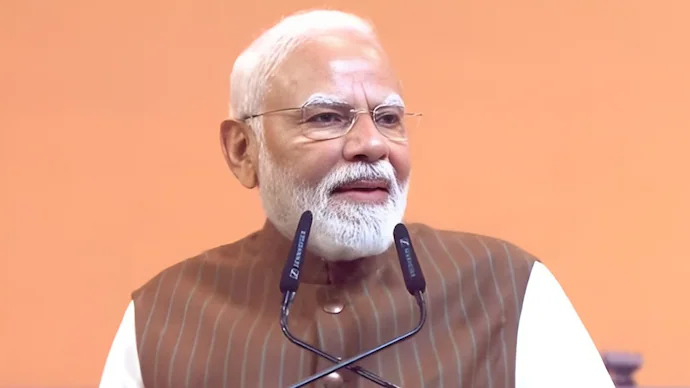
Prime Minister Narendra Modi has urged students of the Indian Institute of Technology (IIT) Kharagpur to challenge self-imposed limitations, think beyond conventional boundaries and use their abilities to shape India’s future. Addressing the institute’s Platinum Jubilee celebrations in Kharagpur, West Bengal, on Saturday, November 21, 2026, Modi delivered a message centred on ambition, innovation and national development as the country’s first IIT completed 75 years.
The Prime Minister unveiled a commemorative coin marking the institution’s 75th anniversary and interacted with students and professors during the celebrations. He described IIT Kharagpur‘s journey as closely connected with India’s transformation, highlighting the contribution of its graduates to engineering, industrial development, infrastructure, scientific research and the global technology industry.
Modi’s central message was that individuals and nations must overcome limiting beliefs to realise their full potential. Referring to India’s economic and technological progress, he said the country had demonstrated what could be achieved by changing its approach and pursuing opportunities that were once considered difficult or beyond reach.
PM Modi Urges Students to ‘Break the Limit, Unlock the Possibilities’
Addressing students at the institute, Modi said people often restrict their ambitions because of limitations in their own thinking. Such beliefs, he suggested, can prevent individuals from exploring their abilities and pursuing opportunities that could lead to meaningful achievements.
He urged young people to reject these mental barriers and approach challenges with confidence. The message, “Break the limit, unlock the possibilities”, was presented as a broader call for students to think ambitiously and contribute to India’s development.
“India has declared, loud and clear, break the limit, unlock the possibilities,” Modi said, emphasising that a nation understands its true capabilities only when it moves beyond the boundaries it has created for itself.
The Prime Minister connected this idea with India’s changing economic and technological position. He argued that the country had shown its ability to pursue ambitious goals by challenging assumptions about what it could achieve.
For students at an institution known for producing engineers, researchers, entrepreneurs and technology leaders, the message placed particular emphasis on innovation and the responsibility of young professionals to help address national challenges.
IIT Kharagpur’s 75-Year Journey Mirrors India’s Transformation
Established in 1951, IIT Kharagpur became India’s first Indian Institute of Technology and laid the foundation for a network of premier technical institutions across the country. Its creation reflected the importance independent India placed on scientific education, engineering expertise and technological capacity as essential components of nation-building.
During the Platinum Jubilee celebrations, Modi highlighted how the institute’s contribution had evolved alongside the country’s changing economic priorities. He said its graduates had supported India through different stages of development, from the early years of industrialisation to the expansion of modern technology sectors.
He described the transformation witnessed by the country over the past 75 years through a comparison between older and newer forms of transportation and communication.
“Over the 75 years since its inception, IIT Kharagpur has achieved numerous milestones. During these 75 years, India has witnessed a remarkable transformation from bullock carts to bullet trains, and from postal letters to social media messages. Throughout these phases of change, IIT Kharagpur as the nation’s first IIT has played a significant role,” he said.
The comparison underlined how the country’s development has involved changes in infrastructure, mobility, communication and industrial capabilities. IIT Kharagpur’s history, in this context, represents the changing requirements placed on India’s engineers and researchers across generations.
From Industrial Development to Space and Atomic Energy
Modi recalled that when IIT Kharagpur began its journey, India needed trained engineers to support industrial expansion and the construction of essential infrastructure. The country was building its economic foundations, and technical education was considered crucial to developing the expertise required for large-scale projects.
As India’s scientific capabilities expanded, the contribution of engineers and researchers also extended into more specialised areas. Graduates from the institute and other technical institutions became part of the country’s broader scientific and technological ecosystem, supporting developments in sectors such as space research and atomic energy.
The Prime Minister also highlighted the later expansion of information technology, which created new opportunities for Indian engineers in software development, digital services and global technology businesses.
Indian technology professionals went on to occupy leadership positions in major international companies, while India’s software industry became an important part of the country’s global economic presence.
Modi said IIT Kharagpur had consistently adapted to the country’s changing needs, contributing to different phases of development rather than remaining confined to the priorities of its early years.
The institute’s anniversary therefore offered an opportunity to recognise not only its academic history but also the wider role of technical education in building India’s industrial, scientific and technological capabilities.
A Campus With a Legacy of India’s Freedom Struggle
During his address, Modi also referred to the historical significance of the land on which IIT Kharagpur stands. Before becoming a centre of higher technical education, the campus was associated with the British colonial administration’s detention of Indian freedom fighters.
The Hijli Detention Camp was used by the British to imprison political activists during the freedom struggle. Its history connects the present-day educational institution with an important period in India’s movement for independence.
The Prime Minister used this background to draw a connection between the aspiration for political freedom during colonial rule and the modern objective of building a self-reliant nation through knowledge, technology and innovation.
“Where there was once a dream of freedom, there is now an opportunity to shape the future,” Modi said.
His remarks presented the transformation of the site as symbolic of India’s changing national priorities. The location that once represented the struggle against colonial rule now serves as a place where students and researchers work towards scientific advancement and technological development.
The reference also connected the institute’s history with the government’s broader emphasis on self-reliance, particularly in areas where India seeks to strengthen domestic manufacturing, research and technological capabilities.
Modi Links India’s Poverty Reduction With Changing Mindsets
The Prime Minister also referred to India’s reported progress in reducing poverty, citing a World Bank assessment that he said showed around 50 crore people had moved out of poverty over the past 12 to 13 years.
Modi presented the figure as evidence that India could achieve major changes when it challenged established assumptions and expanded opportunities for people. He argued that the country had demonstrated its potential by moving beyond what he described as limiting beliefs.
The claim refers to the World Bank’s October 2026 India Poverty and Equity Brief, which estimated that approximately 496 million people moved above the lower-middle-income poverty threshold between 2011 and 2023. The estimate is based on the World Bank’s poverty line of $4.20 per person per day, measured using 2021 purchasing power parity.
The report also recorded a decline in extreme poverty, using the separate threshold of $3 per person per day. These are different measures, and the figure of approximately 50 crore refers to the reduction in the number of people below the broader lower-middle-income poverty line, not simply the number lifted out of extreme poverty.
Modi used the reported progress to reinforce his argument that India’s development depends on changing expectations and creating opportunities for people to improve their living conditions.
His remarks placed poverty reduction alongside technological advancement as examples of the country’s ability to pursue ambitious objectives when existing barriers are challenged.
PM Modi Recalls Criticism Over Toilet Construction Plans
Modi also recalled facing criticism when he announced plans to build toilets for poor households. He said some critics had failed to understand why sanitation should be treated as an important development priority.
The Prime Minister particularly highlighted the significance of household toilets for poor women, for whom the absence of sanitation facilities can create serious challenges involving privacy, safety, dignity and health.
The remarks referred to the government’s sanitation push under the Swachh Bharat Mission, which was launched in 2014 with the objective of improving sanitation coverage and eliminating open defecation.
Under the programme, the government encouraged the construction of household toilets and expanded efforts to improve sanitation infrastructure across rural and urban India. The initiative became one of the prominent components of the government’s basic-services and public-health agenda.
By recalling the criticism, Modi sought to highlight how development priorities that initially face scepticism can become important parts of public policy when their wider social impact is recognised.
Why IIT Kharagpur’s Platinum Jubilee Matters
The 75th anniversary of IIT Kharagpur is significant beyond the institution’s own history. Its establishment marked the beginning of India’s IIT system, which has since become an important part of the country’s higher technical education and research landscape.
The institute has contributed to the development of skilled professionals across engineering, science, management and technology. Its alumni have worked in India’s public and private sectors, founded businesses, contributed to research and taken leadership roles in organisations around the world.
India’s economic priorities have changed considerably since the institute was established. The early focus on industrialisation and infrastructure has expanded to include digital technology, artificial intelligence, semiconductor manufacturing, advanced materials, clean energy and other emerging fields.
These sectors require a combination of technical education, research investment, entrepreneurial activity and collaboration between academic institutions and industry. IIT Kharagpur’s future contribution will therefore depend not only on producing skilled graduates but also on strengthening innovation and developing solutions to complex national and global challenges.
The institute’s Platinum Jubilee celebrations provided an opportunity to reflect on that responsibility as India seeks to strengthen its position in the global technology landscape.
What Modi’s Message Means for the Next Generation of Engineers
The Prime Minister’s address placed students at the centre of India’s future development ambitions. His call to break limiting beliefs was not restricted to individual success; it was connected with the broader expectation that young professionals should contribute to the country’s scientific, industrial and economic progress.
India’s growing ambitions in areas such as semiconductors, artificial intelligence, space technology and advanced manufacturing will require engineers and researchers capable of working across disciplines and developing new solutions.
However, building technological leadership requires more than ambition. Research infrastructure, industry partnerships, investment, access to advanced equipment and opportunities for practical innovation will also determine how effectively students and institutions can translate ideas into real-world outcomes.
For IIT Kharagpur, the next phase of its journey will involve adapting its academic and research priorities to these changing requirements while preserving the institution’s long-standing role in national development.
At 75, India’s first IIT stands as a symbol of the country’s investment in technical education after independence. Modi’s message to its students was that the next generation must build on that legacy by questioning limitations, pursuing ambitious ideas and helping shape India’s technological future.
For breaking news and live news updates, like us on Facebook or follow us on Twitter and Instagram. Read more on Latest Education on thefoxdaily.com.






COMMENTS 0