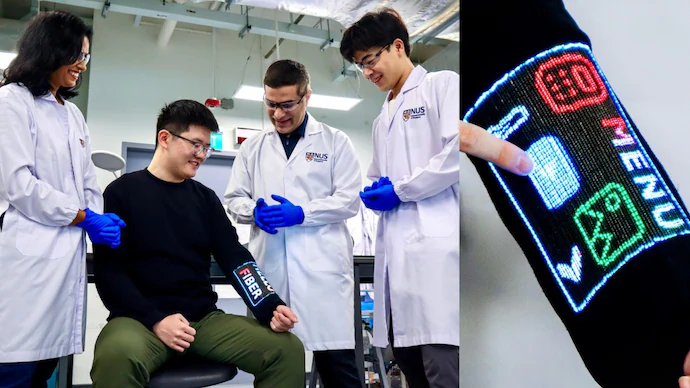
Researchers at the National University of Singapore (NUS) have developed a touchscreen sleeve that can display images and videos, respond to touch and connect wirelessly to other devices. The wearable technology has also demonstrated impressive durability, retaining nearly the same display brightness and touch response after 50 machine washes. Indian researcher Swetika Chaturvedi, a research associate at NUS, is among the team members behind the invention.
The innovation could offer a new way to interact with digital technology by turning ordinary clothing into a flexible electronic interface. Instead of reaching for a smartphone to check information, use a calculator or view images, users could potentially perform these tasks directly on a touchscreen woven into their sleeves.
The research, published in the journal Nature on October 21, 2026, introduces a textile-based display made from specially engineered electronic fibres. Led by Assistant Professor Tural Khudiyev of NUS, the research team integrated these fibres into a sleeve to create a flexible display that combines visual output with touch-sensitive controls.
Unlike conventional touchscreens, which typically depend on rigid display panels, the new technology incorporates electronic components into fibres that can be integrated into fabric. The prototype can also support applications such as a photo gallery, compass and calculator, while incorporating sensors capable of measuring temperature, movement, ambient brightness and magnetic direction.
What Is the Smart Touchscreen Sleeve Developed at NUS?
The smart sleeve is a wearable textile display designed to bring touchscreen functionality directly into clothing. It uses specially engineered electronic fibres that combine display capabilities with touch sensitivity, allowing the fabric to show visual information and respond when a user presses its surface.
Traditional touchscreen devices generally rely on flat, rigid panels made from specialised materials. Although flexible electronic displays already exist, integrating a functional touchscreen into ordinary clothing presents additional challenges, including maintaining flexibility, comfort and durability during everyday use.
The NUS researchers approached this challenge by building the electronic components into fibres that can be incorporated into a garment. Rather than attaching a conventional screen to a sleeve, the team integrated the technology into the textile itself.
The resulting prototype can display images and videos while detecting where a finger touches the surface. This allows the sleeve to function as more than a passive display: it can also act as an interactive interface for selected digital applications.
The research describes the development as the world’s first touchscreen integrated into a garment. Its combination of textile construction, visual display and touch input represents a step towards clothing that can interact directly with digital devices.
However, the sleeve remains a research prototype rather than a commercially available replacement for smartphones or smartwatches. Further development will be needed before the technology can be assessed for widespread consumer use.
Indian Researcher Swetika Chaturvedi Is Part of the Research Team
Indian researcher Swetika Chaturvedi, a research associate at the National University of Singapore, is among the researchers involved in developing the wearable touchscreen technology.
Her participation places an Indian researcher within a team working on the intersection of textile engineering, electronic fibres and wearable computing. The project explores how electronic functions traditionally associated with phones, tablets and other digital devices might be incorporated into clothing.
The research team is led by Assistant Professor Tural Khudiyev of NUS. Its work focuses on specially engineered fibres that can be integrated into fabric while supporting the functions required for an interactive display.
The technology is significant because wearable electronics must overcome practical limitations that do not affect conventional devices in the same way. Clothing bends, stretches, moves with the body and requires regular cleaning. A wearable display must therefore remain functional under conditions that could damage more delicate electronic components.
The NUS prototype addresses some of these challenges by demonstrating that its display and touch-response performance can remain nearly unchanged after repeated machine washing. It also withstands repeated bending, an important requirement for electronics intended to be worn as part of everyday clothing.
How Does the Touchscreen Sleeve Work?
The touchscreen sleeve is built using specially engineered electronic fibres rather than a conventional rigid display panel. The researchers integrated fibres containing 54 pixels into a sleeve to create a display measuring 168 millimetres by 105 millimetres.
The prototype’s stated resolution is 96 × 54 pixels, and it can refresh at 30 frames per second. These specifications describe a relatively low-resolution display compared with modern smartphone screens, but the technology is designed around the different requirements of a flexible textile interface.
When a user presses a fibre, its touch-sensitive layer is activated. The system detects the location of the finger and illuminates the corresponding pixel, allowing the sleeve to respond to touch input.
This interaction is central to the prototype’s functionality. A display that could only show images would offer limited practical use, whereas the ability to recognise touch makes it possible to navigate applications and interact with information shown on the fabric.
The textile construction is also intended to preserve the characteristics of clothing. According to the research description, the display remains flexible and breathable, allowing it to behave much like conventional fabric rather than a rigid electronic accessory.
Smart Sleeve Display Specifications
- Research institution: National University of Singapore
- Research leader: Assistant Professor Tural Khudiyev
- Indian researcher involved: Swetika Chaturvedi, research associate at NUS
- Display construction: Specially engineered electronic fibres
- Integrated pixel fibres: 54-pixel fibres
- Display dimensions: 168mm × 105mm
- Reported resolution: 96 × 54 pixels
- Refresh rate: 30 frames per second
- Touch functionality: Detects finger position and activates the corresponding pixel
- Wireless connectivity: Bluetooth image reception
- Wash durability: Nearly unchanged brightness and touch response after 50 machine washes
- Bend durability: Withstood 1,000 bends around a 5mm radius
- Publication: Nature, October 21, 2026
What Can the Wearable Touchscreen Do?
The prototype supports a range of functions that go beyond displaying static images. The researchers demonstrated video playback, a calculator, a photo gallery and a compass, alongside features that allow the sleeve to receive images wirelessly and respond to voice commands.
These capabilities suggest that textile displays could eventually support a range of simple digital tasks without requiring users to hold a separate screen. The technology could be particularly useful in situations where checking a phone is inconvenient, although the prototype’s current capabilities should not be confused with those of a fully developed smartphone.
1. Play Videos and Display Images
The sleeve can display images and play videos, allowing visual content to appear directly on the fabric. This is one of the technology’s most distinctive features because it turns a section of clothing into an electronic display surface.
The photo gallery function also allows the prototype to present stored or received images. The researchers demonstrated that images can be transferred to the sleeve over Bluetooth, providing a wireless way to deliver visual content to the wearable display.
2. Run a Calculator
The prototype can run a calculator, demonstrating how a textile display might support simple interactive tools. Combined with touch sensitivity, this function illustrates the potential for users to enter information or interact with applications through their clothing.
Although the calculator is a relatively basic application, it demonstrates an important principle: wearable fabric can be designed to support both the presentation of information and user input.
3. Function as a Compass
The sleeve can also function as a compass. The research team incorporated fibres and sensors capable of measuring magnetic direction, which can support directional information.
This feature demonstrates how wearable displays could combine sensor readings with visual information. Instead of simply showing content sent from another device, the clothing can present information connected to its own sensing capabilities.
4. Respond to Voice Commands
Voice-command functionality is another feature demonstrated by the prototype. The researchers incorporated fibres carrying a microphone and speaker, allowing the system to support voice-related interaction.
Voice input could complement the touch interface by giving users another way to interact with a wearable device. The available research description does not specify the full range of supported voice commands or explain how the system handles each task.
5. Receive Images Wirelessly
The smart sleeve can receive images over Bluetooth, allowing content to be transferred wirelessly from another compatible device. This capability could support the display of images without requiring the user to connect the garment through a physical cable for each transfer.
Wireless connectivity is an important part of making textile displays practical. A garment-based screen could become more useful if it can exchange information with phones or other digital devices, although the prototype’s full connectivity options and compatibility requirements would need to be established through further development.
Built-In Sensors Could Make the Sleeve Useful for Health Monitoring
One of the more promising aspects of the research is the integration of sensors into the wearable textile system. The team incorporated fibres carrying a microphone, speaker and sensors capable of measuring temperature, movement, surrounding brightness and magnetic direction.
These sensors expand the sleeve’s potential beyond displaying visual content. By combining sensing capabilities with an interactive screen, the technology could present information gathered from the wearer’s environment or body.
A temperature sensor positioned under the arm can measure body temperature and display the reading directly on the sleeve. This demonstration points towards possible applications in wearable health monitoring.
For example, clothing equipped with appropriate sensors could potentially make certain measurements easier to access during everyday activities. Instead of checking a separate device, users might be able to view selected information directly on the garment.
However, the prototype’s temperature-measurement capability should not be interpreted as evidence that it can replace medical thermometers or clinical monitoring equipment. The research description does not provide the accuracy specifications, clinical validation results or regulatory status required to assess its suitability for medical use.
The inclusion of movement, brightness and magnetic-direction sensors also demonstrates the potential for different types of information to be collected and presented through the same textile interface. Future versions could incorporate additional sensing capabilities, depending on how the technology develops.
Can the Smart Touchscreen Sleeve Really Survive 50 Machine Washes?
One of the biggest challenges facing wearable electronics is durability. Ordinary clothing is routinely bent, stretched, folded and washed, while conventional electronic components can be vulnerable to repeated mechanical stress and exposure to water and detergent.
A wearable touchscreen would have limited practical value if it stopped working after a few washes or became damaged through normal movement. The NUS team therefore tested whether its textile display could maintain its performance under repeated washing and bending.
According to the researchers, the prototype retained nearly unchanged display brightness and touch response after 50 machine washes using detergent. This result suggests that the integrated electronic fibres can tolerate repeated laundering under the tested conditions.
The prototype also withstood 1,000 bends around a radius of just 5 millimetres. The test demonstrates its ability to tolerate repeated bending, which is important for a screen incorporated into clothing that moves with the wearer.
Its reported flexibility and breathability are also relevant to comfort. Unlike a rigid panel attached to a sleeve, the textile display is designed to retain fabric-like characteristics.
Why Washability Matters for Wearable Electronics
Washability is a practical requirement for any electronic system intended to become part of everyday clothing. Shirts, sleeves and other garments need regular cleaning, so an integrated display must withstand conditions that a typical smartphone screen would not encounter during normal use.
The reported results address two important durability questions: whether the display continues to function after repeated washing and whether its electronic structure can withstand repeated bending.
Nevertheless, surviving 50 machine washes does not establish that the sleeve will remain functional indefinitely under every washing condition. The available research description does not specify all possible variations in detergent, washing temperature, cycle intensity or long-term wear.
The findings represent a promising research result rather than a guarantee of unlimited durability. Additional testing and product development would be needed to establish how the technology performs under a wide range of everyday conditions.
How Is the Smart Sleeve Different From a Smartphone or Smartwatch?
Smartphones and smartwatches use conventional electronic displays mounted within dedicated devices. Their screens are designed as distinct components, while the NUS prototype integrates display and touch functions into fibres that can be incorporated into fabric.
This difference could change how people interact with digital information. A textile display could allow a garment to become an interface rather than requiring users to carry or wear a separate screen-based accessory.
The sleeve also combines visual output with sensors, a microphone and a speaker. Its ability to receive images wirelessly and support selected applications demonstrates how clothing might connect with other parts of a digital system.
However, the prototype is not yet a direct replacement for a smartphone. Its reported resolution of 96 × 54 pixels is modest compared with contemporary mobile displays, and the research description does not establish that it supports the full range of applications, processing power or connectivity available on a phone.
Its significance lies instead in demonstrating a different approach to wearable computing: placing electronic functions within the textile structure itself.
Potential Applications of Washable Smart Clothing
If the technology can be developed into reliable and commercially practical products, textile touchscreens could eventually support several types of wearable applications. The current prototype already demonstrates display, touch, wireless image reception and environmental sensing capabilities.
Everyday Wearable Interfaces
A fabric-based screen could allow users to access selected information without constantly reaching for a smartphone. Applications such as a calculator, compass or image viewer demonstrate the kinds of functions that might be incorporated into future garments.
However, practical use would depend on improvements in resolution, usability, power requirements and integration with other devices.
Health and Fitness Monitoring
The temperature and movement sensors incorporated into the prototype suggest potential applications in wearable monitoring. Clothing could potentially collect selected measurements and display them directly on the garment.
Any health-related application would require further evaluation of sensor accuracy, reliability and suitability for its intended purpose. The present prototype does not, on the information provided, establish clinical performance or medical approval.
Interactive Clothing
The ability to display images and respond to touch could also support interactive garments. Textile displays might eventually be used to present visual information on clothing while retaining the flexibility and breathability associated with fabric.
Further development would be necessary to determine which applications can be delivered reliably and whether the manufacturing process can be scaled for practical use.
What Happens Next in the Development of Smart Textile Displays?
The NUS touchscreen sleeve remains at the research-prototype stage. Although its ability to display content, respond to touch and survive repeated washing represents a significant demonstration, further work is needed before the technology becomes a product that consumers can purchase and use routinely.
The research team’s next goals include improving screen resolution, integrating additional sensing capabilities and incorporating artificial intelligence.
Improving resolution could make the display more suitable for presenting detailed information and a wider range of visual content. The current 96 × 54-pixel resolution demonstrates the concept, but more detailed applications may require substantially greater display capability.
Additional sensors could expand the range of information the garment can collect, while artificial intelligence could potentially support more advanced interactions. The precise functions of future versions, however, have not been established in the information available.
Commercialisation would also involve practical questions about manufacturing, cost, maintenance, power requirements, device compatibility and long-term durability. The available research description does not provide a commercial launch date or a price for the technology.
For now, the prototype offers a demonstration of how electronic fibres can combine display technology, touch input and sensing functions in a washable textile structure.
Key Facts About the Washable Touchscreen Sleeve
- Developed at: National University of Singapore
- Research leader: Assistant Professor Tural Khudiyev
- Indian team member: Swetika Chaturvedi, research associate
- Research publication: Nature, October 21, 2026
- Technology: Touchscreen integrated into clothing using engineered electronic fibres
- Display size: 168mm × 105mm
- Resolution: 96 × 54 pixels
- Refresh rate: 30 frames per second
- Applications: Video playback, calculator, photo gallery and compass
- Connectivity: Can receive images over Bluetooth
- Other capabilities: Voice commands, microphone, speaker and integrated sensors
- Temperature monitoring: An underarm sensor can measure body temperature and display the reading
- Washing durability: Nearly unchanged display brightness and touch response after 50 detergent machine washes
- Bending durability: Withstood 1,000 bends around a 5mm radius
- Development stage: Research prototype, not a commercially available smartphone replacement
- Next research goals: Higher resolution, more sensing capabilities and artificial intelligence integration
Conclusion: Could Clothing Become the Next Digital Interface?
The washable touchscreen sleeve developed by researchers at the National University of Singapore offers a glimpse of how electronic technology could become part of everyday clothing. Using specially engineered electronic fibres, the prototype can display images and videos, respond to touch, receive images over Bluetooth and support applications such as a calculator and compass.
The involvement of Indian researcher Swetika Chaturvedi adds another dimension to the research team’s work on wearable technology. Led by Assistant Professor Tural Khudiyev, the team has demonstrated a textile display that combines electronic functions with flexibility, breathability and resistance to repeated washing.
Its reported ability to retain nearly unchanged brightness and touch response after 50 detergent machine washes is particularly important because regular cleaning is essential for wearable electronics. The prototype also withstood 1,000 bends around a 5mm radius, addressing another challenge associated with integrating electronics into fabric.
The technology is still experimental, and further development will be required to improve resolution, expand sensing capabilities and explore artificial intelligence integration. Its commercial availability, price and launch timeline have not been established.
Nevertheless, the research points towards a future in which clothing could do more than provide protection and comfort. With continued advances in electronic fibres and textile engineering, garments could eventually combine the functions of a display, a sensor and an interactive interface within the fabric itself.
For breaking news and live news updates, like us on Facebook or follow us on Twitter and Instagram. Read more on Latest Education on thefoxdaily.com.

COMMENTS 0