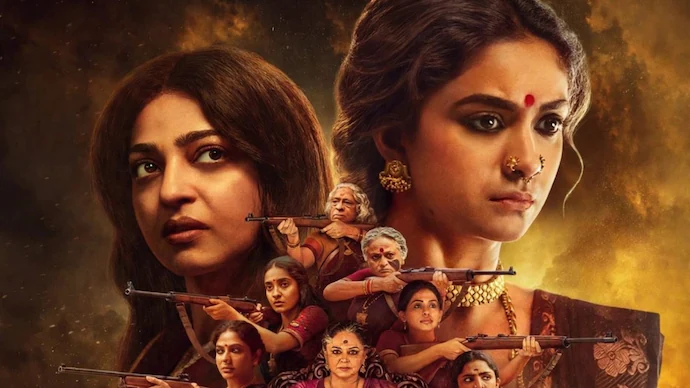
Gangster dramas have traditionally revolved around male characters, their rivalries, criminal empires and struggles for power. Filmmaker Dharmaraj Shetty wanted to explore a different perspective with Akka, his debut series. Instead of following the familiar template of male-dominated underworld stories, he created Pernuru, a fictional 1980s town where women control territories, command loyalty and lead a powerful gangster empire.
Starring Keerthy Suresh as Bhawani and Radhika Apte as Rudra, the Netflix series builds its narrative around two women navigating a world shaped by authority, tradition, violence and political rivalry. Its distinctive setting and female-led power structure have made it stand apart from conventional gangster dramas.
However, the idea for Akka did not begin as a story about women gangsters. In an interview with India Today, Shetty explained that his research into the history of Mumbai’s underworld, women warriors and matrilineal communities along India’s western coast gradually transformed the original concept. He also discussed the challenges of presenting women as action-driven crime bosses, collaborating with Keerthy and Radhika, designing Pernuru’s visual identity and the possibility of a second season.
Why Dharmaraj Shetty moved away from the traditional gangster story
Before developing Akka, Shetty was working on a gangster story set in Mumbai. He had begun researching the city’s underworld and its history before the Covid-19 pandemic. However, as the writing process progressed, he felt that he had explored that particular world enough.
The pandemic brought another unexpected change. Shetty was stranded in Mangaluru for a couple of years, which encouraged him to reconsider the setting of his story. He initially imagined shifting the gangster narrative to South India, but a conventional male-dominated criminal empire did not excite him.
As he explained, he felt audiences had already seen enough stories about male gangsters in action films. Repeating the familiar formula in a different city would not necessarily offer anything new.
“I was in Bombay before Covid, writing a gangster story and studying the history of gangs in the city. After a point, I felt I had explored that world enough. Then Covid happened, and I got stuck in Mangaluru for a couple of years. I thought of setting the gangster story in Mangaluru instead. Initially, it was about a male-dominated gangster world in South India, but that too felt boring because we had seen that before,” he said.
The turning point came when Shetty began reading about women warriors from Mangaluru and Kerala who had fought against the British, Dutch and Portuguese. Their histories prompted him to imagine what their descendants might be like in a contemporary fictional setting.
Rather than simply replacing male gangsters with female characters, he wanted to create a society in which women’s authority was embedded in the structure of the community itself. This idea eventually became the foundation of Pernuru.
How women warriors and matriarchal communities inspired Pernuru
Shetty’s research into women warriors led him towards the history of matrilineal and matriarchal communities along India’s western coast, particularly in Kerala and Mangaluru. He also explored the region’s traditions of Devi worship and the cultural significance of women in different historical communities.
These influences helped him imagine a fictional society where women were not exceptions to a male-controlled system. Instead, they occupied positions of authority as a natural part of the social order.
“I wondered where those women would be today and what their world might look like. That led me to research matrilineal and matriarchal communities along India’s west coast, particularly in Kerala and Mangaluru. The region also has a strong tradition of Devi worship. Gradually, these ideas came together and I found the story,” he said.
The distinction is important to understanding Akka. Its female-led gangster world is not presented simply as a reversal of conventional gender roles. The filmmaker wanted the audience to understand the social and cultural foundations that allow women to exercise power within Pernuru.
Historical inspiration also gave the series an opportunity to explore questions about inheritance, leadership, community identity and the relationship between tradition and authority. These elements help make the fictional setting feel like a society with its own rules rather than an ordinary crime story with women occupying traditionally male roles.
How real history shaped the rules of Akka’s fictional society
Although Pernuru is fictional, Shetty said several aspects of its social structure were inspired by historical practices. He specifically referred to the opening episode, in which Tanvi Azmi’s character, Muthakka, explains the community’s foundational rules.
According to the director, the first three rules introduced in the episode were inspired by a history book he had read about Mangaluru. He also referred to the historical matrilineal system associated with the former Travancore kingdom in Kerala.
“The foundation is real. There were matriarchal communities in Kerala and Mangaluru. Even the first three rules explained by Tanvi Azmi’s Muthakka in the opening episode were inspired by a history book I read about Mangaluru. The Travancore kingdom in Kerala also historically followed a matrilineal system,” he explained.
It is useful to distinguish between matrilineal and matriarchal systems when understanding these historical references. Matrilineality generally concerns tracing descent or inheritance through the mother’s line. Matriarchy, meanwhile, refers more broadly to women holding central positions of authority within a social structure. The two concepts are related but are not interchangeable.
Shetty did not intend to reproduce one historical community exactly. His research also included women rulers and warrior traditions from other parts of the world, including China’s only female emperor and communities in Africa.
He acknowledged that researching these histories was particularly important because he was approaching the story as a male writer. Rather than assuming that he could understand every aspect of women’s experiences, he used research to develop a fictional world influenced by multiple cultures and histories.
This approach allowed Akka to combine historical references with creative world-building. Pernuru draws from real traditions but remains a fictional society with its own identity, conflicts and power structures.
Why creating a female-led gangster drama was challenging
One of Shetty’s biggest concerns was how audiences would respond to women occupying powerful positions in an action-driven gangster story. Viewers are familiar with male gangsters performing elaborate stunts, engaging in violent confrontations and controlling criminal networks. Presenting women in similar situations required the filmmakers to consider how those scenes would be received.
Shetty pointed out that audiences often accept exaggerated action sequences involving male characters without questioning their physical credibility. When women perform similar feats, however, viewers may be more likely to scrutinise whether the action appears believable.
“We were presenting female actors as gangsters, and that meant the audience would have more questions. We have seen enough male gangsters in action films. Even if a male character flies 20 or 30 feet in the air after a fight, audiences are used to accepting it. When a woman performs an action sequence, people may question whether it is possible,” he said.
To address this challenge, the team placed considerable importance on preparation, action choreography and rehearsals. The aim was to ensure that the performances felt convincing within the world of the series rather than relying only on the novelty of female characters performing action sequences.
Keerthy Suresh, Radhika Apte and the other actresses underwent months of action training. Their preparation helped them approach the physical demands of their characters and bring the fictional gangster society to life.
Shetty credited the performers for the effort they invested in the process. While he could guide them through the research and the world he had developed, he said the actors were ultimately responsible for making those characters believable on screen.
Male viewers’ response surprised the Akka director
One of the most satisfying aspects of the series’ reception for Shetty was the response from male viewers. Before the show’s release, he had wondered whether audiences would readily accept a gangster narrative in which women held the most influential positions.
He expected viewers to respond to the action, costumes, fictional setting and the dynamic between Keerthy Suresh and Radhika Apte. However, the acceptance of the central characters by male viewers exceeded his expectations.
“What overwhelmed me was the response from male viewers. I was initially concerned about how they would receive this world, but they have been very accepting of the characters,” he said.
The filmmaker suggested that viewers might be connecting with the women of Pernuru through the important women in their own lives, including mothers, sisters and wives. He also observed that many people were watching the series with their partners and families.
This response is significant because female-led stories are sometimes discussed primarily in terms of representation. Akka attempts to make women’s authority central to the narrative rather than treating it as a secondary theme. The characters are allowed to make difficult decisions, exercise control and participate in the same morally complicated conflicts commonly associated with gangster dramas.
The series therefore invites viewers to engage with its characters as individuals within a complex criminal and political world, rather than judging them only through conventional expectations about gender.
Working with Keerthy Suresh and Radhika Apte
Akka also marked an important professional milestone for Shetty, as it was his first series and brought him together with established actors Keerthy Suresh and Radhika Apte.
He described the collaboration as rewarding and credited both performers with helping create a supportive working environment. Their involvement was particularly important because the series required the cast to navigate an unfamiliar fictional society, period-specific details and demanding action sequences.
Keerthy’s role as Bhawani involved additional preparation, including working with a different language and adapting to the period setting. Shetty recalled that the actor regularly spent time with him after filming to prepare her dialogue for the following day.
“After the shoot, she would sit with me for half an hour or an hour, going through her lines and preparing for the next day. I saw the effort she put in every day,” he said.
He also praised the working atmosphere created by the predominantly female cast and crew. According to the filmmaker, Keerthy and Radhika contributed to making the set a comfortable and collaborative environment.
The performances of the two leads are central to the series because their characters represent different dimensions of power within Pernuru. Their relationship and rivalry provide an important emotional and narrative foundation for the fictional gangster world.
Why Akka’s costumes make the women look like royalty
The visual identity of Akka was another important part of Shetty’s world-building process. He did not want the women of Pernuru to resemble conventional street gangsters. Instead, he imagined them as descendants of royal lineages, with their clothing, jewellery and surroundings reflecting a sense of inherited authority.
“The idea was to make these women feel like they came from a lineage of queens, rather than being street gangsters. That is where the scale and grandeur of the world came from,” he said.
The production team studied cultural influences from Mangaluru, Kerala and Tamil Nadu, but the intention was not to recreate any single location. Different architectural, cultural and visual elements were combined to establish Pernuru as a distinctive fictional town.
Even the colour schemes of the houses were planned according to the communities and territories within the story. The homes associated with the water and forest communities featured different palettes, while the central house used earthy and maroon tones.
Bhawani’s purple wardrobe was another deliberate decision. The colour was intended to underline her position as the queen and distinguish her visual identity within the series.
The costumes also had to be practical. Since the women were involved in physical confrontations and action sequences, their clothing needed to allow movement without compromising the visual character of the setting.
Shetty drew on his observations of how women in his family wore saris differently at home, at work and during special occasions. These everyday details helped the costume team develop clothing that felt connected to the characters’ lives.
He explained that women preparing for battle would not wear garments that restricted their movement. Their clothing had to reflect both their social status and their practical needs as warriors.
Why Bhawani decides to kill Nanda
One of the series’ significant narrative moments involves Bhawani’s decision to kill Nanda, played by Vishak Nair. The scene raises questions about loyalty, love, leadership and the difficult choices faced by people responsible for an entire community.
Shetty explained that Bhawani’s decision was driven by her responsibilities as a leader rather than her personal relationship with Nanda. He recalled that YRF’s Aditya Chopra had also questioned him about the character’s choice.
According to the director, Bhawani has to decide between her feelings as a lover and her obligations towards the people of Pernuru. Her position as a leader requires her to make a decision based on what she believes is necessary for the community, even when the consequences are personally painful.
“My answer was that, as a leader, she has to do what is right for her people. It is not about whether I like Vishak Nair or want to work with him for five seasons. At that point, Bhawani has to choose between being a lover and being a leader responsible for all of Pernuru,” he said.
Shetty also argued that viewers need to understand the characters through the history and social structure of their fictional world. The violence within Pernuru is part of its established way of life, and the characters operate according to responsibilities and expectations that may differ from those of contemporary society.
This does not necessarily mean that viewers must agree with Bhawani’s actions. Instead, the director wants the decision to be understood within the character’s circumstances, where personal relationships can conflict with political authority and collective responsibility.
The spirit-shrine sequence that stayed with the director
Among the scenes that left a lasting impression on Shetty was the spirit-shrine sequence in the third episode. The scene involves a dance through which the presence of the goddess is invoked, connecting the fictional world to the cultural and spiritual influences that helped inspire the series.
The performer playing the goddess was a trained dancer rather than a professional actor. Shetty recalled that the sequence required considerable physical effort and was filmed over two nights.
He described how the performer’s jewellery contained sharp metal pieces that caused cuts during filming. Despite the discomfort and bleeding, she continued performing with energy and dedication.
For the director, her commitment became one of the memorable experiences of the production. The scene also illustrates how the cultural elements of Akka were not limited to costumes or set design. Dance, ritual and performance were used to establish the spiritual atmosphere of Pernuru.
How YRF supported Dharmaraj Shetty’s creative vision
Shetty credited Yash Raj Films for providing him with the creative freedom to develop the series. He specifically acknowledged Aditya Chopra, Akshaye Widhani and Yogendra Mogre for supporting the project.
According to the filmmaker, Akka came together within two months of him sharing the script with the studio. As writer and director, he was closely involved in shaping the series’ story, language, costumes and visual identity.
That level of involvement was important because the project depended on creating a believable fictional society. The gangster narrative, historical references, character relationships and visual design needed to work together rather than feel like separate creative elements.
For a debut series, the opportunity to establish such a detailed world also allowed Shetty to develop his own creative voice. The result is a story that uses familiar crime-drama elements while placing them within a setting shaped by a different understanding of power and leadership.
Will Akka return for Season 2?
The possibility of a second season remains open, but Shetty said it was too early to confirm whether the series would continue. Any decision would depend on audience response and discussions between Netflix and YRF.
However, the filmmaker admitted that he had already thought about the possible futures of some characters. The introduction of Mahesh Manjrekar’s character towards the end of the first season, in particular, creates opportunities for further storytelling.
Shetty expressed interest in exploring the relationship between the new character and the existing world of Pernuru, especially the father-daughter dynamic within its gangster hierarchy.
“The characters stay with you even after you have finished writing and shooting. You keep wondering what might happen to them next. I have several ideas about where the story could go,” he said.
He added that the ending introduces a new dynamic through Manjrekar’s character and that there is considerable scope to explore the father-daughter relationship in the fictional gangster world.
For now, however, the filmmaker has not confirmed a second season. The next chapter will depend on the decisions of the makers and the response to the existing series.
Akka offers a different perspective on the gangster genre
With Akka, Dharmaraj Shetty has attempted to move beyond the familiar image of the male gangster and build a fictional society where women control territory, make political decisions and carry the responsibilities of leadership.
The series draws from histories of women warriors, matrilineal communities and cultural traditions along India’s western coast, while combining those influences with an original fictional setting. Its costumes, architecture, rituals and character relationships all contribute to the identity of Pernuru.
Keerthy Suresh and Radhika Apte lead a story that treats women as central figures in a world of power and violence rather than as supporting characters in someone else’s criminal empire. The response from male viewers, which Shetty described as particularly encouraging, has also been an important part of his experience with the show.
Whether Akka returns for another season remains uncertain. For now, the series represents a distinctive debut for Shetty and an attempt to expand the possibilities of the Indian gangster drama.
Akka is streaming on Netflix.
For breaking news and live news updates, like us on Facebook or follow us on Twitter and Instagram. Read more on Latest Entertainment on thefoxdaily.com.






COMMENTS 0