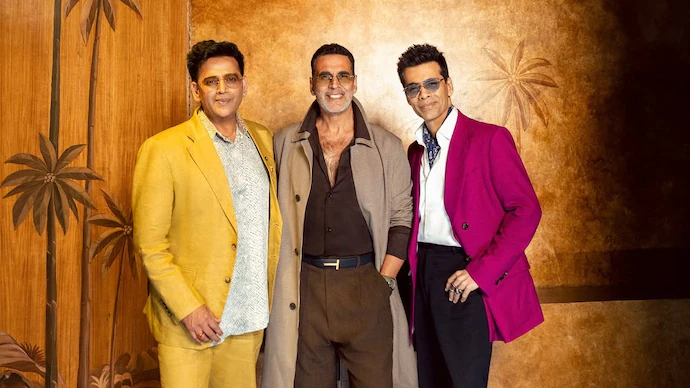
Akshay Kumar Recalls Taking Producer’s Tape Recorder Over Unpaid Rs 68,000 on KWK 9
Akshay Kumar and Ravi Kishan revisit their difficult early years in Bollywood on Koffee With Karan 9, sharing stories of unpaid film fees, financial pressure and the challenges of establishing themselves as actors.
Behind the success and popularity of Bollywood stars are often years of professional uncertainty, financial difficulties and uncomfortable experiences with film producers. Akshay Kumar and Ravi Kishan recently revisited some of those moments during their appearance on Koffee With Karan 9, hosted by Karan Johar. Their conversation offered an unusual glimpse into the struggles they faced before becoming established names in the entertainment industry.
Akshay recalled an incident in which a producer allegedly failed to pay him Rs 68,000 for a film. Frustrated by the outstanding amount, the actor visited the producer’s residence and eventually walked away with a tape recorder from his living room. He later sold the device for Rs 32,000, although the full payment remained unsettled.
Ravi Kishan shared a different but equally difficult experience involving the 1994 film Udhaar Ki Zindagi. He said he had been promised Rs 1.8 lakh but initially received only Rs 8,000. With his family’s agricultural land mortgaged, the unpaid money had significant personal consequences.
While Akshay’s recollection involved an unusual confrontation, Ravi’s account highlighted the emotional pressure of being an inexperienced actor dependent on producers for promised remuneration. Together, their stories revealed a less glamorous side of the film industry.
Akshay Kumar Recalls Taking a Producer’s Tape Recorder for Unpaid Rs 68,000
During the conversation with Karan Johar, Akshay Kumar opened up about a payment dispute from his early acting career. The actor said a producer had failed to clear Rs 68,000 owed to him after a film did not perform well.
Instead of continuing to wait for the payment, Akshay decided to approach the producer personally. He visited the producer’s house and rang the doorbell, believing the man understood the reason for his arrival.
Remembering the encounter, Akshay said:
“I had Rs 68,000 pending, so I went to his house and rang the bell. He opened the door. He was a small man, and he understood that I had come to collect my money.”
Once inside, the actor noticed a tape recorder in the living room. He decided to take the device with him rather than leave without recovering at least some value against the unpaid amount.
Akshay described how he unplugged the tape recorder and looked around to see whether anything else was worth taking. Finding nothing else, he picked up the device and walked out. Interestingly, he recalled that the producer did not attempt to stop him.
“I unplugged the tape recorder and looked around to see if there was anything else worth taking, but there wasn’t. So I picked it up and walked out. The producer didn’t stop me either.”
The actor subsequently sold the tape recorder for Rs 32,000. However, this was considerably less than the Rs 68,000 he said was owed to him.
How Much Money Did Akshay Kumar Recover?
The figures shared by Akshay offer a straightforward picture of the financial dispute. He said the producer owed him Rs 68,000, while the tape recorder fetched Rs 32,000 when he sold it.
- Outstanding payment: Rs 68,000.
- Amount received from selling the tape recorder: Rs 32,000.
- Difference: Rs 36,000.
Based on his account, the sale recovered less than half of the outstanding amount. The incident has become one of the more unusual stories from the actor’s early career, particularly because it illustrates how frustrating unpaid professional dues can become.
There is also a broader issue behind the anecdote. Film professionals depend on agreed payments for their work, and delays can create financial uncertainty. For actors working project by project, an unsettled fee can affect their ability to manage personal expenses and commitments.
Ravi Kishan Recalls Being Called ‘Gareebon Ka Mithun’
Ravi Kishan also spoke about the difficulties he encountered while trying to establish himself in the film industry. Alongside financial struggles, he recalled how people compared his appearance and walking style with veteran actor Mithun Chakraborty.
According to Ravi, the resemblance became noticeable enough for people to give him the nickname ‘Gareebon Ka Mithun’, meaning ‘the poor man’s Mithun’.
“I looked a little like Mithun Dada and even walked a little like him. People started calling me ‘Gareebon Ka Mithun’.”
The comparison reflected how people perceived the young actor during his early professional years. For newcomers, being associated with an established performer can sometimes create recognition, but it can also make it difficult to develop an independent screen identity.
Ravi’s recollection offered a glimpse into the labels and expectations that can follow actors before they establish their own identities. His experience also showed that professional recognition was only one part of the challenges he faced during that period.
Ravi Kishan’s Rs 1.8 Lakh Payment Dispute During Udhaar Ki Zindagi
One of the most emotional stories Ravi shared concerned his work in the 1994 film Udhaar Ki Zindagi, which featured Kajol, Jeetendra and Moushumi Chatterjee.
The actor said he had been promised Rs 1.8 lakh for his role in the film. However, he initially received only Rs 8,000. The difference between the agreed amount and the money he received created a serious financial problem.
At the time, his family’s agricultural land in their village had been mortgaged. Ravi needed the remaining payment to get the land released, making the money particularly important to his family.
Unlike an ordinary disagreement over professional remuneration, the situation involved a personal financial responsibility that extended beyond his acting career. The money he expected from the film was connected to his family’s circumstances.
Producer Threatened to Remove Ravi Kishan’s Role
Ravi recalled approaching the producer after completing the dubbing for Udhaar Ki Zindagi to request his pending payment. However, the response he received reportedly made the situation even more difficult.
He said the producer warned that his role could be removed from the film if he continued insisting on receiving the money.
For a newcomer attempting to build a career, losing a completed role could mean losing an important opportunity for visibility. Ravi’s account suggested that he felt caught between two difficult choices: continue demanding his promised remuneration or protect his place in the film.
Recalling his response, the actor said:
“Don’t pay me, but please let my role remain in the film.”
The statement reflected the difficult position he believed he was in. Although he needed the money, he did not want his work to disappear from the final film.
Ravi eventually left the producer’s premises on his motorcycle. He said that by the time he reached Bandstand, he had broken down in tears.
The emotional nature of the incident made it one of the most revealing parts of the conversation. It showed how financial difficulties and professional insecurity could overlap for actors trying to find a foothold in the industry.
Akshay Kumar and Ravi Kishan’s Early Struggles Reveal Bollywood’s Less Glamorous Side
Although Akshay Kumar and Ravi Kishan described different incidents, their experiences shared a common theme: receiving the money promised for professional work was not always straightforward.
Akshay’s account involved a direct confrontation with a producer and an unusual attempt to recover part of his outstanding payment. Ravi’s story, meanwhile, highlighted the vulnerability of an actor who feared losing his role if he continued demanding his dues.
Their experiences also illustrate three important challenges associated with project-based entertainment work:
- Financial uncertainty: Actors may depend on individual projects for income, making delayed payments particularly difficult.
- Unequal bargaining power: Newcomers may find it harder to challenge producers when future opportunities depend on professional relationships.
- Personal responsibilities: Unpaid remuneration can affect family commitments and financial obligations beyond the workplace.
These stories should not be treated as evidence that every film production operates in the same way. However, they offer an insight into the pressures that performers can experience while trying to establish themselves.
There is also an important difference between professional success and financial security. An actor may secure a role, complete the work and contribute to a production without necessarily receiving the full amount expected at the agreed time.
For newcomers, the consequences can extend beyond money. Losing a role or damaging a professional relationship may affect future opportunities, making it difficult to challenge an unfair situation.
Why Akshay Kumar and Ravi Kishan’s Stories Stand Out on Koffee With Karan
Koffee With Karan is widely associated with celebrity conversations about relationships, friendships, controversies, films and personal experiences. However, stories about early professional struggles offer a different perspective on personalities audiences usually associate with success.
Akshay’s tape recorder anecdote stands out because of its unusual nature. Rather than simply describing an unpaid fee, he recalled how he personally confronted the producer and left with an object that he later sold.
Ravi’s experience carries a different emotional weight. His account connects an industry payment dispute with his family’s financial circumstances and the possibility of losing his role in a film.
Both stories also demonstrate why early career experiences can remain memorable long after an actor achieves recognition. Professional success does not erase difficult experiences; instead, it can provide an opportunity to reflect on how far an individual has travelled.
Koffee With Karan 9: Guests, Streaming Details and Latest Episode
Hosted by filmmaker Karan Johar, the ninth season of Koffee With Karan is being billed as the final edition of the celebrity chat show. The season began streaming on JioHotstar on October 14, with Salman Khan appearing as the first guest.
The latest episode brings Akshay Kumar and Ravi Kishan together on the iconic couch. The appearance is particularly notable because it marks Ravi Kishan’s debut on the show.
Several other celebrity combinations have featured during the season, including:
- Rashmika Mandanna and Vijay Deverakonda
- Varun Dhawan and Janhvi Kapoor
- Saif Ali Khan and Kareena Kapoor Khan
- Kiara Advani and Sidharth Malhotra
- Ananya Birla and Ananya Panday
- Arjun Kapoor and Shanaya Kapoor
The guest combinations have brought together actors and personalities from different corners of the entertainment industry. Akshay and Ravi’s conversation adds another dimension by focusing on the financial and professional realities of their early careers.
What Their KWK 9 Appearance Says About Their Journeys
Akshay Kumar and Ravi Kishan have established themselves in the entertainment industry through different career paths. Their appearance together offers a reminder that the journey towards recognition can involve uncertainty, financial compromises and difficult professional decisions.
Akshay’s recollection of the Rs 68,000 payment dispute is memorable because of the unusual way he attempted to recover his dues. Ravi’s account is more personal, highlighting the pressure of supporting family responsibilities while trying to protect an acting opportunity.
Ultimately, their stories go beyond entertaining celebrity anecdotes. They highlight the importance of fair remuneration, professional accountability and financial security for people working in the film industry. For viewers, the conversation provides a rare opportunity to understand the struggles that existed before these actors became familiar faces on screen.
:::
For breaking news and live news updates, like us on Facebook or follow us on Twitter and Instagram. Read more on Latest Entertainment on thefoxdaily.com.






COMMENTS 0