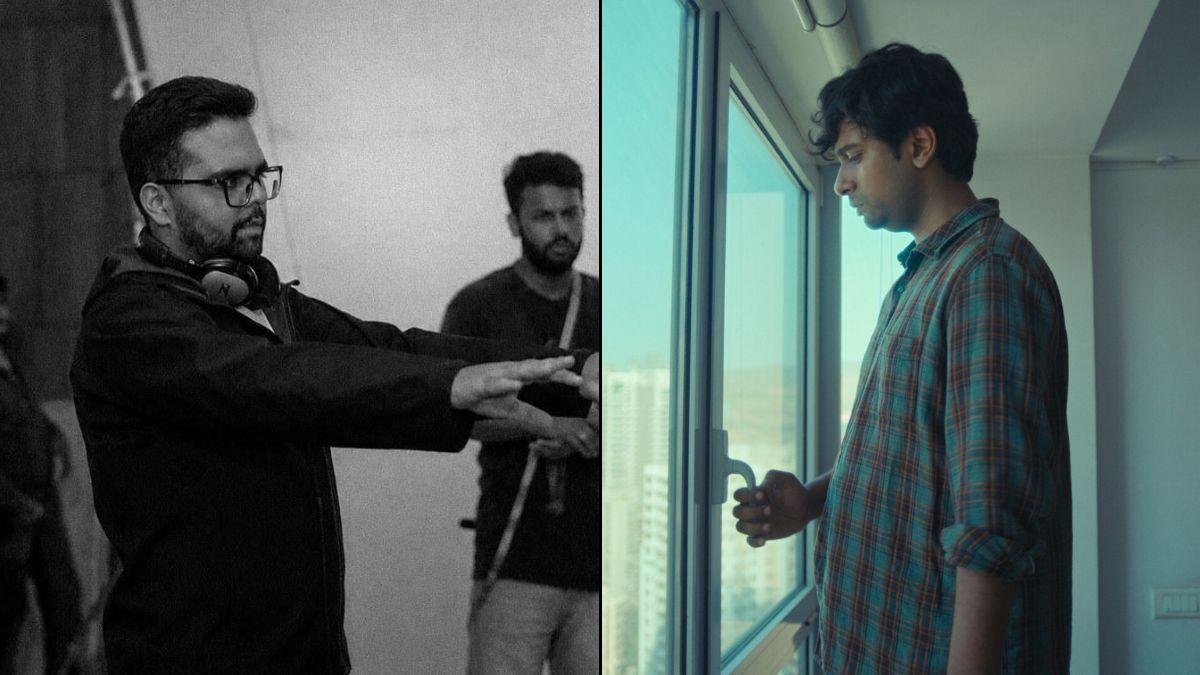
What if the biggest horror in Mumbai was not a ghost, a demon or an ancient curse, but the apartment you finally managed to rent? That is the unsettling premise behind Chaar Diwari, an independently produced psychological horror short by writer-director Syed Shadan.
Set in Mumbai, the film takes an experience familiar to countless renters — the desperate search for an affordable home — and pushes it into the realm of the impossible. A tenant finds a suspiciously inexpensive apartment, only to discover that its walls are literally closing in on him. The shrinking home becomes more than a supernatural device: it turns the pressures of urban life into something physical, measurable and impossible to ignore.
The film premiered at the Fantasia International Film Festival, where it became the only Indian selection in its category and won the Bronze Audience Award and Best Asian Short. But the festival recognition is only one reason Chaar Diwari is worth paying attention to. Its more interesting achievement is conceptual: it demonstrates how horror can emerge from a contemporary Indian reality without borrowing its fears from folklore, mythology or haunted architecture.
For Shadan, horror is not necessarily about inventing a monster. It is about finding an emotionally recognisable fear and making it impossible to escape.
Why Chaar Diwari’s horror begins with an ordinary Mumbai problem
Anyone who has searched for a rental home in Mumbai knows the peculiar mixture of hope and suspicion that accompanies the phrase “perfect flat”. The cheaper the property, the more likely the prospective tenant is to wonder what is wrong with it.
That anxiety provides the foundation for Chaar Diwari.
The film does not begin by asking audiences to believe in an unfamiliar supernatural mythology. Instead, it starts with a problem that already exists. Housing in a densely populated and expensive city forces people to compromise on space, location, privacy and comfort. The apartment becomes a financial calculation before it becomes a home.
Shadan takes that compromise to its logical nightmare.
If an apartment is already too small, what happens when it becomes smaller?
If the city already makes a person feel trapped, what happens when the walls themselves begin to move?
That is the film’s central creative insight: the supernatural does not replace reality; it exaggerates reality until reality becomes terrifying.
The shrinking apartment is more than a horror gimmick
A shrinking room is an immediately understandable visual idea. It creates physical tension without requiring extensive exposition. The protagonist can see the danger, measure it and experience it with his entire body.
But the metaphor becomes more interesting because the apartment is supposed to represent security.
A home traditionally suggests privacy, stability and refuge. In Chaar Diwari, that promise is reversed. The very space that should protect the tenant becomes the source of his confinement.
This reversal gives the film several possible layers of interpretation.
The shrinking apartment can represent financial pressure. It can suggest the gradual loss of personal freedom that accompanies urban overcrowding. It can also embody loneliness: a person may technically possess four walls while having no meaningful sense of belonging inside them.
Most importantly, the film makes these abstract anxieties physical.
Economic stress is usually invisible. Loneliness is invisible. The feeling that one’s life is becoming smaller is invisible. A room that physically contracts around a person makes all three visible.
Why urban horror can be more frightening than traditional horror
Indian horror has a rich history of drawing on supernatural folklore, religious imagery, abandoned mansions, family curses and rural landscapes.
Those settings remain effective because they carry cultural memory. But they can also become predictable when filmmakers repeatedly use the same visual and narrative vocabulary.
Chaar Diwari moves in the opposite direction.
Its setting is not an abandoned palace or a remote village. It is a rented apartment in Mumbai.
That distinction matters.
A haunted mansion is frightening because it is unusual. A rental apartment is frightening precisely because it is ordinary.
For an urban audience, the latter may be more disturbing. Viewers do not have to imagine themselves wandering into an unfamiliar supernatural location. They have to imagine coming home one evening and discovering that their own living room has become smaller.
The film therefore transforms familiarity into threat, which is one of the most effective foundations for psychological horror.
What makes Mumbai such a natural horror setting?
Mumbai already contains many of the ingredients of claustrophobic cinema.
High population density, expensive housing, long commutes, compact apartments and intense competition for living space create a city where physical space is constantly negotiated.
For renters, the search for accommodation can also involve compromises that are difficult to quantify. A person might accept a smaller bedroom for a better location, sacrifice privacy for affordability or tolerate an inconvenient building because alternatives are financially out of reach.
These decisions are usually described as practical.
Horror allows a filmmaker to ask what happens psychologically when those compromises accumulate.
The apartment in Chaar Diwari can therefore be read as a miniature version of Mumbai itself: desirable, expensive, crowded and increasingly difficult to inhabit on one’s own terms.
The four walls become a psychological trap
The title Chaar Diwari literally evokes the four walls that define a domestic space. But walls have two contradictory functions.
They keep things outside.
They also keep things inside.
That ambiguity is central to the psychology of confinement.
A person can feel safe because walls separate them from the outside world. The same walls can become oppressive when escape becomes impossible.
Shadan’s premise exploits that contradiction. The apartment is initially valuable because it offers something the city makes difficult to obtain: affordable personal space. Once the space begins shrinking, however, the same feature becomes the protagonist’s greatest threat.
The home stops being shelter and becomes a mechanism of entrapment.
Horror works when the fear is primal
Shadan has described horror as an elastic form capable of carrying stories that need a certain kind of processing, provided they remain engaging and tap into something primal.
That idea helps explain why the premise of Chaar Diwari is so effective.
The film does not require audiences to understand a complicated supernatural mythology before they can become frightened. Its basic fear is immediate: there is not enough space, and the space is disappearing.
Claustrophobia is almost universally comprehensible. So are helplessness and the fear of losing control over one’s surroundings.
This gives the filmmaker an important advantage. The social commentary does not have to be understood before the horror works.
The audience can first experience the fear physically and only then begin interpreting what it might mean.
Chaar Diwari and the future of Indian horror
The film arrives at an interesting moment for Indian genre cinema.
Indian filmmakers have increasingly demonstrated that horror does not need to exist separately from social commentary. Some of the strongest genre stories use supernatural or speculative ideas to discuss family structures, gender, class, isolation, desire, grief or political anxiety.
Chaar Diwari belongs to that broader movement, but its approach is particularly useful because its social metaphor is inseparable from its physical premise.
There is no need to stop the horror and explain the housing crisis to the audience. The shrinking apartment is the explanation.
This is also where independent filmmaking can have an advantage.
A large commercial production may be tempted to expand a horror concept into a familiar mythology, add comic relief, introduce a conventional villain or build a franchise around the supernatural element.
A short film can be more disciplined.
It can take one strange idea and explore it until the audience understands its emotional implications.
Why Indian horror often falls back on formulas
Shadan’s comments also point towards a larger problem in Hindi genre filmmaking: the tendency to confuse recognisable ingredients with originality.
Audiences already understand the basic architecture of a conventional haunted-house story. Someone enters an apparently ordinary location, discovers a supernatural presence, investigates its history and eventually confronts or escapes the entity.
The formula works, but repetition can make the supernatural feel less threatening.
The paradox is that horror depends on surprise while commercial filmmaking often depends on familiarity.
That tension can encourage filmmakers to recycle established tropes because they are immediately legible to audiences.
Shadan’s approach suggests another route: keep the emotional grammar familiar but change the source of the fear.
Everyone understands being afraid. They do not necessarily need another haunted mansion to experience it.
Comparison: traditional Indian horror versus urban psychological horror
| Element | Traditional horror approach | Chaar Diwari’s approach |
|---|---|---|
| Setting | Haunted houses, villages or isolated locations | A rented Mumbai apartment |
| Source of fear | Ghosts, curses or supernatural entities | Confinement and an impossible shrinking home |
| Emotional trigger | Fear of the supernatural | Fear of losing space and control |
| Social context | Often rooted in family history or folklore | Urban housing, loneliness and economic anxiety |
| Core metaphor | The past returning to haunt the present | Modern life physically closing in on the individual |
The comparison highlights why the film’s premise feels contemporary. It does not discard the mechanics of horror; it changes what those mechanics are talking about.
The loneliness hidden inside a crowded city
One of the film’s most intriguing potential themes is urban loneliness.
Mumbai is famously crowded, yet crowded cities can produce profound isolation. Physical proximity to millions of people does not guarantee emotional connection.
An apartment can intensify that contradiction.
A tenant may live surrounded by neighbours while remaining effectively invisible to them. The home becomes a private world that can offer comfort but can also amplify isolation.
In a psychological horror film, that isolation becomes particularly powerful because the audience is forced to experience events largely from the protagonist’s perspective.
If the walls are shrinking and nobody outside believes the protagonist, the apartment becomes both prison and witness.
The city may be just beyond the door, but psychologically it might as well be another planet.
The economic anxiety behind the supernatural
There is another layer that makes the film particularly relevant to contemporary urban audiences: affordability.
The phrase “perfect flat” usually carries an implied question: perfect for whom?
A property that seems affordable may demand compromises elsewhere. Location, floor space, maintenance, access to transport and privacy all become part of the calculation.
The tenant is therefore not simply looking for a home. They are negotiating with the limits of their income.
By making the apartment physically contract, Chaar Diwari gives visual form to that economic pressure.
The home is shrinking because the tenant’s available choices are shrinking.
That is a particularly modern kind of horror because the monster does not necessarily need a face.
Why the short-film format suits the idea
A concept this focused could easily become diluted if stretched into a conventional feature without a strong narrative engine.
The short-film format allows Shadan to preserve the central metaphor.
There is a natural escalation built into the premise. First, something feels wrong. Then the protagonist notices that the space has changed. Then the changes become undeniable. Finally, the very idea of escape becomes uncertain.
That progression can generate tension without requiring multiple subplots.
It also allows the film to remain ambiguous.
Is the apartment genuinely changing? Is the protagonist experiencing a psychological breakdown? Is the supernatural phenomenon a literal manifestation of urban anxiety?
The most interesting psychological horror often allows several interpretations to coexist.
What Chaar Diwari says about storytelling beyond formulas
The film’s broader importance may lie in its demonstration that originality does not always require inventing something completely unprecedented.
The idea of a haunted house is familiar.
The idea of a person trapped inside a room is familiar.
The idea of urban loneliness is familiar.
The originality comes from connecting those familiar elements in a way that produces a new emotional experience.
That is a useful lesson for Indian genre cinema.
Filmmakers do not necessarily need to abandon folklore, mythology or traditional horror. They simply need to stop treating those elements as the only available sources of fear.
India’s present contains plenty of horror material: precarious housing, loneliness, surveillance, economic insecurity, migration, shrinking personal space and the psychological pressure of living in cities designed around scarcity.
Those fears may not have centuries-old legends attached to them, but they are real enough to keep people awake.
A new direction for Indian horror?
It would be premature to suggest that one short film can transform an entire genre. But Chaar Diwari does point towards a productive possibility.
The next wave of Indian horror could become more interested in contemporary life.
Instead of asking what happened in a house 100 years ago, filmmakers could ask what is happening inside the homes people inhabit today.
Instead of inherited curses, they could explore inherited debt, social isolation or generational anxiety.
Instead of abandoned villages, they could examine high-rise apartments where thousands of people live close together but barely know one another.
This does not make horror less fantastical. It can make it more recognisable.
What makes Chaar Diwari stand out
- A contemporary setting: Mumbai’s rental market provides the film’s emotional and physical foundation.
- A simple but flexible premise: A shrinking apartment creates immediate claustrophobic tension.
- A social metaphor: The supernatural reflects pressures involving space, affordability and urban isolation.
- Psychological rather than formulaic horror: The fear comes from loss of control rather than a conventional monster.
- International recognition: Its Fantasia festival awards suggest the concept can communicate beyond its specifically Mumbai setting.
- Independent perspective: The film demonstrates how a focused genre idea can challenge familiar commercial formulas.
The larger idea: the city itself can become the monster
The most interesting thing about Chaar Diwari is that its supernatural premise does not require Mumbai to disappear.
Mumbai remains exactly what it is: crowded, expensive, energetic, aspirational and relentlessly competitive.
That is precisely what makes the horror work.
The film takes a normal urban compromise and asks what it would feel like if that compromise became literal. You accept a smaller apartment because it is affordable. Then the apartment gets smaller. You accept less privacy because the city demands it. Then even your private space disappears.
The metaphor is simple enough to understand immediately but broad enough to accommodate different interpretations.
For one viewer, it may be a story about rent. For another, it may be about loneliness. For someone else, it may represent the feeling that adulthood has gradually reduced their world to survival.
That interpretive flexibility is precisely what can make a horror story linger after the frightening moment is over.
Conclusion: Why Chaar Diwari’s most frightening idea may be its most ordinary one
Chaar Diwari begins with a premise that could almost be a joke among Mumbai renters: an unbelievably good apartment deal is probably too good to be true.
Syed Shadan turns that everyday suspicion into psychological horror.
By making the walls of a rented home shrink, the filmmaker converts economic pressure, claustrophobia and urban loneliness into a physical threat. The result is a horror concept that does not depend on another haunted haveli or forgotten curse to frighten its audience.
Its importance extends beyond the film itself. It offers a useful reminder that horror becomes most powerful when it finds the anxieties people already carry and gives them an impossible form.
For Indian cinema, that could be an increasingly valuable direction. The country does not lack frightening stories. It may simply need to look more carefully at the present rather than always searching for ghosts in the past.
And in a city where finding four affordable walls can feel like an achievement, the idea of those four walls closing in may be more frightening than any ghost waiting behind them.
For breaking news and live news updates, like us on Facebook or follow us on Twitter and Instagram. Read more on Latest Entertainment on thefoxdaily.com.

COMMENTS 0