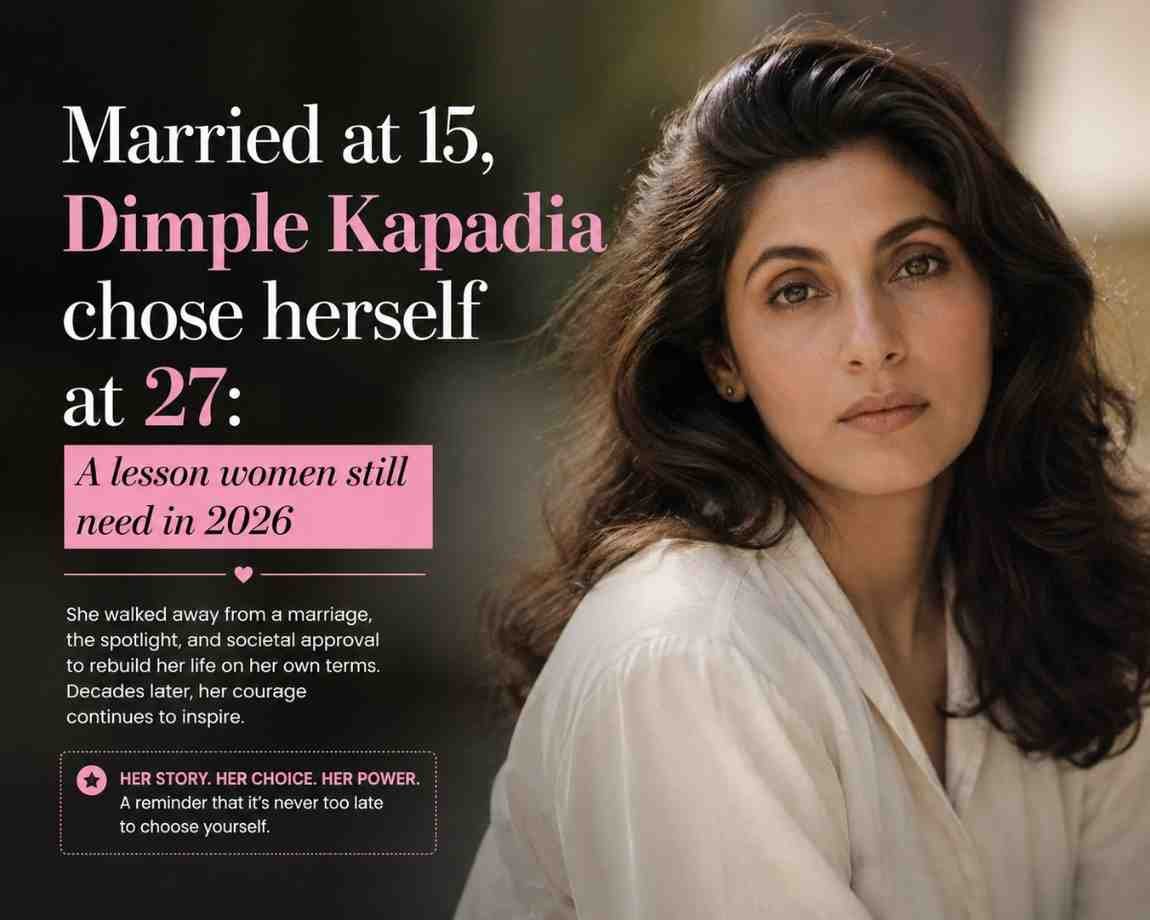
Few stories in Indian Cinema have aged as meaningfully as that of Dimple Kapadia. While she is widely remembered for her stunning debut in Bobby and her status as one of Bollywood’s most celebrated actresses, her real-life journey offers lessons that extend far beyond the silver screen.
In an era when women were expected to prioritise marriage above personal ambitions, Dimple Kapadia chose a different path. Married as a teenager, she stepped away from a promising career, embraced family life, faced personal challenges, and eventually rebuilt her identity on her own terms. More than four decades later, her story remains deeply relevant because it speaks to a universal struggle: the search for selfhood in a world that often defines women through their relationships.
As India continues discussing issues such as emotional well-being, unhealthy marriages, gender expectations, and women’s empowerment, Dimple Kapadia’s life offers an important reminder that personal happiness and self-respect are not luxuries. They are essential components of a meaningful life.
The Fairytale Beginning That Captivated India
When Dimple Kapadia burst onto the Bollywood scene in 1973 with Bobby, she instantly became a national sensation. Her natural charisma, youthful energy, and screen presence made her one of the most talked-about new stars in Indian cinema.
For many aspiring actors, such success would mark the beginning of a long and thriving career. However, Dimple’s life took an unexpected turn when she married Rajesh Khanna, India’s first superstar and one of the biggest cultural icons of the era.
The marriage fascinated the nation. Rajesh Khanna was at the peak of his fame, adored by millions and regarded as an unmatched phenomenon in Indian Entertainment. To the public, the union appeared to be a dream come true a cinematic romance brought to life.
Yet history repeatedly shows that public perception often differs dramatically from private reality.
Behind the glamour, Dimple was still a teenager navigating adulthood, marriage, fame, and motherhood simultaneously. While the world admired the fairytale, she was facing challenges that many young people would struggle to understand, LeT alone manage.
The Reality of Growing Up Too Fast
One of the most overlooked aspects of Dimple Kapadia’s story is her age. At a stage when most teenagers are discovering their interests, building friendships, and shaping their future identities, she entered one of life’s most demanding institutions: marriage.
Modern psychology consistently demonstrates that emotional maturity continues developing well into a person’s twenties. Decisions made during adolescence are often influenced by idealism, emotion, and limited life experience.
Dimple herself later acknowledged that she entered marriage with youthful expectations shaped by cinema, romance, and imagination. Like many young people, she believed life would mirror the stories she had grown up watching.
Reality proved more complicated.
Years later, she openly reflected on the difficulties she experienced, describing the period as traumatic. That honesty resonated because it highlighted a truth many people recognise but rarely discuss: dreams can evolve, expectations can change, and Personal Growth can alter how we view major life decisions.
Her experience speaks to a broader human reality. The person someone is at 15 is rarely the same person they become at 25 or 35.
Why Her Separation Was Considered Revolutionary
Today, discussions about divorce, separation, emotional health, and personal boundaries are far more common than they were decades ago. Social Media, support networks, and evolving cultural attitudes have made these topics more visible and less stigmatised.
In the early 1980s, however, the social landscape was very different.
Women who left marriages often faced severe judgment. They were frequently blamed for relationship failures regardless of the circumstances. Economic opportunities for women were more limited, and societal expectations strongly favoured preserving appearances over pursuing personal fulfilment.
Against this backdrop, Dimple Kapadia’s decision to walk away was remarkably courageous.
Her choice challenged several deeply rooted assumptions:
- That women should remain in unhappy marriages regardless of personal consequences.
- That motherhood should prevent women from rebuilding their lives.
- That public opinion should dictate private decisions.
- That a woman’s identity should revolve entirely around her marital status.
These issues remain relevant today because countless women still face pressure to prioritise social acceptance over personal well-being.
How Indian Society Has Changed Since Then
India in 2026 is very different from India in the early 1980s. Educational opportunities for women have expanded significantly. Female entrepreneurship is rising. Women occupy leadership positions in business, politics, science, sports, and entertainment.
Conversations about Mental health, emotional abuse, relationship dynamics, and gender equality are more visible than ever before.
Yet progress does not mean challenges have disappeared.
Many women continue to face expectations related to family honour, social image, and traditional gender roles. While the language may have evolved, the pressure to endure difficult circumstances often remains.
Dimple Kapadia’s story continues to resonate because it represents an alternative narrative one where personal growth, self-respect, and independence are treated as legitimate priorities rather than acts of rebellion.
| Social Reality in the 1980s | Social Reality in 2026 |
|---|---|
| Divorce carried significant stigma | Greater acceptance, though challenges remain |
| Limited support systems for women | Access to counseling, support groups, and digital communities |
| Fewer career opportunities after separation | Expanded professional opportunities across sectors |
| Marriage often defined identity | Increasing emphasis on individual identity and achievement |
| Mental health rarely discussed publicly | Mental well-being is part of mainstream conversation |
The Art of Reinvention: Dimple Kapadia’s Greatest Achievement
What makes Dimple Kapadia’s story extraordinary is not merely that she left a difficult chapter behind. It is what she did next.
Many people spend years allowing past disappointments to define their future. Reinvention requires a different mindset. It demands confidence, resilience, and the willingness to embrace uncertainty.
At 27, Dimple returned to the Film Industry she had left years earlier. She was no longer the teenage sensation audiences remembered. She returned as a mature woman determined to create a new chapter.
Her comeback was not simply a professional achievement. It represented something much deeper the reclamation of identity.
She proved that success does not always follow a straight line. Careers can pause and restart. Lives can change direction. New beginnings can emerge from unexpected circumstances.
Today, career experts often discuss concepts such as reinvention, second careers, and lifelong growth. Dimple Kapadia embodied those ideas decades before they became popular topics.
Financial Independence and the Power of Choice
One of the most important lessons from Dimple Kapadia’s journey involves the connection between independence and opportunity.
Financial independence does not guarantee happiness, but it creates options. Emotional independence provides the confidence to act on those options.
Together, they form the foundation of personal agency.
Women with economic independence are often better positioned to make decisions based on values rather than fear. They can pursue opportunities, leave unhealthy situations, and build lives aligned with their goals.
Dimple’s return to acting was therefore more than a professional comeback. It was a demonstration of how economic participation can support personal freedom and self-determination.
This lesson remains particularly relevant in 2026 as more women seek financial literacy, entrepreneurship opportunities, and career growth as pathways to greater autonomy.
The Example She Set for Future Generations
The influence of personal choices often extends beyond the individual making them.
Dimple Kapadia’s daughters grew up witnessing a woman who refused to allow adversity to define her future. Instead of accepting limitations, she rebuilt her life through discipline, hard work, and determination.
Twinkle Khanna has spoken about observing her mother’s work ethic and resilience. Those experiences became part of a broader legacy that extends far beyond cinema.
Children learn powerful lessons from the examples set by their parents. Seeing someone overcome challenges teaches confidence, adaptability, and self-belief in ways that words alone cannot.
In that sense, Dimple’s legacy is not only professional but generational.
Why Her Story Resonates With Women Today
Despite advances in Education, employment, and social awareness, many women still grapple with questions that Dimple Kapadia faced decades ago:
- How much should someone sacrifice to meet societal expectations?
- Can personal happiness coexist with family responsibilities?
- Is it acceptable to choose oneself without being labelled selfish?
- How does someone rebuild after a major life change?
Her story offers a compelling answer: personal growth and self-respect are not acts of selfishness. They are essential components of a healthy and fulfilling life.
The most enduring aspect of her journey is not the separation itself. It is the belief that life can be rebuilt, identity can be reclaimed, and happiness can be pursued regardless of age or circumstance.
The Broader Lesson About Courage
Courage is often misunderstood. Popular culture tends to associate bravery with dramatic gestures and extraordinary achievements.
In reality, courage frequently appears in quieter forms.
Sometimes courage means admitting that a situation is no longer working. Sometimes it means pursuing change despite uncertainty. Sometimes it means starting over when others expect you to remain where you are.
Dimple Kapadia’s journey demonstrates that courage is not always about fighting external battles. Often, it involves confronting internal fears, challenging societal expectations, and choosing authenticity over approval.
Conclusion: A Story That Transcends Bollywood
Dimple Kapadia’s life story is far more than a chapter in Bollywood history. It is a case study in resilience, reinvention, and personal empowerment.
Married young, faced with immense expectations, and navigating the pressures of fame and family, she made a decision that was controversial in its time but increasingly understandable through a modern lens. More importantly, she transformed that decision into an opportunity for growth rather than allowing it to become a source of limitation.
Her journey remains relevant because it addresses timeless human questions about identity, happiness, and self-worth. It reminds us that personal fulfilment is not something reserved for a fortunate few. It is something worth pursuing, even when the path is difficult.
As conversations about women’s rights, emotional well-being, and independence continue evolving in 2026, Dimple Kapadia’s story stands as a powerful reminder that reinvention is always possible. The courage to choose oneself, rebuild, and move forward may be one of the most transformative decisions a person can make.
More than forty years later, that lesson remains as powerful as ever.
For breaking news and live news updates, like us on Facebook or follow us on Twitter and Instagram. Read more on Latest Entertainment on thefoxdaily.com.






COMMENTS 0