Yash’s 10-Headed Ravana Brooch Steals the Spotlight at Ramayana LA Premiere
Yash’s 10-Headed Ravana Brooch Steals the Spotlight at Ramayana’s LA Premiere
Yash combines contemporary menswear with imagery from Indian mythology at the Los Angeles premiere of Ramayana: Rise of a Legend, while Ranbir Kapoor and Sai Pallavi take contrasting approaches to red-carpet style.
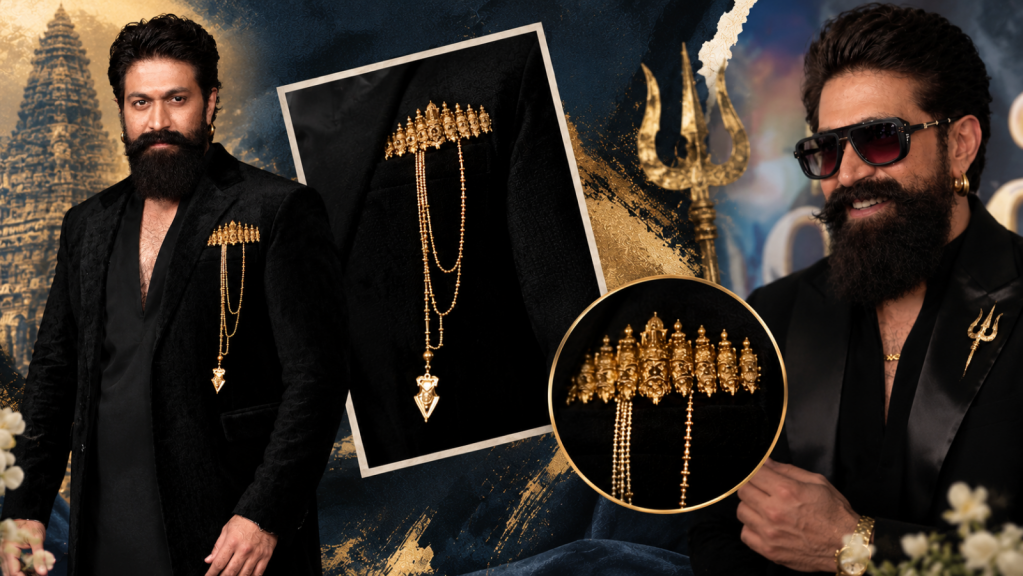
Actor Yash made a striking fashion statement at the Los Angeles premiere of Ramayana: Rise of a Legend, turning a carefully chosen accessory into the defining feature of his red-carpet appearance. The Kannada star, who plays Ravana in director Nitesh Tiwari’s upcoming mythological epic, arrived in an all-black ensemble featuring an elaborate gold brooch depicting the legendary king’s ten heads.
Held on October 27, 2026, at the David Geffen Theatre inside the Academy Museum of Motion Pictures in Los Angeles, the premiere brought together Yash, Ranbir Kapoor, Sai Pallavi, director Nitesh Tiwari and producer Namit Malhotra ahead of the film’s theatrical release. The event placed an Indian epic at the centre of an international promotional showcase, with the lead actors presenting different interpretations of red-carpet dressing.
Yash’s outfit stood out because of its deliberate contrast between simplicity and detail. His black jacket and dark sunglasses created an understated base, while the gold ornament drew attention to the character he is preparing to portray on screen. Rather than relying on an elaborate outfit, the actor used a single, distinctive accessory to connect his personal appearance with the mythology behind the film.
The brooch also offered a conversation starter beyond conventional Celebrity Fashion. Its ten-headed design references Ravana, one of the most recognisable figures in the Ramayana, making the accessory both a styling choice and a visual nod to the story. At an event promoting a film rooted in Indian mythology, that connection gave Yash’s appearance an identity of its own.
Inside Yash’s all-black outfit and gold Ravana brooch
Yash’s look was built around a sharply tailored black outfit that allowed the gold brooch to take centre stage. Pinned to his jacket, the ornament featured intricate detailing, with delicate gold chains hanging beneath the central design. Black sunglasses completed the appearance, reinforcing its contemporary, understated character.
The contrast was central to the look’s impact. Black provided a restrained background, while the metallic accessory introduced texture, movement and visual interest. The dangling chains added another dimension to the design, ensuring that the brooch looked more elaborate than a conventional lapel pin.
The accessory depicted Ravana’s ten-headed form, commonly associated with the name Dashamukha. In the epic tradition, Ravana is the powerful ruler of Lanka and the principal antagonist in the narrative of Rama’s search for Sita. His multiple heads have become one of the most recognisable visual representations of the character in Indian art, performance and popular culture.
According to reporting on the premiere, Indian jewellery brand House of Amrapali created the bespoke brooch for Yash’s appearance. Its detailed construction and mythological subject made it a distinctive piece rather than a generic gold accessory.
The choice also reflects a broader approach to celebrity styling in which clothing and jewellery can communicate something about a project before an actor discusses it. A character-inspired accessory provides an immediate visual reference, particularly when the character has an established identity in cultural memory.
For Yash, the brooch offered a way to acknowledge Ravana without dressing entirely in costume. His outfit remained recognisably modern, appropriate for an international film premiere, while the ornament introduced an unmistakable connection to the role.
Why Ravana’s ten heads make the brooch more than a fashion accessory
Ravana’s ten heads are among the most familiar images associated with the Ramayana. They appear in religious storytelling, theatrical productions, illustrations, sculptures and the elaborate effigies burned during many Dussehra celebrations. The image is so widely recognised that it can identify the character even without additional costume details.
However, the symbolism of Ravana’s ten heads is not limited to one universally accepted explanation. Different interpretations associate them with his immense knowledge, intellectual abilities, powerful personality and complex character. Some explanations connect the ten heads with mastery of the four Vedas and six Vedangas, while other popular interpretations use them to represent human emotions and qualities.
These interpretations help explain why the ten-headed motif remains visually powerful. Ravana is not simply presented as a formidable ruler; traditional accounts also portray him as a learned figure with extraordinary abilities. His intelligence, devotion to Shiva, ambition and pride all contribute to the complexity of his place in the epic.
At the same time, Ravana’s role in the story is shaped by his actions and his conflict with Rama. His power and knowledge do not prevent his downfall. The character therefore carries several layers of meaning, and the ten-headed image has become a compact way of representing his larger-than-life identity.
Yash’s brooch draws on that established imagery. It does not require viewers to know the details of the film’s plot to recognise the reference. Anyone familiar with popular representations of Ravana can immediately understand the connection between the accessory and the actor’s role.
This is one reason character-inspired fashion can be particularly effective at premieres of mythological films. A contemporary outfit can remain appropriate for the occasion while a carefully selected symbol connects the wearer to the cultural material being adapted for the screen.
The brooch also gives the styling a degree of narrative depth. Instead of treating the accessory as decoration alone, viewers can read it as a reference to the character’s identity, mythology and place in the story. That interpretation does not establish the actor’s personal views about Ravana, but it helps explain why the design attracted attention.
Gold, black and the visual identity of Ravana
The colours in Yash’s outfit reinforce the connection between the accessory and the character. Gold is closely associated with traditional depictions of Lanka, Ravana’s kingdom, which is frequently described in popular retellings as a city of extraordinary wealth and splendour. Black, meanwhile, is often used in theatrical and popular portrayals of powerful or imposing characters, including Ravana in some Ramleela productions.
These associations should not be treated as fixed rules for representing the character. The Ramayana has been retold across regions, languages, artistic traditions and performance styles, each of which may approach its characters differently. Costume colours and visual details can therefore vary considerably.
Nevertheless, the combination of black clothing and gold ornament creates a clear visual effect. The dark outfit gives the brooch prominence, while the gold detail recalls the grandeur commonly associated with Lanka and its ruler.
The approach is also practical from a fashion perspective. An all-black ensemble creates continuity, allowing the eye to move naturally towards the accessory. If the outfit had included several competing patterns, colours or decorative elements, the ten-headed motif might have lost some of its impact.
Yash’s appearance demonstrates how a single symbolic element can provide a look with a recognisable theme. The actor did not need a literal representation of Ravana’s full costume to establish the connection. The brooch carried the reference while the rest of the outfit maintained a modern silhouette.
That balance between symbolism and restraint is particularly relevant at an international premiere. The styling remains accessible to viewers who see it primarily as fashion, while those familiar with the epic can recognise the cultural reference behind it.
Yash’s trishul brooch at San Diego Comic-Con
The Ravana brooch was not the first time Yash incorporated mythological imagery into his promotional wardrobe. At San Diego Comic-Con in July 2026, the actor appeared in an all-black outfit featuring a gold trishul-shaped brooch pinned to his blazer.
The trishul, or trident, is one of the most recognisable symbols associated with Lord Shiva. Its presence carried a connection to Ravana, who is traditionally portrayed as a devoted worshipper of Shiva in several versions of the Ramayana narrative.
That earlier appearance established a styling approach similar to the one seen in Los Angeles: a contemporary black outfit paired with a gold accessory that references Indian mythology. The two brooches use different symbols, but both connect Yash’s public appearances with the character he plays in the film.
The difference lies in the specificity of the imagery. The trishul refers to Shiva and, indirectly, to Ravana’s devotional associations. The ten-headed brooch represents Ravana himself, making the reference more immediate for audiences familiar with the epic.
The progression from one accessory to the other also illustrates how promotional fashion can develop a visual theme across separate appearances. Rather than presenting unrelated outfits, a performer can use recurring design choices to reinforce the identity of a project.
In Yash’s case, the repeated use of black and gold provides a degree of continuity. The clothing remains modern and restrained, while the jewellery supplies the mythological detail. This approach allows the actor to participate in fashion-led promotional events without abandoning the cultural identity of the film.
It is not necessary to assume that every styling decision was made by Yash personally. Celebrity red-carpet appearances typically involve collaboration between performers and styling teams. What can be observed is the consistency of the visual approach and the way the accessories relate to his role.
Ranbir Kapoor’s look: A classic approach to playing Lord Rama
Yash was not the only actor to draw attention at the Los Angeles premiere. Ranbir Kapoor, who plays Lord Rama, chose a light-toned, bandhgala-style outfit with silver detailing and dark trousers.
His look relied on tailoring and a restrained colour palette rather than a single oversized statement accessory. The bandhgala silhouette brought a formal Indian menswear element to the international red carpet, while the lighter fabric and silver embellishments gave the outfit visual texture.
The choice offered a different interpretation of how an actor can connect a premiere appearance with a mythological project. Instead of using a recognisable symbol to reference his character directly, Ranbir’s outfit drew on the formal language of Indian clothing.
The contrast with Yash was clear. Both actors wore carefully coordinated outfits, but their styling approaches served different visual purposes. Ranbir’s look emphasised classic tailoring, while Yash’s all-black ensemble created a dramatic background for the gold Ravana brooch.
Neither approach needs to be understood as more authentic than the other. A red-carpet outfit is not the same as a film costume, and the actors were attending an international promotional event rather than appearing in character. Their clothing offered individual interpretations of the occasion, not definitive representations of Rama or Ravana.
For viewers following the film’s development, the contrasting looks also reinforced the distinct identities of the two central characters. The visual references were subtle, but they gave the premiere an additional point of interest beyond the cast’s appearance together.
Sai Pallavi brings traditional elegance to the Ramayana premiere
Sai Pallavi, who plays Sita, chose a traditional saree featuring silver embellishments. She paired the outfit with jewellery and minimal makeup, creating a look that placed the garment itself at the centre of her appearance.
Her styling offered another perspective on Indian red-carpet fashion. While some celebrity outfits rely on dramatic silhouettes, elaborate accessories or contemporary tailoring, a saree can make a statement through its drape, fabric, embellishments and craftsmanship.
The silver details added texture without overwhelming the overall appearance. The jewellery complemented the outfit, while the restrained makeup kept the focus on the traditional ensemble.
Sai’s choice also brought Indian clothing into an international setting without requiring a heavily constructed or unconventional silhouette. The result was a look that remained rooted in traditional dressing while fitting the formal atmosphere of a major film premiere.
Her appearance complemented the different fashion approaches seen among the lead actors. Ranbir opted for a tailored bandhgala-inspired look, Yash used a character-specific gold brooch against black clothing, and Sai relied on traditional Indian wear and understated styling.
Together, the three appearances demonstrated that a shared film promotion does not require a uniform fashion strategy. Each actor could interpret the occasion differently while remaining part of the same cinematic project.
Why the Ramayana LA premiere matters beyond red-carpet fashion
The Los Angeles premiere took place ahead of the film’s scheduled theatrical release on November 5, 2026. It brought the principal cast and creative team together at the Academy Museum of Motion Pictures, providing an international platform for the upcoming adaptation of the Indian epic.
A premiere of this kind serves several purposes. It introduces a film to invited audiences, creates opportunities for cast and filmmaker interviews, and generates photographs and videos that can reach viewers far beyond the venue. Red-carpet appearances become part of the wider conversation surrounding a film before its general release.
For a story as widely known as the Ramayana, the challenge is not simply introducing the characters. It is presenting a new cinematic interpretation of a narrative that audiences may already know through religious texts, regional retellings, television adaptations, theatre and family storytelling.
The actors’ appearances can contribute to that introduction by giving the project a recognisable public identity. Yash’s Ravana brooch is a particularly clear example because it uses an established cultural symbol to connect the actor with his role without revealing anything about the film’s plot.
At the same time, red-carpet attention should not be confused with evidence of a film’s eventual performance. A memorable accessory or widely shared photograph can increase visibility, but it does not establish how audiences will respond to the finished film, how critics will assess it or how successful it will be commercially.
The more meaningful test will come when viewers can evaluate the film itself, including its performances, visual storytelling, treatment of the epic and interpretation of its characters. Until then, the premiere offers an early glimpse of the presentation surrounding the project rather than a verdict on its artistic achievement.
What makes Yash’s Ravana brooch stand out?
The brooch stands out because it combines recognisable mythology with contemporary fashion. Its ten-headed design immediately references Ravana, while the gold finish and dangling chains give the accessory a distinctive visual presence. The all-black outfit ensures that the ornament remains the focal point.
It also connects Yash’s appearance to a character who occupies a central place in the film’s identity. The accessory is specific enough to be meaningful to audiences familiar with the epic, yet it remains an ornament that fits naturally into formal menswear.
There is a broader lesson in the styling choice: an outfit does not always need multiple dramatic elements to make an impression. A carefully selected accessory can establish a theme, communicate a reference and give an otherwise restrained look a memorable focal point.
Yash’s earlier trishul brooch at San Diego Comic-Con suggests continuity in the way his promotional appearances have incorporated mythological symbols. The Los Angeles look builds on that approach with a design that directly represents Ravana, the character he plays in Ramayana: Rise of a Legend.
Meanwhile, Ranbir Kapoor’s tailored outfit and Sai Pallavi’s traditional saree showed how the film’s lead cast could take different routes to the same red carpet. Their choices made the premiere a showcase not only for the upcoming film but also for the variety of ways Indian clothing, jewellery and cultural references can be presented internationally.
Ultimately, Yash’s ten-headed Ravana brooch became the defining detail of his appearance because it did more than complement his jacket. It connected fashion with mythology, gave viewers an immediate reference to his character and demonstrated how a small design element can carry a larger story.
With the film scheduled to reach theatres on November 5, the Los Angeles premiere has offered audiences an early look at the cast and the visual identity surrounding the project. For Yash, the gold brooch ensured that his red-carpet appearance had a clear signature: modern in silhouette, rooted in Indian mythology and unmistakably associated with Ravana.
For breaking news and live news updates, like us on Facebook or follow us on Twitter and Instagram. Read more on Latest Lifestyle on thefoxdaily.com.






COMMENTS 0