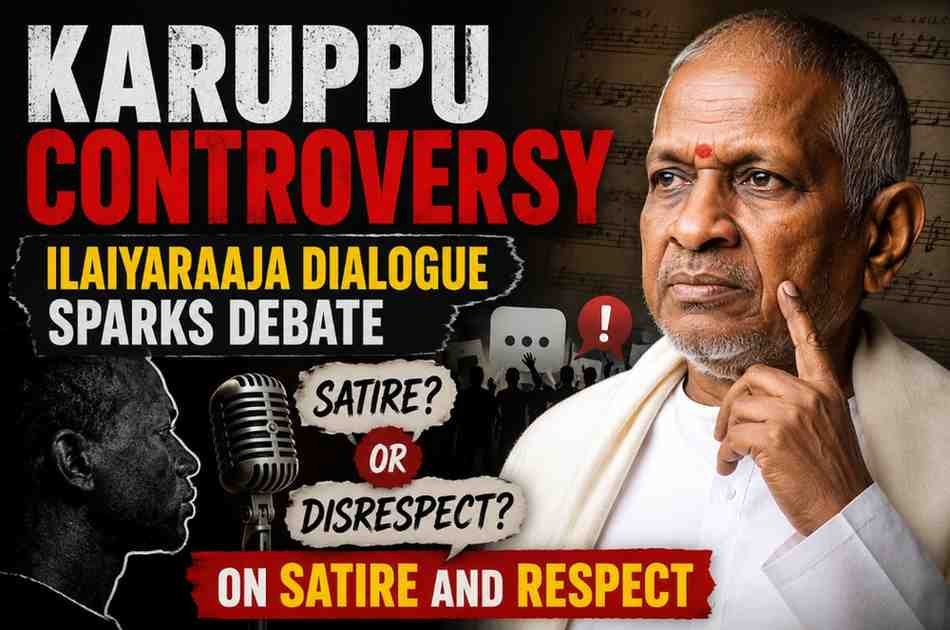
What happens when cinema, satire, and legacy collide? That question came into sharp focus following the release of ‘Karuppu’, the Suriya-starrer directed by RJ Balaji. Who is at the center of the controversy? Legendary composer Ilaiyaraaja and the makers of the film. What triggered it? A dialogue referencing the composer’s well-known stance on unauthorized use of his music. When did this unfold? Just days after the film’s release on May 15, 2026. Where? Across social media platforms and the Tamil film industry. Why does it matter? Because it raises important questions about artistic expression, satire, and respect for cultural icons. How did the makers respond? By agreeing to remove or modify the dialogue, emphasizing that no disrespect was intended.
This incident is more than just a fleeting controversy—it reflects deeper tensions within modern cinema, where creativity often intersects with legacy and public sentiment.
The Context Behind the ‘Karuppu’ Dialogue
‘Karuppu’, featuring Suriya in a powerful lead role, is a film that blends social commentary with commercial storytelling. Directed by RJ Balaji, known for his satirical tone, the movie uses humor and sharp dialogue to address real-world issues.
At the heart of the controversy is a line referencing Ilaiyaraaja’s strict approach toward the unauthorized use and remixing of his compositions. Over the years, the composer has built a reputation for fiercely protecting his intellectual property, often taking legal action when his work is used without permission.
According to the production house, the dialogue was part of a “broader satirical context” not a targeted criticism. However, in today’s hyper connected environment, even contextual humor can quickly be taken out of its intended frame.
Why Ilaiyaraaja’s Legacy Matters So Much
To understand the sensitivity around this issue, one must first understand Ilaiyaraaja’s stature in Indian music.
With a career spanning decades, he is widely regarded as one of the greatest composers in Indian cinema. His work has shaped the soundscape of Tamil films and influenced generations of musicians.
Key aspects of his legacy:
- Pioneering fusion of Western and Indian classical music
- Thousands of songs across multiple languages
- A strong stance on artistic ownership and copyright
Insight: For many fans, Ilaiyaraaja is not just a composer he is a cultural institution. Any reference to him, even in jest, carries emotional weight.
The Rise of Sensitivity in the Social Media Era
In earlier decades, film dialogues often passed without intense scrutiny. Today, however, social media amplifies every line, every joke, and every perceived slight.
What’s changed?
- Instant audience reactions on platforms like X (formerly Twitter)
- Fan communities actively defending public figures
- Viral clips that remove scenes from their full context
This creates a new challenge for filmmakers: balancing creative freedom with audience sensitivity.
Key takeaway: Intent no longer defines impact—audience interpretation does.
Dream Warrior Pictures Responds: Damage Control or Responsibility?
Following the backlash, Dream Warrior Pictures issued a public statement clarifying their position.
Their response included:
- Assurance that there was no intention to disrespect Ilaiyaraaja
- Explanation that the dialogue was satirical, not personal
- A decision to remove or modify the line
This swift response highlights a growing trend in the film industry proactive damage control.
Analysis: While some may view this as a compromise on creative freedom, others see it as a necessary step in maintaining audience trust.
Satire vs. Respect: Where Should Filmmakers Draw the Line?
This controversy raises a broader question: how far can satire go when it involves real people?
Satire has always been a powerful storytelling tool. It challenges authority, questions norms, and reflects society back at itself. But when it references living legends, the boundaries become blurred.
| Aspect | Satire | Respect |
|---|---|---|
| Purpose | Critique and provoke thought | Honor legacy and contribution |
| Risk | Misinterpretation | Over-sensitivity limiting creativity |
| Balance | Context and clarity | Audience awareness |
Insight: The most effective satire doesn’t punch down or alienate it invites reflection without diminishing respect.
A Pattern in Modern Tamil Cinema?
This isn’t the first time a Tamil film has faced backlash over dialogues or references. In recent years, filmmakers have increasingly experimented with meta-humor, pop culture references, and real world commentary.
Emerging trend:
- Films blending fiction with real life figures
- Increased use of self aware humor
- Greater audience engagement and scrutiny
Prediction: As this trend continues, filmmakers may adopt more nuanced writing strategies to avoid unintended controversy.
Real-World Impact: Beyond the Film
While the controversy may seem limited to a single dialogue, its implications are broader.
For filmmakers:
- Greater caution in referencing public figures
- Increased importance of context in storytelling
For audiences:
- More active role in shaping film narratives
- Growing influence over creative decisions
For the industry:
- A shift toward accountability and responsiveness
- Ongoing debate about artistic freedom
The Bigger Question: Who Owns Cultural Narratives?
At its core, this controversy touches on a deeper issue—ownership of cultural narratives.
Can filmmakers freely reference icons who have shaped culture? Or do those icons, and their audiences, have a say in how they are portrayed?
Analysis: The answer likely lies somewhere in between. Art thrives on freedom, but it also exists within a cultural ecosystem that demands sensitivity.
Conclusion: A Teachable Moment for Cinema
The ‘Karuppu’ dialogue controversy is not just about a single line it’s about the evolving relationship between creators, audiences, and cultural icons.
Dream Warrior Pictures’ decision to modify the dialogue reflects a broader shift in the industry: one where listening to audiences is as important as telling stories.
Final thought: As cinema continues to evolve, the challenge will not be avoiding controversy altogether—but navigating it thoughtfully. Because in the end, the most powerful stories are not just heard they are understood.
Future outlook: Expect filmmakers to become more intentional with satire, more precise with language, and more aware of the cultural weight behind every word.
For breaking news and live news updates, like us on Facebook or follow us on Twitter and Instagram. Read more on Latest Entertainment on thefoxdaily.com.






COMMENTS 0