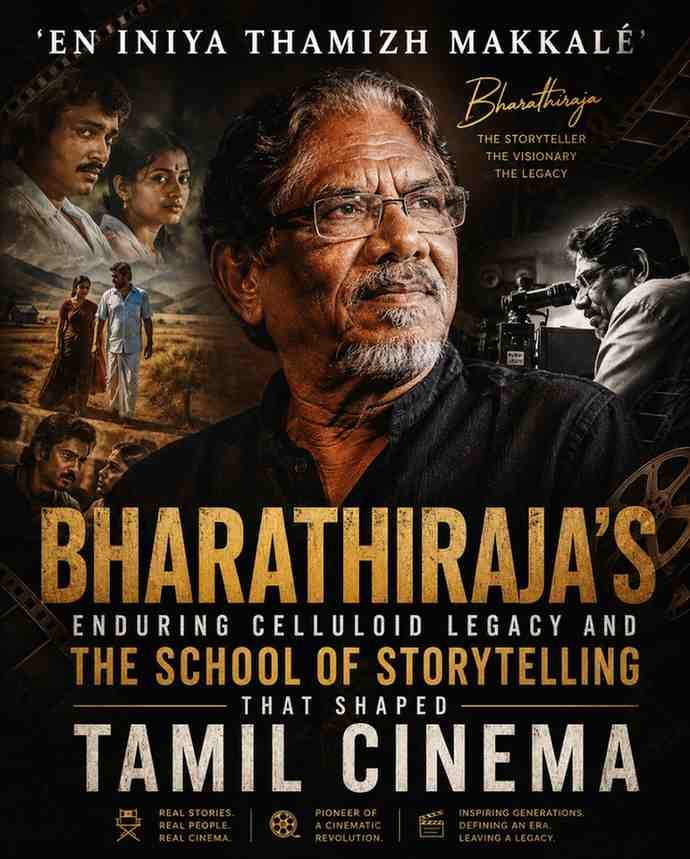
Few filmmakers have altered the identity of an industry as profoundly as Bharathiraja. Revered as the “son of the soil,” the director revolutionized Tamil Cinema by taking stories out of studio sets and placing them amid villages, farms, dusty roads, and the emotional realities of ordinary people. But his greatest contribution may not be confined to the films he directed. Instead, it lives on in the filmmakers he nurtured and inspired.
His famous salutation, “En Iniya Thamizh Makkale” (“My beloved Tamil people”), was more than an introduction. It reflected a philosophy that cinema belonged to the people, and that stories rooted in local culture and authentic emotions could resonate universally.
From K. Bhagyaraj and R. Parthiban to Pandiarajan and countless others, generations of directors emerged from what many call the “Bharathiraja school of thought.” Yet the remarkable aspect of his mentorship was that he never encouraged imitation. Instead, he inspired individuality.
Before Bharathiraja, Tamil Cinema Looked Very Different
To understand Bharathiraja’s significance, it is important to appreciate the cinematic landscape he entered. Tamil cinema in earlier decades was heavily influenced by theatrical traditions. Films were often shot inside studios, with elaborate sets and dramatic performances.
Rural life existed in cinema, but frequently as a backdrop rather than as the emotional center of stories.
Bharathiraja changed that perception entirely.
He brought realism and visual freshness into filmmaking. Villages were no longer settings they became characters in themselves. Dialects, customs, landscapes, and relationships were portrayed with an authenticity that audiences instantly connected with.
For many viewers, his films felt less like entertainment and more like reflections of lived experiences.
The Director Who Took Cinema Outdoors
One of Bharathiraja’s biggest innovations was his extensive use of real locations. Instead of relying on artificial environments, he embraced the natural beauty of Tamil Nadu.
His films celebrated:
- Village landscapes and everyday life.
- Strong emotional storytelling.
- Complex characters with relatable struggles.
- Regional dialects and cultural identity.
- Human relationships over spectacle.
- Music that complemented storytelling.
This approach transformed audience expectations and influenced filmmakers far beyond Tamil cinema.
The Rise of the Bharathiraja School of Thought
Unlike conventional mentors who expect their protégés to follow established formulas, Bharathiraja believed that every storyteller should discover their own voice.
His assistants were encouraged to observe life closely, understand human emotions, and create narratives rooted in authenticity.
As a result, those who worked under him did not emerge as replicas of their mentor. They evolved into filmmakers with entirely different styles.
That creative freedom became the defining characteristic of the Bharathiraja school of thought.
K. Bhagyaraj: Master of Everyday Stories
K. Bhagyaraj perhaps represents one of the most successful examples of Bharathiraja’s philosophy.
While Bharathiraja focused heavily on rural realism, Bhagyaraj developed his own identity through witty screenplays, middle-class narratives, and humor-driven storytelling.
His films captured everyday struggles with remarkable simplicity and emotional intelligence.
Rather than being remembered merely as Bharathiraja’s assistant, Bhagyaraj established himself as one of Tamil cinema’s most respected writer-directors.
That independence itself reflected the values instilled by his mentor.
R. Parthiban: The Fearless Experimenter
R. Parthiban emerged from the Bharathiraja camp with a style that was strikingly unconventional.
Known for his willingness to experiment with form and narrative, Parthiban challenged traditional filmmaking structures.
His films often pushed artistic boundaries while retaining a strong emotional core.
Although his cinematic language differed significantly from Bharathiraja’s, the commitment to originality remained a shared trait.
Parthiban’s career demonstrates that the Bharathiraja school was less about methods and more about mindset.
Pandiarajan and the Beauty of Simplicity
Pandiarajan carved a niche through relatable humor and stories centered around ordinary people.
His films embraced simplicity and warmth, proving that entertainment need not rely on grandeur.
Like Bhagyaraj and Parthiban, Pandiarajan showcased how Bharathiraja’s mentorship empowered filmmakers to pursue their own creative identities.
That diversity became one of Bharathiraja’s greatest achievements.
Comparison: A Mentor Who Created Filmmakers, Not Followers
| Traditional Mentorship | Bharathiraja’s Approach |
|---|---|
| Encourages imitation | Encourages individuality |
| Fixed style and formulas | Creative freedom |
| Hierarchy-based learning | Collaborative learning |
| Focus on technical execution | Focus on emotional truth |
| Produces assistants | Produces storytellers |
This difference explains why Bharathiraja’s influence remains visible across generations.
His Legacy Is Bigger Than His Filmography
Most filmmakers are remembered for the films they direct. Bharathiraja’s legacy extends beyond that.
He created a creative ecosystem that encouraged innovation. His assistants became directors, writers, actors, and visionaries who carried forward the spirit of authenticity while developing their own cinematic identities.
Few artists leave behind both masterpieces and generations of talent.
Bharathiraja accomplished both.
How He Preserved Tamil Identity Through Cinema
At a time when urban themes often dominated mainstream narratives, Bharathiraja highlighted the beauty and complexity of rural Tamil life.
His films preserved:
- Regional dialects.
- Traditional customs.
- Village culture.
- Social realities.
- Human emotions rooted in everyday experiences.
Many of his works now serve as cultural archives, documenting ways of life that have changed dramatically over the decades.
An Insight Often Overlooked: Bharathiraja’s Greatest Film Was a Generation of Filmmakers
When discussing Bharathiraja, attention often centers on iconic movies and memorable scenes. But perhaps his most extraordinary creation was not a film at all.
It was a generation of storytellers.
By giving young talents confidence rather than control, he created an environment where originality thrived. The success of Bhagyaraj, Parthiban, and Pandiarajan stands as proof that great mentors are not measured by how many followers they create, but by how many independent voices they help discover.
In an industry where imitation is often rewarded, Bharathiraja chose a different path.
He taught filmmakers to trust themselves.
Why His Influence Will Continue Into the Future
The tools of filmmaking may change with digital technology, streaming platforms, and artificial intelligence, but the principles that defined Bharathiraja’s cinema remain timeless.
- Authenticity matters.
- Human emotions are universal.
- Local stories can achieve global appeal.
- Originality outlives trends.
- Mentorship shapes industries.
Future generations may tell stories differently, but the spirit that Bharathiraja championed truth, emotion, and individuality—will continue to inspire filmmakers.
Conclusion
Bharathiraja’s unforgettable celluloid legacy extends far beyond the films he directed. As the “son of the soil,” he transformed Tamil cinema by bringing realism, rural landscapes, and emotional depth to the forefront. More importantly, he nurtured a generation of filmmakers who went on to build remarkable careers while staying true to their own voices.
K. Bhagyaraj, R. Parthiban, and Pandiarajan did not become copies of Bharathiraja. They became themselves, and that may be the greatest tribute to their mentor.
Through his films and through the artists he inspired, Bharathiraja ensured that his greeting, “En iniya Thamizh makkale,” would echo across generations—not merely as a phrase, but as the voice of a filmmaker who belonged to the people and changed Tamil cinema forever.
For breaking news and live news updates, like us on Facebook or follow us on Twitter and Instagram. Read more on Latest Entertainment on thefoxdaily.com.






COMMENTS 0