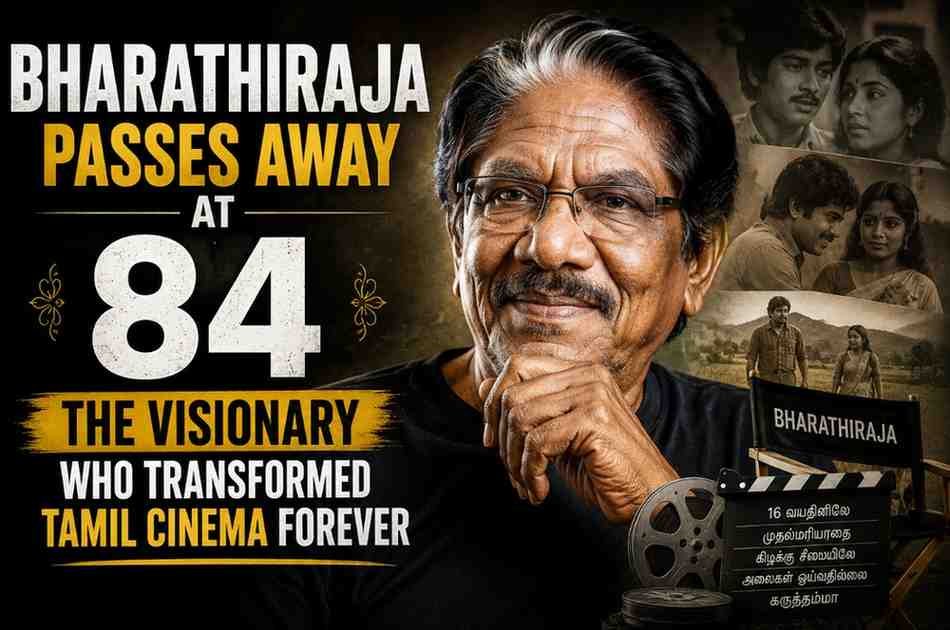
There is a reason Tamil Cinema has two distinct eras before 16 Vayathinile and after it. When a young man from Theni named Chinnasamy Periyamaya Thevar walked onto the sun-scorched fields of a Tamil village with a camera in 1977, he did not just make a film. He rewrote the grammar of an entire industry. That man, who the world came to know as Bharathiraja Iyakkunar Imayam, the Himalaya of directors passed away at his Chennai residence on June 10, 2026, at the age of 84, following age-related complications after months of battling respiratory illness. Tamil Nadu is in mourning. Tamil cinema has lost its most fertile root.
Chief Minister Vijay announced full state honours for the veteran filmmaker, paying tribute to a body of work that spans five decades and dozens of films from the landmark 16 Vayathinile to the emotionally devastating Muthal Mariyathai, from the socially fearless Vedham Pudhithu to the timeless youth romance Alaigal Oivathillai. To call Bharathiraja a filmmaker is accurate but incomplete. He was, in the truest sense of the phrase, a school of thought.
The Man from Theni Who Rewired Tamil Cinema
Born on July 17, 1941, in Theni Allinagaram in Madurai district, Bharathiraja came to filmmaking through apprenticeship a fact that would later define how he trained the next generation. He worked as an assistant director under Kannada filmmaker Puttanna Kanagal and later under P. Pullaiah, M. Krishnan Nair, and A. Jagannathan. He was a student of cinema before he became its teacher.
When he finally made his directorial debut with 16 Vayathinile in 1977, the Tamil film industry was largely a studio-bound enterprise. Most films were shot on sets with painted backdrops, in controlled environments that bore little resemblance to the lives of the majority of Tamil people. Bharathiraja shattered this with a single film. Shot predominantly outdoors the first Tamil film to do so 16 Vayathinile placed its cameras in the actual dust and heat of Tamil village life. It starred a young Kamal Haasan, Rajinikanth, and a luminous Sridevi, and it told a story of rural longing with an honesty that audiences had simply never seen before. The media dismissed it as an experimental film that would fail commercially. It ran for 175 days.
More importantly, it launched careers. Ilaiyaraaja, who composed the music for the film after his mentor G. K. Venkatesh insisted he take the offer, began one of cinema’s most celebrated composer-director partnerships. The film also launched the acting careers of multiple assistant directors who would go on to define the next generation of Tamil cinema.
The Bharathiraja Cinematic Universe: A Filmography of the Soul
Bharathiraja’s greatest films were not action entertainers or glamour showcases. They were deeply human documents of rural Tamil life its loves, its conflicts, its caste wounds, its seasonal rhythms. Each film was a world you could smell and feel.
Ninaithale Inikkum (1979) demonstrated that he could craft urban romance with the same sensitivity he brought to village stories. Alaigal Oivathillai (1981) is perhaps Tamil cinema’s definitive portrayal of adolescent love set in a coastal village, shot with poetic restraint, scored by Ilaiyaraaja with melodies that an entire generation carries in its chest. The film introduced Karthik, who would go on to become one of Tamil cinema’s most distinctive leading men, and established Radha as a major actress. It tackled caste and religious division not through argument but through the simple, devastating fact of two young people in love.
Muthal Mariyathai (1985) is widely regarded as his masterpiece. Sivaji Ganesan the greatest actor Tamil cinema has produced plays a respected village elder in an unfulfilling marriage who forms an unspoken bond with a younger woman played by Radha. The film does not sensationalize the relationship. It watches it with the same quiet attention a poet gives to the first rain on parched earth. The restraint is extraordinary. The emotion is devastating. It remains one of the finest films ever made in the Tamil language.
Vedham Pudhithu (1987) was the work of a filmmaker who was not afraid to make enemies. A searing indictment of the caste system and Brahminical hypocrisy, the film was controversial enough for the Tamil Nadu Brahmins Association to call for its ban. It is still relevant, perhaps more than ever. Kizhakke Pogum Rail, Mann Vasanai, Kadalora Kavithaigal, and Kizhakku Cheemayile each added chapters to the same extended meditation on Tamil rural life — its beauty and its brutality, its tenderness and its injustice.
| Film | Year | Key Significance |
|---|---|---|
| 16 Vayathinile | 1977 | First Tamil film shot predominantly outdoors; launched Ilaiyaraaja, Kamal, Rajinikanth era |
| Ninaithale Inikkum | 1979 | Proved his range beyond rural themes; delicate urban romance |
| Alaigal Oivathillai | 1981 | Definitive Tamil youth romance; launched Karthik and Radha; tackled caste divisions |
| Mann Vasanai | 1983 | Won National Film Award for Best Screenplay; raw rural drama |
| Muthal Mariyathai | 1985 | Widely regarded as his masterpiece; Sivaji Ganesan’s finest late-career performance |
| Vedham Pudhithu | 1987 | Fearless caste commentary; controversial and acclaimed in equal measure |
| Kizhakku Cheemayile | 1993 | Moving sibling drama; National Award winner |
| Karuththamma | 1994 | National Film Award for Best Tamil Film; inter-caste love tragedy |
The Bharathiraja School: A Legacy Measured in Other Directors
The measure of a great teacher is not what they create themselves but what they enable in others. By this measure, Bharathiraja stands alongside K. Balachander as the most generative figure in the history of Tamil cinema a director whose assistants went on to shape the industry in their own distinctive voices.
K. Bhagyaraj is perhaps the most celebrated product of the Bharathiraja school. He worked as an assistant to Bharathiraja before emerging as a director whose films warm, sharply written comedies grounded in recognizable human emotion found a different but equally authentic register to his mentor’s. Bhagyaraj also appeared as an actor in Bharathiraja’s films before becoming a storyteller entirely his own, known for hits that combined humor with genuine emotional depth. He was, in a real sense, Bharathiraja’s most immediate artistic heir.
R. Parthiban brought a theatrical, cerebral sensibility to Tamil cinema that no one else has replicated. He began his career as assistant director under K. Bhagyaraj making him a second-generation product of the Bharathiraja lineage and went on to craft films of extraordinary formal ambition, including the single-take experimental masterwork Oththa Seruppu Size 7. Parthiban’s cinema is stylistically very different from Bharathiraja’s, but the DNA is legible: both share a commitment to telling stories rooted in recognizable humanity, with a fearlessness toward formal experimentation.
Pandiarajan traveled a path from Bhagyaraj’s assistantship to directorial stardom, making films that blended comedy, rural warmth, and genuine emotional intelligence. His debut Aan Paavam (1985) was a massive commercial success, and his films retained the quality that marks all directors from this school: they trusted their audiences with real emotion rather than manufactured sentiment.
The lineage does not end there. Manivannan and Thiyagarajan both first appeared as actors in Bharathiraja’s films before becoming directors themselves. Director Thamira, known for Rettaisuzhi, also came through the Bharathiraja school and cast both his mentors Bharathiraja and K. Balachander in that film as a tribute. The tree Bharathiraja planted in 1977 has branches that reach across four decades of Tamil filmmaking.
Bharathiraja and Ilaiyaraaja: A Partnership for the Ages
No tribute to Bharathiraja is complete without speaking of his most consequential creative partnership: the one with composer Ilaiyaraaja. The two men from Tamil Nadu’s heartland found each other at the beginning of their careers, and their collaboration produced some of the most beloved music in the history of Indian cinema. Ilaiyaraaja’s melodies for 16 Vayathinile, Ninaithale Inikkum, Alaigal Oivathillai, Mann Vasanai, and Muthal Mariyathai are inseparable from the films themselves and inseparable from the emotional memory of multiple generations of Tamil music lovers.
What made the partnership extraordinary was a shared sensibility: both men were rooted in the folk musical traditions of rural Tamil Nadu, both were interested in emotional truth over commercial formula, and both were willing to take creative risks that the mainstream industry of their era was reluctant to sanction. Their best work together did not feel like film music accompanying a narrative it felt like music and narrative breathing as a single organism.
The Second Act: Bharathiraja as Actor
In the latter phase of his career, Bharathiraja remade himself as a powerful character actor. Younger audiences who may never have seen 16 Vayathinile or Alaigal Oivathillai encountered him as the unforgettable grandfather figure in Thiruchitrambalam, or as the fierce villain Manimaran in Rocky. His most celebrated performance as an actor came in Mani Ratnam’s Aaytha Ezhuthu, where his portrayal of Selvanayagam was widely praised as among the finest character acting in recent Tamil cinema history.
The transition from director to actor is one that many filmmakers attempt and few accomplish with real distinction. Bharathiraja managed it because he brought to acting the same quality he brought to direction: absolute authenticity. He did not perform. He inhabited.
A Life Shadowed by Personal Loss
Bharathiraja’s final years were marked by grief that no award or acclaim could soften. His son, actor-director Manoj Bharathiraja, passed away from a cardiac arrest on March 25, 2025, at just 48 years old a devastating blow to a father who had already faced years of health challenges. Manoj had made his directorial debut in 2023 with Margazhi Thingal, starring his father in the lead role, in what would turn out to be both a son’s tribute to his father and one of their last creative collaborations.
Bharathiraja bore these losses as he bore everything with the quiet dignity of a man who had spent his life telling stories about people who endure. He continued to be treated for respiratory illness through early 2026, and passed away at his residence this morning. He is survived by his wife Chandraleela and daughter Janani.
What Tamil Cinema Loses Today
Tamil cinema will continue to make films. New directors will emerge, new storytelling forms will evolve, and new audiences will find their own cinematic languages. But what Bharathiraja represented the conviction that rural Tamil life, in all its unglamorous specificity, was worthy of the full resources of cinema’s artistic attention is not something any industry can simply replace.
He received the Padma Shri in 2004, six National Film Awards, and countless state and industry recognitions. But the most meaningful recognition of his legacy is not any award. It is the fact that when directors like Vetrimaaran, Pa. Ranjith, or Mari Selvaraj make films today that root themselves in the soil of Tamil social reality, they are making films in a tradition that Bharathiraja built. The camera going out of the studio and into the village in 1977 changed what Tamil cinema believed it was permitted to be.
Actress and politician Khushbu Sundar captured the feeling in her tribute: “His films have been benchmarks and shall continue to be the actual school of filmmaking.” Actor Sibi Sathyaraj wrote that Bharathiraja “brought the soul of rural Tamil Nadu to the screen and changed the course of Tamil cinema forever.”
They are not wrong. And they are not using hyperbole.
En Iniya Thamizh Makkale
The phrase En Iniya Thamizh Makkale my beloved Tamil people was more than an address from a filmmaker to his audience. It was a declaration of kinship. Bharathiraja made films about Tamil people and for Tamil people, with a love for the land and its inhabitants that never curdled into sentimentality or condescension. He saw the village not as a backdrop but as a protagonist alive, complex, wounded, and beautiful.
Today, that voice has fallen silent. But the films remain. The school remains. The lineage of directors trained in his shadow remains. And somewhere in the dust and heat of a Tamil village, in the memory of everyone who has ever watched Muthal Mariyathai and felt something loosen in their chest Bharathiraja, Iyakkunar Imayam, the Himalaya of directors, remains.
Om Shanti.
For breaking news and live news updates, like us on Facebook or follow us on Twitter and Instagram. Read more on Latest Entertainment on thefoxdaily.com.






COMMENTS 0