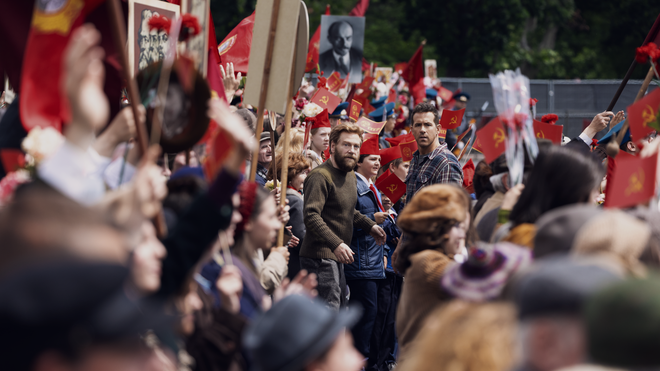
Mayday movie review: Mayday takes a familiar Hollywood recipe—fighter jets, military secrets, international tension and two very different pilots—and gives it an unexpectedly comic personality. Directed by John Francis Daley and Jonathan Goldstein, the film pairs Ryan Reynolds with Kenneth Branagh in a story that uses the visual language of classic aviation movies while sending its characters into a Cold War-flavoured adventure.
At first glance, the combination sounds deliberately strange. Reynolds is associated with fast-talking, self-aware comedy, while Branagh brings the authority and theatrical weight of a veteran dramatic performer. Put them in cockpits, surround them with military hardware and throw them into a geopolitical mystery, and the obvious question becomes: can the movie make these contrasting personalities feel like believable wingmen?
The answer is largely yes. Mayday works best when it stops trying to be another solemn aviation blockbuster and embraces the odd-couple energy at its centre. The action provides the scale, the Cold War setting supplies the mystery, but the relationship between its two leads gives the film its personality.
The result is not a reinvention of the fighter-pilot movie. It is something more modest and, in some ways, more enjoyable: a knowingly old-fashioned adventure that understands that spectacle becomes more entertaining when the people inside the aircraft are worth watching.
What Is Mayday About?
Mayday is built around two pilots whose personalities and approaches to flying could hardly be more different. Their mission places them inside a larger conflict involving military power, secrecy and Cold War-era tensions, turning what initially resembles a straightforward aviation assignment into something considerably more complicated.
The film uses that setup to move between several genres. It is part fighter pilot movie, part action comedy, part espionage adventure and part buddy movie. Rather than committing completely to any one of those identities, Daley and Goldstein allow them to overlap.
That hybrid structure is important because the film is not really selling the audience a complicated geopolitical thesis. Its primary attraction is the collision between two characters who have to operate together despite their differences.
That makes the title itself feel appropriate. A mayday call represents danger, urgency and the possibility that a situation has suddenly gone badly wrong. In this film, that tension becomes both a literal element of the aviation adventure and a useful metaphor for a partnership that is constantly being tested.
Ryan Reynolds and Kenneth Branagh Are the Film’s Secret Weapon
The most obvious reason to watch Mayday is its central pairing.
Ryan Reynolds has spent much of his recent career refining a particular screen persona: quick-witted, sarcastic, charming and capable of turning danger into a punchline. That persona can become predictable when every scene demands another joke, but it becomes more effective when placed against a performer who refuses to play the same game.
Kenneth Branagh provides precisely that contrast.
Branagh’s presence gives the film a different rhythm. His performance carries a sense of seriousness and old-school authority, creating a useful counterweight to Reynolds’ comic timing. Their scenes work because neither performer completely overwhelms the other.
Reynolds brings speed. Branagh brings gravitas. The comedy comes from the collision.
That chemistry also gives the film something many large-scale action movies struggle to establish: a human centre. Fighter jets can be spectacular, but audiences ultimately connect with characters, not machinery. When the relationship between the pilots becomes more compelling, the aerial sequences acquire greater emotional weight.
Why the Top Gun Comparison Makes Sense—and Where Mayday Differs
Any contemporary movie involving fighter aircraft is likely to invite comparisons with Top Gun, particularly when it combines military aviation with charismatic pilots and large-scale action.
But Mayday appears less interested in copying the emotional formula of Top Gun than in borrowing its cultural vocabulary.
Top Gun traditionally places enormous emphasis on individual identity, competition, training and personal redemption. Its cockpit sequences are connected to a broader coming-of-age story. Mayday, by contrast, leans more heavily into the idea of two experienced personalities being thrown together by circumstances larger than themselves.
| Element | Top Gun-style approach | Mayday approach |
|---|---|---|
| Central appeal | Pilot culture and personal ambition | Buddy chemistry and adventure |
| Tone | Drama with blockbuster spectacle | Action mixed with comedy |
| Character dynamic | Competition and mentorship | Opposites forced to cooperate |
| Genre influence | Military aviation drama | Aviation thriller, espionage and buddy comedy |
This distinction matters. The film does not necessarily need to defeat Top Gun on its own terms. It has a better chance of succeeding when it establishes its own identity.
The Cold War Setting Gives the Story More Than Nostalgia
The Cold War is one of Hollywood’s most durable backdrops because it naturally creates uncertainty. Unlike a conventional war story, where opposing sides and battle lines can be relatively clear, Cold War narratives thrive on suspicion, secrecy and conflicting loyalties.
That atmosphere is particularly useful for a movie about pilots.
Aircraft represent technological power, but the Cold War also represented a battle of information. Governments were not simply concerned with defeating an enemy in open combat; they were concerned with intelligence, deterrence, strategic advantage and what the other side might do next.
That gives Mayday an opportunity to make its aviation action feel connected to something larger than simply putting characters in the sky.
The nostalgia also works on another level. The movie can evoke an era when military thrillers often relied on practical spectacle, charismatic stars and straightforward adventure storytelling. Instead of presenting nostalgia as a museum piece, the filmmakers use it as a playground for contemporary performers.
Does the Action Deliver?
The success of an aviation movie ultimately depends on whether its action feels exciting rather than merely expensive.
Mayday understands that aerial sequences need geography and stakes. The audience should know where the pilots are, what they are attempting to accomplish and what could happen if they fail. Without those elements, even impressive aircraft footage can become visual noise.
The film’s strongest action moments benefit from the contrast between technical danger and character-driven humour. A tense situation can become more entertaining when the people inside the cockpit react like recognisable human beings rather than emotionless action heroes.
That is where the Reynolds-Branagh dynamic becomes especially valuable. The aircraft may be moving at extraordinary speeds, but the movie keeps bringing the attention back to the people trying to control the situation.
Where Mayday Struggles
For all its charm, Mayday is not immune to the weaknesses of the genre it embraces.
The biggest challenge is tonal balance. A film that combines Cold War intrigue, aerial action and comedy has to know exactly when to change gears. If the jokes arrive too frequently, the danger loses credibility. If the serious material becomes too dominant, the playful chemistry starts to feel disconnected from the story.
That balancing act can occasionally make the film feel less focused than it could be.
There is also an unavoidable familiarity to the basic ingredients. Audiences have seen military conspiracies, reluctant partnerships and aviation missions many times before. The movie’s originality therefore depends less on its premise than on execution.
This is why the two leads matter so much. When the characters are clicking, familiar material feels fresh. When the plot takes over completely, the formula becomes more visible.
John Francis Daley and Jonathan Goldstein Know How to Mix Genres
The directing partnership of John Francis Daley and Jonathan Goldstein is particularly suited to a movie that wants to move between action and comedy.
Their filmmaking background has demonstrated an interest in genre entertainment that does not take itself too seriously while still respecting the mechanics of the story. That approach is useful here because Mayday needs to feel entertaining without becoming a parody of aviation movies.
The directors’ biggest achievement is therefore tonal rather than purely visual. They recognise that the film’s military setting gives the story scale, while the bromance gives it warmth.
That combination prevents the movie from becoming just another collection of explosions and cockpit shots.
What Makes the Bromance Work?
The buddy-movie structure is hardly new, but there is a reason Hollywood keeps returning to it: conflict between personalities creates instant dramatic energy.
Two characters who agree on everything have little reason to talk. Two characters who disagree about almost everything can generate scenes organically.
In Mayday, the relationship between Reynolds and Branagh functions as the engine that keeps the story moving. Their differences provide comedy, but their cooperation creates the emotional payoff.
The strongest buddy movies eventually move beyond the joke of two incompatible people being stuck together. The characters begin to understand each other. They develop trust. Their differences become complementary rather than simply irritating.
That progression is essential here because the aerial missions demand teamwork. The film can use the mechanics of flying as an extension of its character story: one pilot may possess qualities the other lacks, and survival depends on recognising those strengths.
Mayday’s Biggest Advantage Over Formulaic Action Movies
The most interesting thing about Mayday is that it understands the value of personality.
Modern action cinema often becomes trapped in a race for scale. Bigger aircraft, larger explosions and increasingly elaborate digital environments are treated as automatic improvements. But spectacle without personality has diminishing returns.
Mayday takes the opposite approach. Its most valuable asset is not necessarily the aircraft or the Cold War premise. It is the chemistry between two performers with radically different screen energies.
That is an important lesson for the genre. The next generation of action movies may not need to become bigger to stand out. They may need to become more character-driven.
Who Should Watch Mayday?
Mayday should appeal most strongly to viewers who enjoy aviation action movies, buddy comedies, spy thrillers and nostalgic Hollywood adventures.
Fans looking for a completely serious military drama may find its comic tone less conventional. Likewise, viewers expecting another Top Gun-style character drama should not assume that the film is simply repeating that formula.
Its sweet spot is the audience that wants action with personality.
If the idea of Ryan Reynolds and Kenneth Branagh sharing a cockpit sounds more entertaining than another anonymous CGI-heavy action team, the film has a strong reason to be on the watchlist.
Mayday Movie Review: Final Verdict
Mayday does not attempt to reinvent the aviation thriller. Instead, it takes familiar ingredients and gives them an appealingly unusual combination of Cold War intrigue, fighter-jet spectacle and buddy-comedy energy.
Its greatest strength is the pairing of Ryan Reynolds and Kenneth Branagh. Reynolds supplies the irreverence, Branagh provides the gravitas, and the contrast creates a surprisingly effective partnership. When the film trusts that chemistry, it becomes lively and entertaining.
The movie is less successful when its familiar genre machinery becomes too obvious or when its different tones compete for attention. Nevertheless, its willingness to mix genres gives it an identity beyond simple Top Gun nostalgia.
The bigger takeaway is that Mayday demonstrates why character chemistry remains one of the most valuable tools in action filmmaking. A spectacular aircraft can attract an audience to the cinema, but memorable personalities are what can keep viewers invested once the engines start roaring.
Final verdict: Mayday is a breezy, genre-blending aviation adventure that gets much of its mileage from the unlikely but entertaining chemistry between Ryan Reynolds and Kenneth Branagh. It may not redefine the fighter-pilot movie, but it knows exactly how to have fun with one.
Mayday Movie Review: Frequently Asked Questions
Is Mayday worth watching?
Mayday is worth considering for viewers who enjoy fighter-jet action, Cold War thrillers and buddy-comedy dynamics. Its strongest selling point is the chemistry between Ryan Reynolds and Kenneth Branagh.
Who stars in Mayday?
Ryan Reynolds and Kenneth Branagh lead the film, with their contrasting personalities forming the centre of its action-comedy dynamic.
Is Mayday similar to Top Gun?
Mayday shares Top Gun’s interest in aviation spectacle and charismatic pilots, but it takes a different route by combining the fighter-pilot genre with Cold War intrigue and buddy-comedy elements.
What genre is Mayday?
Mayday blends aviation action, thriller, espionage and comedy. Its central relationship also gives it the structure of a classic buddy movie.
What is the biggest strength of Mayday?
The biggest strength of Mayday is the contrasting screen presence of Ryan Reynolds and Kenneth Branagh. Their chemistry gives the familiar action premise a distinctive personality.
For breaking news and live news updates, like us on Facebook or follow us on Twitter and Instagram. Read more on Latest Entertainment on thefoxdaily.com.

COMMENTS 0