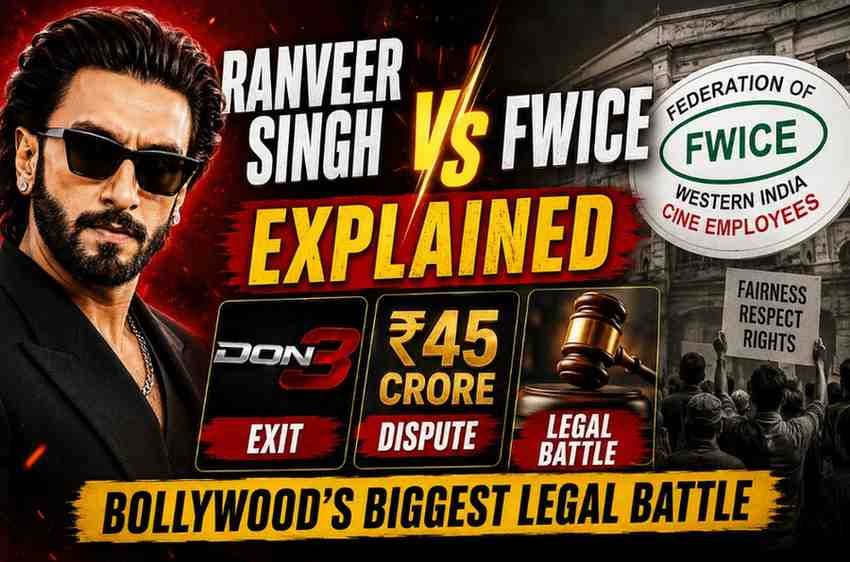
Bollywood rarely does things quietly, but even by its own theatrical standards, the dispute involving Ranveer Singh, FWICE, and the collapsed Don 3 project has taken the industry by storm. On June 3, 2026, reports confirmed that Ranveer Singh has sent a formal legal notice to the Federation of Western India Cine Employees (FWICE) the apex trade body representing over 30 crafts and unions in the Hindi film industry in direct response to the non-cooperation directive the federation issued against him on May 25, 2026. This is not just a celebrity spat. It is a legal and institutional confrontation that could fundamentally reshape how Bollywood handles disputes between stars and production houses and whether trade bodies like FWICE have the legal authority to act as judge, jury, and enforcer all at once.
To fully understand what is happening, where it started, and why it matters well beyond this single film, we need to go back to August 2023.
How It All Began: The Don 3 Announcement and What Followed
In August 2023, Excel Entertainment the production house co founded by filmmaker Farhan Akhtar and producer Ritesh Sidhwani officially announced that Ranveer Singh would headline Don 3, the much-anticipated third installment in one of Bollywood’s most iconic franchise series. The franchise had previously starred Amitabh Bachchan in the 1978 original and Shah Rukh Khan in the 2006 and 2011 reboots. Replacing two of Hindi cinema’s biggest legends was a bold bet, and Singh’s casting was celebrated as a major move for the franchise’s future.
The project was expected to go on floors in 2026, with principal photography originally scheduled to run from January 9 to the end of July 2026. Months of pre-production followed: location scouting, costume trials, action training, script development all of it funded by Excel. On March 25, 2025, the production sent Singh’s management the latest script draft. Between November 3 and 12, 2025, Singh completed a round of action training, the costs of which Excel covered. A costume trial followed on November 27, 2025.
Then, on December 2, 2025 the same day Singh’s blockbuster Dhurandhar opened in cinemas his team notified Excel that he would be unavailable for rehearsals on December 11 and 12. Shortly after, as discussions broke down and communication from Singh’s side reportedly went silent, the news of his exit from Don 3 leaked publicly before either party could agree on a joint statement.
Why Did Ranveer Singh Exit Don 3? The Two Competing Versions
The official story depends entirely on which side of the dispute you ask.
Ranveer Singh’s position is that Don 3 never reached a state of genuine creative readiness. According to his camp, no fully locked script existed even after years of development, key narrative elements remained unresolved, and the project did not match the creative scale and vision that had been presented to him at the time of signing. His team also points out that he did not receive any advance payment and was not compensated for time and opportunities lost on other projects he had declined in anticipation of Don 3.
Excel Entertainment’s position is the polar opposite. Farhan Akhtar has maintained that the script was shared in stages, that Singh had reviewed and approved each draft without raising formal objections, and that the departure came abruptly just weeks before the unit was scheduled to leave for the shoot. By that point, the production had already committed enormous resources to the film’s development.
Farhan Akhtar formally filed a complaint with the Indian Film & Television Directors’ Association (IFTDA) on April 11, 2026. He and Ritesh Sidhwani informed IFTDA and subsequently FWICE that pre-production expenses already incurred amounted to approximately ₹45 crore. That figure became the financial anchor of the entire dispute.
The Complete Timeline of the FWICE Non-Cooperation Directive
| Date | Event |
|---|---|
| August 2023 | Don 3 officially announced with Ranveer Singh in the lead role |
| March 25, 2025 | Excel sends Ranveer’s manager the latest script draft |
| Aug 25, 2025 | Production shares shoot schedule: Jan 9 – July 2026 window |
| Nov 3–12, 2025 | Ranveer completes action training (costs covered by Excel) |
| Nov 27, 2025 | Ranveer attends costume trial |
| Dec 2, 2025 | Dhurandhar releases; Ranveer’s team cancels Dec 11–12 rehearsals |
| December 2025 | Ranveer officially exits Don 3; news leaks publicly |
| April 11, 2026 | Farhan Akhtar files complaint with IFTDA citing ₹45 crore losses |
| April 22, 2026 | FWICE sends First Reminder notice to Ranveer Singh |
| April 30, 2026 | FWICE sends Second Reminder notice |
| May 13, 2026 | FWICE sends Third Reminder notice |
| May 25, 2026 | FWICE issues formal non-cooperation directive against Ranveer Singh |
| May 29, 2026 | CINTAA Vice-President Padmini Kolhapure publicly backs Ranveer Singh |
| May 31, 2026 | Producer TP Aggarwal files civil petition in Bombay Civil Court against FWICE and IMPPA |
| June 2, 2026 | First hearing of TP Aggarwal’s petition; Kangana Ranaut publicly supports Ranveer |
| June 3, 2026 | Ranveer Singh sends formal legal notice to FWICE |
What Exactly Is FWICE, and What Does a Non-Cooperation Directive Actually Mean?
Before analyzing the legal battle, it is important to understand the institution at the center of it. The Federation of Western India Cine Employees (FWICE) is an apex trade body that represents over 30 affiliated crafts unions across the Hindi film industry encompassing everyone from directors, producers, and technicians to light men, spot boys, and makeup artists. Its affiliated body IFTDA covers film directors. FWICE’s president is BN Tiwari, and its chief advisor is veteran filmmaker Ashoke Pandit.
A non-cooperation directive is not, legally speaking, a “ban.” FWICE is a trade body, not a court. It has no judicial authority, it cannot impose legally binding restrictions on any individual’s freedom to work, and it cannot stop a film production from casting whoever it chooses. What a non-cooperation directive does, in practical terms, is instruct the federation’s member unions and crafts the people a film production actually needs to function to decline working on projects that involve the named individual until the dispute is resolved.
In practice, the effect can be significant. If enough FWICE-affiliated technicians, assistants, and workers follow the directive, a film production involving Ranveer Singh could theoretically find itself facing walk-offs across multiple departments. However, whether individual members actually comply is a separate question, and the federation’s ability to enforce such directives has always been ambiguous.
FWICE’s Ashoke Pandit has tried to clarify the body’s position, publicly stating: “All we said is we will not work with Ranveer till he shares his version of the case. The intention is not to ban him.” FWICE argues that it issued three separate reminders to Singh requesting that he appear and present his side of the story something Singh’s legal team contested by arguing that FWICE was not the appropriate forum for a dispute that was fundamentally contractual in nature.
Ranveer’s Legal Counter-Strike: What the Notice Means
By sending a formal legal notice to FWICE, Ranveer Singh has effectively escalated this dispute from an internal industry matter into a legal confrontation. While the exact demands contained in the notice have not been publicly disclosed, the act of sending a legal notice carries several strategic implications.
First, it signals that Singh’s legal team disputes FWICE’s jurisdiction entirely. His side had already stated in response to the federation’s earlier reminders that FWICE was not the appropriate forum for a contractual dispute a position that is legally defensible. Contractual disagreements between a talent and a production house in India are governed by civil contract law and are properly adjudicated by civil courts, arbitrators, or tribunals, not by trade bodies that lack legal standing to compel parties or enforce remedies.
Second, a legal notice creates a formal record. If this matter proceeds to court, Singh’s notice establishes that he challenged the directive immediately, that he considered it legally unjustified, and that he demanded a response. This is important if any future damages claim is made regarding harm to his career or reputation caused by the directive.
Third, it puts FWICE in an uncomfortable institutional position. The federation must now decide whether to withdraw the directive, negotiate, or face potential litigation with courts potentially ruling on a question that Indian trade bodies have rarely had tested in court: can a film industry federation legally direct its members not to work with a specific individual?
TP Aggarwal’s Court Challenge: The Legal Argument That Could Change Everything
Ranveer Singh is not alone in pushing back legally. Veteran producer TP Aggarwal who served as president of the Indian Motion Picture Producers’ Association (IMPPA) for 17 years and headed the Film Federation of India four times filed a civil petition in the Bombay Civil Court at Dindoshi on May 31, 2026, against both FWICE and IMPPA.
Aggarwal’s argument cuts to the heart of the constitutional and legal question: no individual, organization, or trade body has the legal authority to instruct members of the film fraternity to refuse work with any person. He described FWICE’s directive as “gundagardi” (strong-arm tactics), arguing that such directives interfere directly with livelihoods not just of the star in question, but of the hundreds of technicians, workers, and daily wage earners whose employment depends on film productions going smoothly.
Critically, Aggarwal also revealed a personal stake: he had been planning a film featuring Ranveer Singh and Sanjay Dutt. FWICE’s directive, if honored by members, could stall that project entirely harming not just the producer, but the entire cast and crew attached to it. His petition asks the court to scrutinize whether such directives can stand up to legal scrutiny or whether they amount to interference with the fundamental right to practice one’s profession.
The Industry Divide: CINTAA vs. FWICE
The dispute has exposed a significant institutional fault line within Bollywood’s own governance structure. CINTAA the Cine and Television Artistes’ Association, which is the union that represents actors specifically has come out publicly and firmly in Ranveer Singh’s corner, creating a visible conflict with FWICE.
CINTAA president Poonam Dhillon expressed public disappointment that neither Ranveer Singh, Excel Entertainment, nor FWICE had consulted or notified CINTAA before the directive was issued. She pointed out that as the body representing actors, CINTAA should have been part of any process involving an actor’s professional standing. CINTAA Vice President Padmini Kolhapure went further, stating publicly: “CINTAA is proud to have Ranveer Singh as our member. We stand by him and for him whenever he needs us.”
FWICE president BN Tiwari responded by saying he had attempted to reach Poonam Dhillon by letter and phone, but she had not responded. The public back-and-forth between the two bodies is itself unprecedented in its visibility, and it highlights a structural issue: FWICE and CINTAA are affiliated organizations, but their roles and jurisdictions in actor-related disputes are clearly not well-defined enough to prevent exactly this kind of public conflict.
The Bigger Picture: What This Dispute Reveals About Bollywood’s Broken Contracts
The Ranveer Singh vs FWICE legal battle is the symptom of a much deeper problem in the Hindi film industry the almost complete absence of enforceable, standardized contracts between talent and production houses. Unlike Hollywood, where the Screen Actors Guild (SAG-AFTRA) operates under collectively bargained agreements that define an actor’s rights and obligations with considerable legal precision, Bollywood has historically functioned on a combination of personal relationships, verbal commitments, and loosely drafted contracts that are poorly equipped for high-value disputes.
| Feature | Hollywood (SAG-AFTRA Model) | Bollywood (Current Model) |
|---|---|---|
| Standardized contracts | Yes collectively bargained minimum terms | No individually negotiated, highly variable |
| Exit clause protections | Defined force majeure, pay-or-play provisions | Often ambiguous or absent |
| Pre-production cost liability | Clearly allocated in production contracts | Frequently disputed, no standard formula |
| Dispute resolution body | Legal framework + guild arbitration | Trade bodies (FWICE/CINTAA) no formal jurisdiction |
| Enforcement of directives | Legally enforceable through guild contracts | Advisory only cannot be legally compelled |
The Producers Guild of India had already convened two closed-door meetings on the broader question of producer protections when a star exits after heavy pre-production spending. That the matter rose to those levels indicates the industry recognized even before the legal notices began flying that this was not just a bilateral dispute it was a systemic failure that would keep happening until better frameworks were in place.
What Happens Next: Predictions and Implications
Several scenarios are now possible, and each carries significant implications for Bollywood at large.
Scenario 1: Settlement Before Court Judgment. Both sides negotiate privately and FWICE withdraws the non-cooperation directive in exchange for some form of resolution likely involving a financial settlement or agreed framework for the Don 3 damages claim. This is the most common outcome in Indian entertainment disputes and would allow all parties to save face. However, it would leave the underlying legal questions about FWICE’s authority entirely unresolved.
Scenario 2: Court Strikes Down FWICE’s Authority. TP Aggarwal’s civil petition succeeds, and a court rules that trade bodies cannot legally direct members not to work with specific individuals. This would be a landmark judgment that significantly curtails FWICE’s power in any future dispute a ruling that protects actors and technicians from what critics call institutional overreach, but potentially weakens the federation’s ability to enforce accountability in cases of genuine misconduct.
Scenario 3: Negotiated Institutional Reform. The dispute becomes the catalyst for a long-overdue structural reform the creation of a formal, legally constituted arbitration framework for Bollywood disputes, with clear jurisdiction, defined procedures, and enforceable outcomes. This is the best possible long-term outcome for the industry, but also the least likely in the short term.
Conclusion: A Case Bigger Than Don 3
The confrontation between Ranveer Singh and FWICE is not really about Don 3 anymore if it ever was. It is about a fundamental question that Bollywood has avoided answering for decades: who has the authority to resolve disputes in the Hindi film industry, and within what legal framework?
FWICE has historically wielded its non-cooperation directive as a powerful tool previously using it against actors in the MeToo era and against Pakistani artists after national security concerns. But those cases involved conduct, ethics, and public interest in ways that a contractual film exit does not. Applying the same blunt instrument to a commercial disagreement between a star and a production house places FWICE in legally and institutionally contested territory.
Ranveer Singh’s legal notice does not just defend his personal position. It asks a question the courts may now have to answer: does a trade body’s advisory carry any legal weight when it threatens a professional’s livelihood over a dispute it has no judicial jurisdiction to adjudicate? The answer to that question will define the boundaries of Bollywood’s internal governance for a generation.
Whatever happens to Don 3 a film that now seems unlikely to feature Ranveer Singh in any foreseeable future the legal and institutional drama surrounding it has already made a larger mark on the industry than most actual films do.
Key Takeaways
- Ranveer Singh has served a legal notice to FWICE on June 3, 2026, challenging the non-cooperation directive issued against him on May 25, 2026.
- The dispute originates from Ranveer’s exit from Don 3 in December 2025, with Excel Entertainment claiming approximately ₹45 crore in pre-production losses.
- FWICE issued three reminder notices before the directive; Ranveer’s team had argued FWICE was not the appropriate legal forum for a contractual dispute.
- A FWICE non-cooperation directive is not a legal ban it is an advisory to affiliated crafts and unions, and cannot be legally enforced by the federation itself.
- CINTAA, the actors’ union, has publicly backed Ranveer Singh, creating a visible institutional rift with FWICE.
- Veteran producer TP Aggarwal has filed a civil petition in the Bombay Civil Court challenging the legal basis of FWICE’s authority to issue such directives.
- The dispute exposes Bollywood’s lack of standardized contracts and formal dispute resolution mechanisms a structural problem the industry has long avoided addressing.
For breaking news and live news updates, like us on Facebook or follow us on Twitter and Instagram. Read more on Latest Entertainment on thefoxdaily.com.






COMMENTS 0