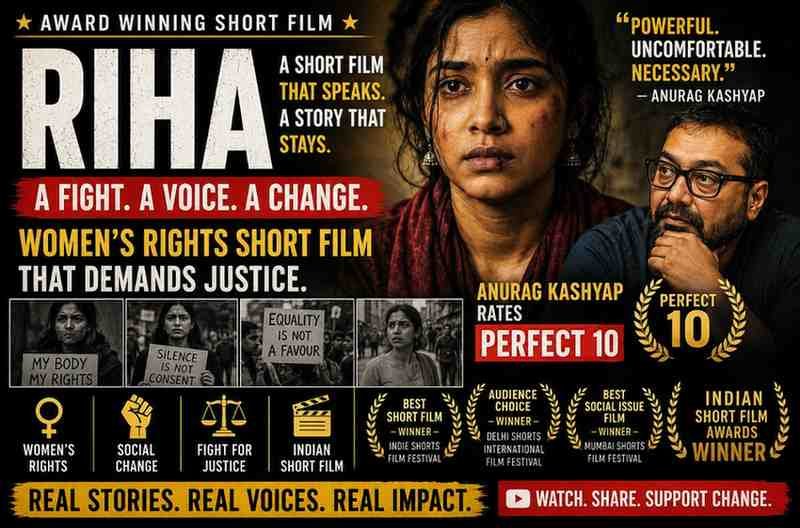
In a competitive year for independent cinema, the short film ‘Riha’, centered on women’s rights activism, has won critical recognition after being selected from over 12,000 entries across India, including nearly 7,000 Hindi-language films. The award was presented in a ceremony that highlighted the growing strength of India’s short film ecosystem.
Among the jury members was filmmaker Anurag Kashyap, who praised the film with unusually high praise, describing it as “literally a perfect 10.” The statement has amplified attention around the film, especially within independent cinema circles.
The recognition of ‘Riha’ reflects not only its storytelling strength but also the increasing visibility of films that engage with social justice themes, particularly those centered on gender equality and women’s rights.
A Story Rooted in Women’s Rights and Resistance
At its core, ‘Riha’ is understood to be a narrative shaped around women’s lived experiences, resistance, and the pursuit of dignity in the face of systemic challenges.
Films in this category often explore themes such as:
- Gender-based discrimination.
- Social and institutional barriers.
- Personal acts of resistance and empowerment.
- The intersection of identity and justice.
By focusing on women’s rights activism, the film aligns itself with a long tradition of socially conscious storytelling in Indian independent cinema.
Why Winning in a 12,000-Film Pool Matters
The scale of competition makes ‘Riha’s’ recognition particularly significant. With over 12,000 entries, the selection process reflects a rapidly growing short film industry in India.
This expansion has been driven by:
- Increased accessibility of digital filmmaking tools.
- Streaming platforms showcasing short-format content.
- Film festival circuits expanding their reach.
- A rise in socially driven storytelling by young filmmakers.
Standing out in such a large pool indicates strong narrative clarity, emotional impact, and technical execution.
Comparison: Mainstream Cinema vs Award-Winning Short Films
| Mainstream Commercial Films | Award-Winning Short Films like ‘Riha’ |
|---|---|
| Long-format storytelling (2–3 hours) | Concise, focused narrative structure |
| Star-driven visibility | Story and theme-driven recognition |
| Commercial entertainment focus | Social and issue-based storytelling |
| Large-scale production budgets | Minimalist, resource-efficient filmmaking |
| Mass audience targeting | Festival and niche audience engagement |
An Insight Competitors Often Miss: Short Films Are Becoming India’s Social Commentary Engine
Beyond awards and recognition, short films like ‘Riha’ are increasingly functioning as platforms for urgent social commentary.
Unlike mainstream cinema, which often balances commercial constraints, short films can directly engage with sensitive topics such as gender inequality, legal injustice, and social reform.
This freedom allows filmmakers to experiment with tone, narrative style, and realism, making the format especially powerful for activism-driven storytelling.
The Role of Jury Recognition in Independent Cinema
When prominent filmmakers like Anurag Kashyap publicly endorse a short film, it significantly boosts its visibility and credibility.
Such recognition can:
- Increase festival circuit opportunities.
- Attract streaming platform interest.
- Open funding opportunities for future projects.
- Amplify social impact reach.
In independent cinema ecosystems, jury validation often acts as a catalyst for wider audience discovery.
Why Women’s Rights Stories Continue to Resonate
Films centered on women’s rights continue to gain attention because they reflect ongoing societal conversations about equality, safety, and representation.
Audiences are increasingly drawn to stories that:
- Reflect lived realities.
- Highlight systemic inequalities.
- Offer emotional authenticity.
- Encourage social awareness.
This makes films like ‘Riha’ both artistically relevant and socially timely.
The Growing Ecosystem of Short Film Platforms in India
India’s short film landscape has evolved significantly over the past decade, driven by digital platforms and festival circuits.
Key growth drivers include:
- Online streaming platforms showcasing short content.
- Film festivals expanding categories for short formats.
- YouTube and social media distribution models.
- Increased participation from emerging filmmakers.
This ecosystem allows socially relevant films to reach audiences far beyond traditional cinema spaces.
Prediction: Socially Driven Short Films Will Gain More Institutional Recognition
The success of films like ‘Riha’ suggests a growing institutional appreciation for short-form storytelling focused on social issues.
In the coming years, we may see:
- More dedicated funding for issue-based short films.
- Greater collaboration between festivals and OTT platforms.
- Increased global recognition of Indian short filmmakers.
- Stronger integration of activism and storytelling.
This trend could further elevate short films as a serious artistic and cultural medium.
Conclusion
The short film ‘Riha’ has earned its place in India’s growing independent cinema landscape by standing out in a highly competitive field of over 12,000 entries. Its recognition, including praise from Anurag Kashyap, highlights the power of socially conscious storytelling rooted in women’s rights and lived experience.
More importantly, its success reflects a broader shift in Indian cinema—where short films are no longer peripheral experiments but central voices in cultural and social dialogue.
In many ways, ‘Riha’ represents not just an award-winning film, but a reminder that powerful stories often come in the shortest formats.
For breaking news and live news updates, like us on Facebook or follow us on Twitter and Instagram. Read more on Latest Entertainment on thefoxdaily.com.






COMMENTS 0