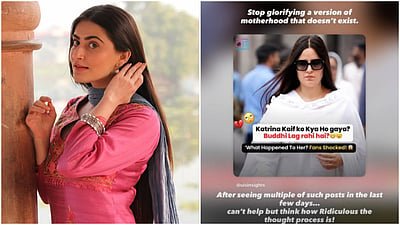
Shivaleeka Oberoi has strongly criticised social media trolls who targeted Katrina Kaif over her post-pregnancy appearance. The Khuda Haafiz actor came to Katrina’s defence, reminding people that changes in a woman’s body after pregnancy are a natural part of motherhood and should not become a subject of public ridicule.
Katrina Kaif, who recently embraced motherhood, has been receiving attention from social media users following her public appearances and photographs after pregnancy. While many fans have celebrated the actor’s new chapter, some comments focused unnecessarily on changes in her physical appearance.
Shivaleeka Oberoi responded to the criticism by highlighting an issue that continues to affect women in the public eye: the expectation that they should quickly return to their pre-pregnancy bodies. Her message, summed up in the words “This is motherhood,” challenges that expectation and asks audiences to look beyond appearance.
Why Shivaleeka Oberoi Spoke Up for Katrina Kaif
Celebrity appearances are routinely examined on social media, but pregnancy and the period after childbirth are particularly sensitive stages. A woman’s body can naturally change during pregnancy and recovery, and those changes do not follow a fixed timeline.
Shivaleeka’s response draws attention to the difference between public interest and personal judgment. Celebrities may choose to share parts of their lives with their audiences, but that does not make every aspect of their appearance open to criticism.
By defending Katrina, Shivaleeka has also raised a larger question about the way women are discussed online. When photographs of a new mother become an invitation for strangers to analyse her weight, shape or appearance, the conversation can quickly move from entertainment into unnecessary body scrutiny.
Katrina Kaif’s Post-Pregnancy Appearance Becomes a Social Media Talking Point
Katrina Kaif has maintained a strong public presence throughout her career, with her fashion choices, fitness routine and film appearances frequently becoming subjects of online discussion.
That level of attention can become especially intense when a celebrity experiences a major personal milestone such as motherhood.
Instead of focusing on the significance of the transition, some social media comments have concentrated on whether Katrina looks different from how she did before pregnancy. Such comparisons ignore the fact that pregnancy and childbirth can have lasting physical and emotional effects.
Shivaleeka’s intervention challenges the idea that a new mother should be judged according to an entertainment industry’s beauty standards.
“This Is Motherhood”: The Larger Message Behind Shivaleeka’s Comment
The phrase “This is motherhood” carries a message that extends beyond Katrina Kaif.
Motherhood is not a makeover or a temporary phase in which a woman is expected to restore her previous appearance as quickly as possible. Pregnancy involves significant physical changes, and recovery can be different for every person.
Expecting every celebrity mother to immediately look exactly as she did before pregnancy can create an unrealistic standard for ordinary women watching from home.
When famous women are body-shamed after childbirth, those comments can reinforce the misconception that returning to a particular body shape should be an immediate priority for every new mother.
The Double Standard Faced by Women in the Spotlight
The incident also reflects a broader double standard surrounding female celebrities.
Women in entertainment are often expected to maintain a particular appearance while simultaneously being judged for every change in their bodies. Pregnancy can make that scrutiny even more intense.
A celebrity may receive praise for embracing motherhood, yet the same person can quickly become the target of comments about weight or physical appearance.
This contradiction reveals how difficult it can be for women in the public eye to control the narrative surrounding their own bodies.
Why Post-Pregnancy Body Changes Should Not Be Treated as a Problem
One of the most important points raised by the controversy is that a post-pregnancy body is not something that needs to be “fixed.”
Pregnancy can bring changes in weight, skin, muscle tone, body shape and overall appearance. Recovery is individual, and there is no universal timetable for how quickly someone’s body may change after childbirth.
Social media often presents highly edited images and carefully curated lifestyles, which can make natural physical changes appear unusual when they are actually completely normal.
For new mothers, constantly comparing themselves with celebrities or expecting a rapid return to an earlier appearance can create unnecessary pressure.
Celebrity Culture and the Problem With Instant Judgement
The Katrina Kaif controversy demonstrates how quickly social media can turn an ordinary photograph into a debate about someone’s appearance.
Platforms built around images naturally encourage visual comparison. A celebrity photograph can receive thousands of reactions within minutes, and comments can quickly shift from discussing an outfit or appearance to making personal judgments.
The problem becomes more serious when the person being discussed has recently gone through pregnancy and childbirth.
Shivaleeka’s reaction effectively asks audiences to pause before commenting and consider the context behind what they are seeing.
Katrina Kaif’s Journey Into Motherhood
Katrina Kaif has traditionally maintained a relatively private approach to her personal life compared with the intense public interest surrounding her professional career.
Her transition into motherhood has therefore attracted considerable attention from fans and entertainment media.
For many admirers, the focus has been on celebrating a new chapter in her life. The body-shaming comments, however, shift attention away from motherhood and towards appearance.
That is precisely the behaviour Shivaleeka has challenged.
Why Shivaleeka Oberoi’s Stand Matters Beyond Bollywood
Shivaleeka Oberoi’s comments are relevant beyond the entertainment industry because body-shaming after pregnancy is not limited to celebrities.
Ordinary women can also face comments from relatives, acquaintances and strangers about how their bodies look after childbirth. Celebrity culture can amplify those expectations because famous women are often treated as examples of how quickly a body “should” return to its previous appearance.
Calling out that pressure can therefore help normalise a more realistic understanding of motherhood.
The message is simple: a woman’s worth does not depend on how quickly she returns to a particular body shape.
Social Media Should Make Room for More Empathy
There is nothing unusual about discussing celebrity fashion, films or public appearances. The line is crossed when commentary becomes personal attacks or humiliating remarks about someone’s body.
The criticism directed at Katrina Kaif also demonstrates how easily online conversations can lose perspective. A photograph captures only one moment, while motherhood is a much larger personal experience.
Instead of asking whether a new mother has returned to her old appearance, a healthier conversation would recognise the reality of pregnancy, childbirth and recovery.
The Bigger Conversation Around Celebrity Mothers
Katrina Kaif is far from the only celebrity mother to face scrutiny over her appearance. Public figures across the entertainment industry have repeatedly been subjected to commentary about weight and body shape during pregnancy and after childbirth.
The pattern reveals an outdated expectation that women should maintain the same physical appearance regardless of major life changes.
At the same time, the growing number of voices speaking against such criticism suggests that attitudes are changing. More celebrities are openly discussing unrealistic beauty standards, postpartum expectations and the importance of allowing women to experience motherhood without constant visual judgement.
What This Controversy Says About Modern Celebrity Culture
The incident involving Katrina Kaif and Shivaleeka Oberoi highlights a fundamental tension in modern celebrity culture.
Fans feel connected to stars because social media provides unprecedented access to their lives. But that access can create the mistaken belief that audiences are entitled to judge every personal detail.
Motherhood should be an area where that boundary is respected.
Shivaleeka’s intervention is therefore more than a defence of one actor. It is a reminder that celebrities remain people, and a public photograph does not remove their right to experience major life events without being subjected to cruel commentary.
Conclusion: “This Is Motherhood” Is a Message Bigger Than One Celebrity
Shivaleeka Oberoi’s defence of Katrina Kaif has brought attention to the unnecessary body-shaming faced by women after pregnancy. Her message that “this is motherhood” challenges the unrealistic expectation that women should immediately look the way they did before childbirth.
Katrina’s post-pregnancy appearance should not be reduced to a before-and-after comparison. Motherhood is a major life transition, and every woman’s experience is different.
The controversy ultimately offers a broader lesson for social media users: celebrities can be discussed without being dehumanised, and opinions about films or fashion do not need to become judgments about someone’s body.
In an industry obsessed with appearances, Shivaleeka Oberoi’s message cuts through the noise with a straightforward reminder: motherhood does not need to meet a beauty standard.
For breaking news and live news updates, like us on Facebook or follow us on Twitter and Instagram. Read more on Latest Entertainment on thefoxdaily.com.


COMMENTS 0