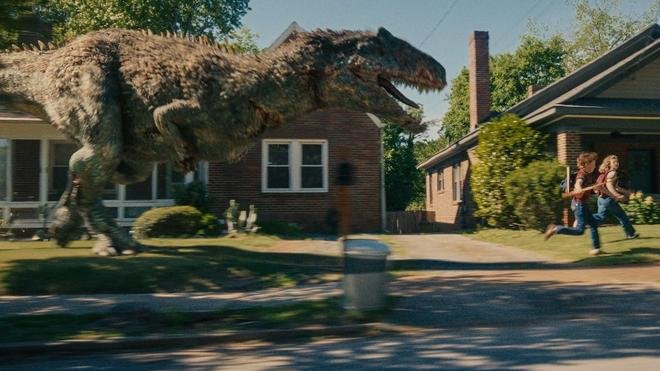
A wildly entertaining Amblin-style adventure, The End of Oak Street combines family drama, prehistoric terror, 1980s nostalgia and blockbuster spectacle into one of the summer’s most deliberately old-fashioned movie experiences.
>
The End of Oak Street movie review is ultimately the story of a filmmaker taking one of Hollywood’s most familiar formulas and finding enough personality inside it to make the ride feel surprisingly fresh. Written and directed by David Robert Mitchell, the filmmaker behind It Follows and Under the Silver Lake, the 2026 science-fiction adventure stars Anne Hathaway, Ewan McGregor, Maisy Stella and Christian Convery.
The premise is wonderfully simple. A mysterious cosmic event tears an ordinary suburban neighborhood away from its familiar surroundings and deposits it somewhere completely unknown. For the Platt family, the crisis quickly becomes a fight to understand where they are, what has happened to their community and how they can stay together long enough to survive.
Released theatrically on August 14, 2026, The End of Oak Street is designed for the big screen. Its central idea combines the domestic intimacy of an 1980s family movie with the scale of a dinosaur adventure, creating a strange but surprisingly effective collision between suburban nostalgia and prehistoric danger.
What makes the film interesting is not simply the presence of dinosaurs. It is Mitchell’s decision to place enormous genre spectacle inside a deliberately ordinary environment. Familiar houses, streets and family routines become unsettling precisely because they are no longer safe. The movie asks a simple blockbuster question: what happens when the place that is supposed to protect you suddenly becomes the most dangerous place imaginable?
The End of Oak Street plot: When ordinary suburbia disappears
At the center of the film is the Platt family, led by Denise and Greg, played by Anne Hathaway and Ewan McGregor. Their children, Audrey and Brian, complete a family unit that already has its own emotional tensions before the extraordinary event occurs.
The neighborhood’s sudden displacement changes everything. Roads no longer lead where they should. Familiar landmarks become meaningless. The rules that govern everyday suburban life disappear almost overnight.
That setup gives Mitchell an advantage that many modern creature features do not have: the audience understands the world before it becomes strange.
This distinction matters. A completely unfamiliar fantasy environment can be visually impressive, but it takes time for viewers to understand what has been lost. In The End of Oak Street, the filmmakers first establish an environment that looks deliberately recognizable. The subsequent transformation therefore feels less like entering another movie and more like watching reality itself become unreliable.
The dinosaurs are the obvious attraction, but they are not the entire point. The film uses its prehistoric setting to test family relationships, personal courage and the fragile assumptions behind comfortable suburban life.
David Robert Mitchell’s unusual return to mainstream filmmaking
One of the most intriguing aspects of The End of Oak Street is the filmmaker behind it.
Mitchell built his reputation through movies that are difficult to classify. It Follows turned an apparently simple horror premise into a study of anxiety, vulnerability and the fear of something that cannot easily be escaped. Under the Silver Lake pushed further into mystery and surrealism.
His move into a large-scale family adventure could therefore have seemed unexpected.
But there is actually a logical connection between his earlier work and this film. Mitchell has always been interested in turning familiar environments into places where ordinary rules stop working. In The End of Oak Street, that idea simply becomes much larger.
Instead of transforming a bedroom, apartment or Los Angeles neighborhood into a source of psychological unease, he transforms an entire suburban community into a survival environment.
That is arguably the film’s most distinctive creative decision.
Why the Amblin influence works
There is no hiding the movie’s affection for the great adventure films associated with 1980s Hollywood. The visual language recalls the era when family entertainment could combine genuine danger, humor, wonder and emotional sincerity without becoming embarrassed by any of those ingredients.
The strongest comparison is naturally Steven Spielberg’s blockbuster tradition, particularly the combination of ordinary families and extraordinary creatures found in films such as Jurassic Park and other Amblin-era adventures.
But The End of Oak Street does not simply attempt to recreate a Spielberg movie frame by frame. Its more interesting achievement is understanding why those older films worked.
The secret was contrast.
A child on a bicycle is ordinary. A child on a bicycle escaping something enormous is extraordinary. A family argument is familiar. A family argument taking place while the world around them has become unrecognizable suddenly carries much greater weight.
Mitchell repeatedly builds scenes around that contrast. The ordinary is allowed to remain ordinary for just long enough before the extraordinary crashes into it.
Anne Hathaway is the film’s emotional anchor
Anne Hathaway gives The End of Oak Street much of its emotional credibility.
Denise is not introduced as an action hero. That is important because the movie’s escalation works better when her character feels like someone who has been forced into extraordinary circumstances rather than someone who was waiting for an excuse to become a superhero.
Hathaway plays the character with a mixture of anxiety, frustration and determination. Her performance helps keep the film grounded when the premise becomes increasingly outrageous.
That balance is particularly important in a movie like this. Spectacle can make characters feel like passengers inside their own story. Hathaway prevents Denise from becoming merely a reaction to whatever enormous creature happens to appear next.
Her performance also gives the movie a useful emotional counterweight to its humor. The film can be knowingly ridiculous without treating its characters as jokes.
Ewan McGregor and the family dynamic
Ewan McGregor brings a different energy to Greg. Rather than turning the character into a conventional blockbuster father figure, the film gives him room to feel imperfect and human.
That matters because the Platt family’s survival is not only a physical problem. Their relationships are tested by circumstances that make everyday disagreements suddenly seem trivial while also exposing deeper problems.
Maisy Stella and Christian Convery help complete the family dynamic as Audrey and Brian. Their presence keeps the film connected to the tradition of family-centered adventure stories, where children are not simply spectators but important participants in the unfolding mystery.
The result is more effective when the movie remembers that survival means more than escaping a dinosaur. The family must also learn to function as a unit when every familiar support system has disappeared.
The dinosaurs are spectacle, but the environment is the real star
The easiest way to market The End of Oak Street is with dinosaurs. The smarter way to understand it is as a movie about environmental displacement.
The film takes something deliberately mundane—a suburban street—and removes the assumptions that make it feel safe.
This creates a useful visual progression. At first, the audience recognizes the architecture, roads and domestic spaces. Then those same locations acquire new meanings. A backyard can become exposed territory. A familiar road can become a trap. The neighborhood itself becomes a character because its physical identity is constantly being challenged.
This approach also separates the movie from straightforward dinosaur action films. Instead of simply transporting its characters to a prehistoric jungle, Mitchell brings the prehistoric world into direct collision with a recognizable piece of modern life.
That contrast provides many of the movie’s best opportunities for visual comedy and suspense.
Michael Gioulakis gives the movie its cinematic scale
Cinematographer Michael Gioulakis, who has worked with Mitchell on previous projects, is an important part of the film’s visual identity.
The collaboration matters because Mitchell’s movies often depend on atmosphere as much as plot. In The End of Oak Street, that atmospheric instinct has been expanded to blockbuster proportions.
The camera can make a familiar suburban setting appear peaceful one moment and strangely threatening the next. That visual instability helps the film maintain tension even when nothing is actively attacking the characters.
The movie also benefits from production design that emphasizes the period setting. The 1980s are not merely used as a collection of nostalgic references. The era’s visual identity becomes part of the story’s emotional texture.
Michael Giacchino’s score reinforces the throwback feeling
Composer Michael Giacchino is another major reason the film feels connected to classic adventure cinema.
His score embraces the grand emotional language traditionally associated with theatrical adventure movies while supporting Mitchell’s more eccentric sensibility.
This is an important distinction. A nostalgic movie can easily become a museum piece, constantly asking the audience to recognize references. The End of Oak Street works better when nostalgia functions as atmosphere rather than as the entire joke.
The music helps sell wonder, danger and family emotion without requiring the audience to understand every reference to 1980s filmmaking.
Is The End of Oak Street original or too nostalgic?
This is where the movie becomes more complicated.
Its biggest strength can also be its biggest weakness.
The Spielbergian influence is obvious. The family adventure structure, suburban setting, children in danger, mysterious science-fiction premise and dinosaurs all belong to a recognizable cinematic vocabulary.
For viewers who want radical originality, that familiarity may feel limiting. Some sequences appear intentionally designed to remind audiences of movies they already love.
But judging the film purely on originality misses Mitchell’s larger experiment. He is not trying to invent the concept of a dinosaur blockbuster. He is exploring whether the emotional grammar of an older kind of blockbuster can still work in a contemporary theatrical environment.
That makes the movie less like a reboot and more like a conversation with a filmmaking tradition.
The bigger insight: Why this kind of blockbuster feels different in 2026
The most interesting thing about The End of Oak Street may have little to do with dinosaurs.
It arrives at a moment when mainstream cinema is increasingly dominated by established franchises, interconnected universes and recognizable intellectual property. Against that background, a large original adventure movie with no existing superhero or franchise mythology carries unusual significance.
The film demonstrates that audiences can still be invited into a completely new world using a simple premise rather than years of previous storytelling.
Its nostalgia is therefore strategic. The movie borrows a familiar emotional language to make an unfamiliar property feel accessible.
That could become increasingly important for theatrical cinema. If original blockbusters are going to compete with franchises, they may need to offer not only spectacle but also an immediately understandable emotional proposition.
The End of Oak Street has exactly that: protect your family, figure out what happened and survive the impossible.
The End of Oak Street compared with Jurassic Park
| Element | The End of Oak Street | Jurassic Park |
|---|---|---|
| Core setting | 1980s suburban neighborhood transformed by a mysterious cosmic event | Isolated dinosaur theme park |
| Primary focus | Family survival and displacement | Scientific ambition, survival and corporate hubris |
| Genre approach | Science fiction, family adventure, thriller and dinosaur spectacle | Science fiction, adventure and creature thriller |
| Central appeal | Ordinary domestic life colliding with extraordinary danger | Human beings confronting resurrected prehistoric life |
| Nostalgic quality | Strong 1980s Amblin influence | Classic early-1990s blockbuster filmmaking |
The comparison reveals why the newer film can stand on its own. Jurassic Park is fundamentally about humans trying to control nature and discovering the consequences of that ambition. The End of Oak Street is more interested in what happens when an ordinary community loses control over its environment altogether.
What works best in The End of Oak Street
- The central premise: Turning an ordinary neighborhood into an impossible survival zone gives the dinosaur concept a distinctive framework.
- Anne Hathaway’s performance: She provides emotional credibility when the story becomes increasingly fantastical.
- The family focus: The movie understands that spectacle works better when the audience has people to care about.
- The visual contrast: Familiar suburban imagery becomes dramatically different once the rules of the environment change.
- The retro filmmaking language: The movie embraces the pleasures of old-fashioned theatrical adventure without completely abandoning modern sensibilities.
- The pacing: At around 100 minutes, the film moves with the efficiency of a traditional summer adventure rather than overstaying its welcome.
Where the movie may divide audiences
The film’s deliberately straightforward approach will not work for everyone.
Viewers expecting the psychological complexity of It Follows may be surprised by how openly playful Mitchell becomes. Those looking for a relentlessly serious dinosaur thriller may similarly find the humor and nostalgic touches distracting.
The script also occasionally prioritizes momentum over deeper explanation. That is partly the point: the movie wants the audience to experience the situation alongside the characters rather than pause every few minutes for a scientific lecture.
For some viewers, that will feel refreshing. For others, the unanswered questions may become frustrating.
That trade-off is central to the film’s identity. The End of Oak Street is not trying to be a hard-science science-fiction movie. It is a cinematic adventure built around a high-concept mystery.
Who should watch The End of Oak Street?
The End of Oak Street is particularly well suited to viewers who enjoy dinosaur movies, 1980s-inspired adventure cinema, family survival stories and large-scale theatrical spectacles.
Fans of David Robert Mitchell’s earlier work should also approach it with the right expectations. This is recognizably his filmmaking, but it is Mitchell operating inside a much more accessible blockbuster framework.
It is also a strong choice for audiences who miss the feeling of going to the cinema without needing to understand an enormous franchise mythology beforehand.
The End of Oak Street movie review verdict
The End of Oak Street is not attempting to reinvent the dinosaur movie. Its achievement is more modest—and arguably more valuable. It remembers that a blockbuster can simply be exciting, funny, sincere and visually imaginative without apologizing for any of those qualities.
David Robert Mitchell takes the emotional architecture of the classic suburban adventure, drops it into a prehistoric nightmare and lets Anne Hathaway, Ewan McGregor and their young co-stars carry the human side of the story.
The result is deliberately familiar but rarely lifeless. Its Amblin influences are obvious, its dinosaur thrills are central and its 1980s atmosphere is carefully constructed. Yet beneath the nostalgia is a clever idea: when everything familiar disappears, the family itself becomes the only definition of home.
That idea gives the movie more staying power than its premise initially suggests.
Final verdict: The End of Oak Street is a big, cheerful, occasionally chaotic throwback that understands the simple pleasure of a summer movie. It may not be as revolutionary as the classics it admires, but it knows exactly why those classics remain beloved. For audiences willing to embrace its deliberately old-school spirit, this dinosaur adventure delivers a roaring good time.
The future outlook for The End of Oak Street
The film’s theatrical performance could be especially interesting because it represents something Hollywood needs more of: an original event movie that is not dependent on an established franchise.
If audiences respond strongly, The End of Oak Street could strengthen the case for filmmakers with distinctive voices to experiment with mainstream spectacle rather than staying confined to smaller genres. Mitchell’s transition from atmospheric horror and surreal mystery into family-oriented science fiction demonstrates how a filmmaker can carry a recognizable creative identity into a much larger commercial format.
Whether the movie becomes a new franchise or remains a standalone adventure, its more lasting contribution may be simpler. It proves that nostalgia does not necessarily have to mean repetition. Sometimes it can be a starting point for making familiar cinematic pleasures feel exciting again.
For breaking news and live news updates, like us on Facebook or follow us on Twitter and Instagram. Read more on Latest Entertainment on thefoxdaily.com.

COMMENTS 0