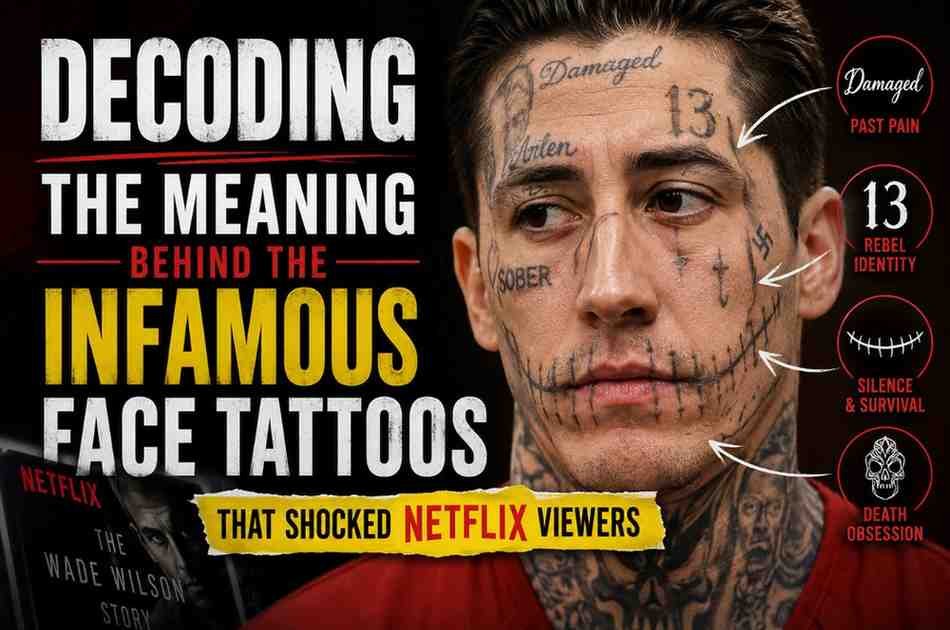
The question “What do Wade Wilson’s face tattoos show?” has surged in search trends ever since Netflix’s true crime series Worst Ex Ever introduced audiences to a deeply unsettling figure often nicknamed the “Deadpool Killer.” With a face covered in bold, cryptic ink, Wade Wilson’s appearance is impossible to ignore and even harder to understand.
Who: Wade Wilson, a convicted criminal featured in a true-crime narrative
What: His distinctive face tattoos and their symbolic meaning
When: Brought into public spotlight through recent streaming exposure
Where: Highlighted globally via Netflix’s platform
Why: His tattoos contribute to a chilling public persona and raise psychological questions
How: Through a combination of personal expression, symbolism, and identity construction
But these tattoos are more than just visual shock value. They represent a complex mix of identity, psychology, and cultural symbolism that goes far deeper than surface-level interpretation.
Understanding the Context: Tattoos as Identity Markers
Tattoos have long been used as a form of self expression. Across cultures, they can symbolize belonging, beliefs, rebellion, or transformation. However, face tattoos occupy a different category altogether they are permanent, highly visible, and often socially polarizing.
In Wade Wilson’s case, the tattoos appear to function as a deliberate construction of identity. Rather than blending into society, they set him apart visually and psychologically.
Key Visual Elements: What His Face Tattoos Typically Include
While interpretations vary, observers and viewers have noted several recurring features in his facial ink:
- Bold lettering: Words or phrases placed prominently to communicate a message
- Abstract symbols: Designs that may represent personal beliefs or emotional states
- Symmetrical placement: Suggesting intentional design rather than randomness
- High contrast ink: Meant to draw immediate attention and create a lasting impression
These elements combine to create a face that looks almost like a “constructed mask” which is where the comparison to comic-book aesthetics begins.
Why the “Deadpool Killer” Comparison Emerged
The nickname stems from a mix of coincidence and visual association:
- His real name matches that of a popular antihero
- The heavy facial markings resemble a stylized or altered face
- Pop culture influences shape how audiences interpret unusual appearances
However, this comparison is purely superficial. The fictional character is known for humor and antihero traits, while the real-life context here is rooted in crime and reality.
Deep Analysis: What the Tattoos Actually Represent
1. A Tool for Intimidation
Facial tattoos are often used to create an intimidating presence. In environments where power dynamics matter, appearance can become a psychological weapon.
In this case, the tattoos amplify fear and unpredictability two traits that strongly influence public perception.
2. Identity Reinvention
One of the most significant aspects of extreme body modification is identity transformation. Covering one’s face in tattoos can symbolize a break from the past.
This reinvention may serve multiple purposes:
- Distancing from previous identity
- Creating a new, dominant persona
- Controlling how others perceive you
3. Emotional Externalization
Tattoos can act as a visual representation of internal emotions. Anger, defiance, or detachment may be expressed outwardly through permanent ink.
Instead of verbalizing feelings, the individual “wears” them.
4. Desire for Recognition
In the digital age, visibility equals influence. A highly distinctive appearance ensures memorability.
This aligns with a broader trend where extreme aesthetics become a form of identity branding even in negative contexts.
Comparison: Face Tattoos vs Traditional Tattoos
| Aspect | Traditional Tattoos | Face Tattoos |
|---|---|---|
| Visibility | Can be hidden | Always visible |
| Social Acceptance | Widely accepted | Still controversial |
| Purpose | Personal or cultural | Strong identity statement |
| Impact | Moderate | High psychological impact |
| Reversibility | Difficult | Extremely difficult |
This comparison highlights why face tattoos carry significantly more weight they are not just art, but a declaration.
The Psychology Behind Extreme Facial Tattoos
Experts in behavioral science often associate extreme body modifications with deeper psychological motivations. While each individual is unique, some commonly observed factors include:
- Control: Taking ownership of one’s body and identity
- Rebellion: Rejecting societal norms and expectations
- Trauma response: Externalizing internal struggles
- Attention-seeking behavior: Desire to stand out or be remembered
It’s important to note that tattoos alone do not define a person’s character but in high-profile criminal cases, they often shape public perception dramatically.
Real-World Impact: How Appearance Shapes Narrative
In true-crime storytelling, visuals play a crucial role. Wade Wilson’s tattoos contribute to how audiences interpret his story even before hearing details.
This creates a powerful narrative effect:
- Viewers associate appearance with personality
- Media framing amplifies certain traits
- Public judgment forms بسرعة often without full context
This raises an important question: Are we reacting to the person or the image?
Unique Insight: The “Visual Identity Era” of Crime Media
We are living in a time where visual identity is becoming as important as factual narrative. In streaming platforms, where attention spans are short, striking appearances often define a story’s impact.
Wade Wilson’s tattoos are not just part of his identity they are part of the content strategy that makes the story viral.
This shift signals a new era:
- Appearance influences storytelling more than ever
- Visual shock value drives engagement
- True crime becomes partly visual entertainment
Future Prediction: What This Trend Means Going Forward
The intersection of identity, media, and visual storytelling is only going to grow stronger. Here’s what we can expect:
1. Increased Focus on Visual Personalities
Individuals with distinctive appearances will continue to dominate attention in digital media.
2. Ethical Questions Around Representation
How media portrays individuals especially in crime stories will face greater scrutiny.
3. Audience Awareness Will Evolve
Viewers may become more critical of how visuals influence perception, leading to more nuanced discussions.
Why This Topic Matters Beyond Curiosity
At first glance, the question “What do Wade Wilson’s face tattoos show?” may seem like simple curiosity. But it opens the door to deeper conversations about identity, psychology, and media influence.
It challenges us to think about:
- How we judge people based on appearance
- How media shapes those judgments
- Where the line lies between reality and narrative
Conclusion: More Than Ink—A Symbol of Modern Identity and Perception
Wade Wilson’s face tattoos are not just random designs they are a powerful combination of symbolism, psychology, and identity construction. They shape how he is perceived, how his story is told, and how audiences react.
Summary: The tattoos represent intimidation, identity, emotional expression, and visibility all amplified by media portrayal.
Future Outlook: As visual storytelling continues to dominate digital platforms, appearances will play an even bigger role in shaping narratives—making it more important than ever to look beyond the surface.
Because in today’s world, sometimes what we see is only part of the story and understanding the rest requires looking deeper.
For breaking news and live news updates, like us on Facebook or follow us on Twitter and Instagram. Read more on Latest Entertainment on thefoxdaily.com.

COMMENTS 0