Primary Keyword: giant chiroptical properties thin films
LSI Keywords: chiral organic dye thin films, circular dichroism materials, IDT-TPO dye research, chiral π-conjugated materials, circularly polarized OLEDs technology, spintronics CISS effect, supramolecular helical structures, organic optoelectronics innovation
Introduction: A Silent Molecule That Speaks Loudly in Thin Films
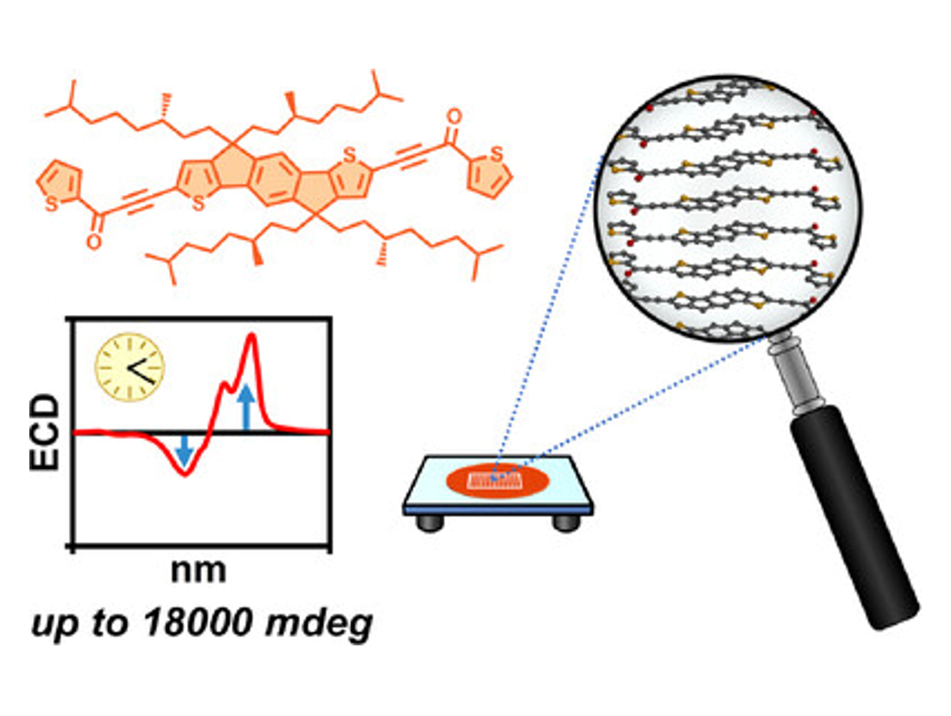
In a major advancement in materials science, researchers have developed a novel chiral organic dye that exhibits giant chiroptical properties in thin films—a breakthrough that could accelerate innovations in next-generation optoelectronic devices.
Who: Researchers led by Gianluigi Albano and Lorenzo Di Bari
What: Development of a new chiral organic dye (IDT-TPO)
When: Recent study in advanced materials research
Where: Universities of Parma and Pisa, Italy
Why: To overcome limitations in achieving strong chiroptical responses in thin films
How: Through innovative molecular design and spontaneous structural evolution
This discovery is particularly striking because the material shows no chiroptical activity in solution—but transforms dramatically when formed into thin films.
Understanding Chiroptical Properties: Why They Matter
Chiroptical properties refer to how materials interact differently with left- and right-handed circularly polarized light. These properties are critical for technologies such as:
- Circularly polarized OLED displays
- Advanced photodetectors
- Spintronic devices using electron spin
The challenge: Achieving strong, stable chiroptical responses in thin films has long been a bottleneck in material science.
The IDT-TPO Dye: A Smart Molecular Design
The newly developed molecule, IDT-TPO, is built using a carefully engineered structure:
- A rigid and planar indacenodithiophene (IDT) core
- Two thiophenylpropynone (TPO) units acting as light-absorbing chromophores
- Chiral side chains derived from natural citronellol
This design balances structural rigidity, electronic performance, and chirality—a combination rarely achieved in a single molecule.
The Breakthrough: From Inactive to Exceptionally Active
One of the most fascinating aspects of this research is the material’s transformation:
Initial State
- Chiroptically silent in solution
- No measurable circular dichroism
After Thin Film Formation
- Spontaneous structural evolution over time
- Development of intense circular dichroism
- Ellipticity reaching up to 18,000 mdeg
This level of response is among the highest ever recorded for thin films of small organic molecules.
Ageing Effect: A Simple Yet Powerful Mechanism
Unlike many materials that require complex processing, IDT-TPO films evolve naturally:
- Drop-cast or spin-coated films are initially inactive
- Over 24 hours at room temperature, they self-organise
- No external treatment or stimuli required
This “set-and-wait” mechanism could significantly reduce manufacturing complexity.
The Science Behind the Phenomenon: Helical Supramolecular Structures
Advanced imaging and computational techniques revealed the origin of this extraordinary behaviour.
Key Discovery
The films form right-handed helical supramolecular architectures during ageing.
Techniques Used
- Circularly Polarized Microscopy (CPM)
- Synchrotron-based Mueller Matrix Polarimetry
- Time-dependent density functional theory (TD-DFT)
These methods confirmed that the strong optical response arises from highly ordered three-dimensional chiral structures.
2D vs 3D Chirality: A Critical Shift
Previous systems often relied on two-dimensional chirality, where optical effects were influenced by surface-level arrangements.
| Feature | 2D Chirality (Earlier Systems) | 3D Chirality (IDT-TPO) |
|---|---|---|
| Structure | Surface-level ordering | Fully three-dimensional helices |
| Optical response | Often mixed effects | Intrinsic circular dichroism |
| Uniformity | Variable | Homogeneous across film |
| Performance | Moderate | Exceptionally high |
This transition to true 3D chirality is a major scientific milestone.
Thickness Matters: A Surprising Discovery
Another unexpected finding was the relationship between film thickness and performance.
- Strongest response observed at ~400 nm thickness
- Thicker films did not perform better
- Indicates a non-linear optimisation curve
This is particularly important because:
- Thinner films are easier to integrate into devices
- Reduced material usage lowers production costs
- Improved efficiency for optoelectronic applications
Real-World Applications: Where This Technology Could Lead
1. Circularly Polarized OLEDs
Enhanced display technologies with better energy efficiency and contrast.
2. Advanced Photodetectors
More sensitive detection of polarized light for imaging and sensing.
3. Spintronics
Improved control of electron spin using the CISS effect, potentially revolutionising data storage and processing.
4. Quantum and Optical Computing
Potential applications in next-generation computing systems relying on light and spin properties.
A Unique Insight: Why Simplicity Is the Real Innovation
While the optical performance is impressive, the true breakthrough lies in the simplicity of the process.
Most high-performance materials require:
- Complex fabrication techniques
- High energy input
- Multiple processing steps
In contrast, IDT-TPO achieves superior results through spontaneous self-assembly at room temperature.
This could democratise access to advanced materials technology.
Challenges and Future Research Directions
Despite its promise, several questions remain:
- Long-term stability of the films
- Scalability for industrial production
- Integration into commercial devices
Future studies will likely focus on:
- Optimising molecular design further
- Exploring other chiral side chains
- Testing performance in real devices
Prediction: A New Era for Organic Optoelectronics
This discovery signals a shift towards self-organising, high-performance materials that combine simplicity with efficiency.
In the coming years, we can expect:
- Wider adoption of chiral organic materials
- More energy-efficient display technologies
- Breakthroughs in spin-based electronics
IDT-TPO may become a foundational material for future photonic and electronic systems.
Conclusion: From Molecular Design to Technological Revolution
The development of giant chiroptical properties in thin films using the IDT-TPO dye represents a major leap forward in materials science.
By combining intelligent molecular design with natural self-assembly, researchers have unlocked:
- Record-breaking optical performance
- Simplified fabrication processes
- New pathways for advanced technologies
This is not just a scientific achievement—it’s a glimpse into the future of how materials will be designed, built, and used.
For breaking news and live news updates, like us on Facebook or follow us on Twitter and Instagram. Read more on Latest Health on thefoxdaily.com.

COMMENTS 0