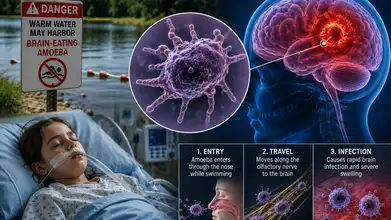
An 8-year-old Louisiana girl has died after developing an infection caused by Naegleria fowleri, the rare organism commonly known as the “brain-eating amoeba.” The child, identified by her family as Lillian Smart of Ruston, died on August 22, one day after her eighth birthday, after being hospitalised since August 15.
The Louisiana Department of Health confirmed the infection on August 19. The case was believed to be associated with swimming in Lake Claiborne, a warm freshwater environment. The tragedy has once again drawn attention to a disease that is extraordinarily uncommon but can progress with devastating speed.
Naegleria fowleri causes primary amebic meningoencephalitis (PAM), a severe infection of the brain and its surrounding tissues. Unlike many infections associated with water, the danger does not come from drinking contaminated water. The amoeba must enter through the nose, after which it can travel along the olfactory pathway towards the brain.
Understanding how the infection occurs, why its early symptoms are difficult to distinguish from other illnesses, and what precautions can reduce exposure is more useful than simply viewing the organism as a mysterious “brain-eating” threat.
What Is Naegleria Fowleri?
Naegleria fowleri is a microscopic, free-living amoeba that can live in warm freshwater and soil. It is particularly associated with warm lakes, ponds, rivers, hot springs and other freshwater environments.
The organism has several life stages, but the form capable of causing human infection is associated with movement through water and exposure to the nasal passages.
Most people exposed to environments where the organism may exist do not develop an infection. The disease is extremely rare. The danger arises when contaminated water enters the nose and the amoeba gains access to the nervous system.
How Does the Brain-Eating Amoeba Infect a Person?
The most important fact about Naegleria fowleri is its route of entry.
When contaminated water enters the nose, the amoeba can move through the nasal cavity and travel along the olfactory nerves. These nerves connect the nose with areas of the brain involved in the sense of smell.
The organism can then reach the central nervous system and trigger primary amebic meningoencephalitis.
This means that activities such as diving, jumping into warm freshwater or swimming underwater can potentially increase exposure because they can force water into the nose.
Swallowing contaminated water does not cause PAM. The infection is not acquired simply because a person drinks water containing the organism.
Can Naegleria Fowleri Spread From Person to Person?
No. Primary amebic meningoencephalitis caused by Naegleria fowleri is not considered a contagious disease.
A person cannot ordinarily transmit the infection to another person through touching, coughing, breathing or being in the same household.
This is an important distinction because the term “brain-eating amoeba” can make the disease sound similar to contagious infections such as influenza or some forms of bacterial meningitis. Its risk is instead connected primarily to environmental exposure.
Why Is Naegleria Fowleri So Deadly?
The danger comes from what happens after the organism reaches the brain.
PAM causes severe inflammation and destruction of brain tissue. As inflammation increases, neurological function can deteriorate rapidly. The brain is particularly vulnerable because swelling inside the skull can interfere with normal neurological function and circulation.
The infection can therefore move from apparently nonspecific symptoms to severe neurological illness over a very short period.
According to CDC data cited in coverage of the Louisiana case, 173 infections were documented in the United States between 1937 and 2025, with only four known survivors. That historical record illustrates the exceptionally high fatality associated with diagnosed PAM.
However, the rarity of the disease is equally important. A high fatality rate does not mean that most people who swim in warm freshwater will become infected. The infection itself is extraordinarily uncommon.
What Are the Early Symptoms?
One of the biggest challenges in diagnosing PAM is that its initial symptoms are not unique.
Early symptoms can include:
- Headache
- Fever
- Nausea
- Vomiting
- Stiff neck
- Fatigue
These symptoms can resemble bacterial or viral meningitis and several other neurological or infectious conditions.
That similarity creates a major diagnostic problem. A patient or doctor may initially have no obvious reason to suspect an amoebic infection, particularly because the disease is so rare.
What Happens as PAM Progresses?
As the infection affects the brain, neurological symptoms can become increasingly severe.
- Confusion
- Changes in behaviour or mental state
- Hallucinations
- Loss of coordination
- Seizures
- Severe neurological deterioration
- Loss of consciousness
- Coma
The rapid progression is one of the defining characteristics of PAM. Severe illness and death can occur within days after symptoms begin.
This makes early medical assessment particularly important when a person develops symptoms consistent with meningitis or encephalitis after recent exposure to warm freshwater.
Why Is Early Diagnosis So Difficult?
PAM presents doctors with an unusual diagnostic challenge: it is both extremely serious and extremely rare.
When someone arrives with fever, headache, vomiting and neck stiffness, doctors must consider common causes of meningitis and encephalitis first. Naegleria fowleri is unlikely to be the first explanation unless the exposure history raises suspicion.
That is why recent recreational water exposure can be an important piece of information.
If a patient has recently been swimming or diving in warm freshwater and develops rapidly worsening neurological symptoms, clinicians may need to consider PAM as part of the differential diagnosis.
How Is Naegleria Fowleri Diagnosed?
Diagnosis can involve testing cerebrospinal fluid, the fluid surrounding the brain and spinal cord, for evidence of the organism.
Specialised laboratory methods can help identify Naegleria fowleri. Depending on the circumstances, testing may include microscopic examination or molecular techniques such as polymerase chain reaction.
The diagnosis requires urgency because laboratory confirmation can be challenging while the disease continues to progress.
The combination of symptoms, neurological deterioration and a history of relevant freshwater exposure can therefore be important in prompting doctors to investigate this rare infection.
Is There a Cure for Naegleria Fowleri?
There is no single drug that has been proven to reliably cure PAM.
Because so few cases occur, researchers have not been able to conduct large clinical trials that establish one standard treatment regimen. Instead, treatment approaches have been developed from laboratory research, clinical experience and reports involving patients who survived.
Doctors have used combinations of antimicrobial and antifungal medicines alongside intensive supportive care.
Treatment regimens have included medicines such as amphotericin B and miltefosine, sometimes combined with other antimicrobial therapies. Intensive care may also be required to manage complications associated with severe brain inflammation.
The existence of documented survivors is significant because it shows that recovery is possible. However, survival remains exceptionally uncommon, which is why early recognition and rapid treatment are considered so important.
Why Treatment Research Is So Challenging
Rare diseases create a fundamental research problem: there are not enough patients to easily conduct the large clinical trials that are normally used to compare treatments.
For common infections, researchers can study thousands of patients and establish which medicines work best. With PAM, treatment evidence has largely accumulated through individual cases and small collections of cases.
That makes it difficult to determine precisely which combination of medicines, treatment timing and supportive interventions provides the greatest benefit.
It also explains why the medical community continues to rely on aggressive, multifaceted treatment rather than one universally accepted drug.
Why Warm Freshwater Matters
Naegleria fowleri thrives in warm freshwater environments, making high temperatures an important environmental factor.
Cases have been associated with natural freshwater bodies such as lakes and rivers, particularly during warmer periods.
The organism cannot be identified simply by looking at the water. Clear water can still contain microorganisms, while dirty-looking water does not necessarily mean that Naegleria fowleri is present.
Temperature and environmental conditions influence where the amoeba can survive, but swimmers cannot determine whether water contains the organism using sight, smell or taste.
How Can You Reduce the Risk?
The CDC recommends several practical precautions for people who enter warm freshwater where Naegleria fowleri may be present.
- Keep your nose above water when swimming in warm freshwater.
- Use a nose clip to reduce the possibility of water entering the nasal passages.
- Avoid diving or jumping into warm freshwater because these activities can force water up the nose.
- Avoid stirring up sediment in shallow, warm freshwater areas.
- Avoid putting your head underwater in potentially contaminated warm freshwater.
- Use safe water for nasal rinsing and avoid introducing untreated freshwater into the nose.
These measures focus on the most important exposure route: preventing potentially contaminated water from entering the nose.
Does Swimming in a Lake Mean You Will Get the Infection?
No. This is one of the most important points to keep in mind.
The presence of Naegleria fowleri in an environment does not mean that everyone who enters the water will become infected. PAM is exceptionally rare despite the large number of people who participate in freshwater recreation.
The risk should therefore be understood as very low but potentially severe.
People do not need to assume that every lake or river is a source of imminent danger. Instead, swimmers can make informed decisions and reduce exposure by keeping water out of the nose, particularly in warm freshwater.
What About Swimming Pools?
Properly maintained and adequately disinfected swimming pools are very different from warm natural freshwater environments.
Chlorination and other appropriate pool-maintenance practices are designed to control microorganisms. The risk associated with poorly maintained or inadequately disinfected water is different from that of a properly treated swimming pool.
People should follow local pool safety and water-treatment guidance rather than assuming that all recreational water carries the same level of risk.
Naegleria Fowleri and Nasal Rinsing: An Overlooked Risk
Freshwater exposure is not limited to swimming.
Water used for nasal irrigation can also enter the nasal passages directly. For this reason, untreated tap water, lake water, river water or other potentially contaminated water should not be used for nasal rinsing.
When performing nasal irrigation, people should follow appropriate safety guidance and use water that has been properly treated for this purpose.
The principle is straightforward: water that is safe to drink is not automatically appropriate for every use involving the nose unless it meets the relevant safety requirements.
What Should You Do After Freshwater Exposure?
Simply swimming in warm freshwater does not mean that someone needs emergency testing for Naegleria fowleri.
However, if a person develops symptoms such as severe headache, fever, vomiting, stiff neck, confusion, seizures or rapidly worsening neurological problems after relevant freshwater exposure, urgent medical attention is necessary.
Patients or their families should tell healthcare professionals about recent swimming or other freshwater exposure, particularly if water entered the nose.
These symptoms can have many causes, and they do not automatically indicate PAM. But because PAM progresses rapidly, providing the exposure history can help clinicians consider the appropriate possibilities.
Naegleria Fowleri vs Other Causes of Meningitis
| Feature | Naegleria fowleri PAM | Other infectious meningitis |
|---|---|---|
| Typical exposure | Warm freshwater entering the nose | Depends on the infectious organism |
| Person-to-person transmission | No | Depends on the cause |
| Early symptoms | Headache, fever, nausea and vomiting | May include headache, fever, nausea and vomiting |
| Neurological progression | Often extremely rapid | Varies by cause |
| Diagnosis | Specialised testing, including cerebrospinal fluid analysis | Laboratory testing based on suspected cause |
| Treatment | Combination therapy and intensive supportive care | Depends on the specific pathogen |
The Most Important Warning Signs to Remember
There is no reason to panic after ordinary freshwater recreation. But several symptoms deserve immediate medical attention regardless of their cause.
- Severe or rapidly worsening headache
- High fever
- Repeated vomiting
- Stiff neck
- Confusion or unusual behaviour
- Hallucinations
- Seizures
- Loss of consciousness
When these symptoms occur after a relevant freshwater exposure, the exposure history should be communicated clearly to medical professionals.
The Bigger Public Health Lesson
The Louisiana case illustrates a difficult balance in communicating rare infectious diseases.
The term “brain-eating amoeba” understandably attracts attention because it describes an extremely frightening outcome. But focusing only on the nickname can create the wrong impression about the actual risk.
The more useful message is that Naegleria fowleri infection is extraordinarily rare, is not spread from person to person and is primarily associated with contaminated warm freshwater entering the nose.
At the same time, the disease deserves serious attention because once PAM develops, its progression can be extraordinarily rapid and treatment outcomes remain poor.
This makes prevention and early recognition more valuable than fear.
Conclusion: Rare Does Not Mean Harmless
Naegleria fowleri infection is one of the rarest causes of severe brain infection, but its consequences can be devastating. The organism can enter through the nose during exposure to warm freshwater and travel to the brain, where it can cause primary amebic meningoencephalitis.
The early symptoms can resemble more common illnesses, while the disease can progress rapidly to severe neurological damage, coma and death. There is no single reliably effective cure, and treatment often requires several medicines alongside intensive medical care.
For the public, the most practical approach is simple: understand the route of infection, reduce the chance of warm freshwater entering the nose, use safe water for nasal rinsing and seek urgent medical care for rapidly worsening neurological symptoms after relevant exposure.
The Louisiana child’s death is a heartbreaking reminder of how severe PAM can be, but the appropriate response is informed caution rather than panic: the infection is extraordinarily rare, while basic water-safety precautions can help reduce exposure to the organism.
For breaking news and live news updates, like us on Facebook or follow us on Twitter and Instagram. Read more on Latest Health on thefoxdaily.com.

COMMENTS 0