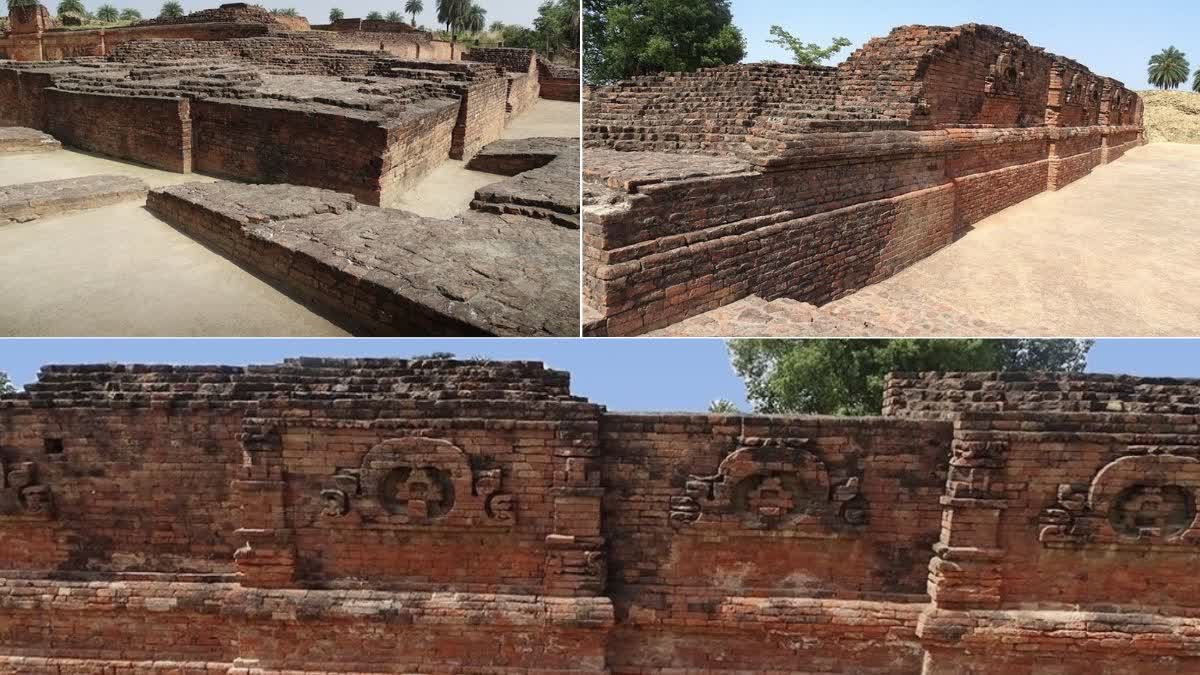
A 90-acre archaeological mound near Kashipur in Uttarakhand has drawn renewed attention as the Archaeological Survey of India (ASI) begins a fresh round of excavations at a site associated with the Mahabharata and the accounts of Chinese traveller Xuanzang. The excavation, which began this week, is expected to continue until March, as archaeologists seek to establish a clearer cultural sequence and investigate evidence recovered during earlier explorations.
According to mythology and local traditions, the site was once the residence and training ground of sage Dronacharya, who taught warfare to the Pandavas and Kauravas in the Mahabharata. Legend also holds that the Pandavas built Drona Sagar Lake as guru dakshina, or an offering to their teacher, in recognition of the battle skills he imparted to them. However, the relationship between these traditions and the archaeological evidence remains a subject for investigation.
The latest excavation is intended to build on decades of archaeological work at Kashipur, a location identified with the ancient settlement of Govisana mentioned by Xuanzang during his travels in India in the 6th century. Researchers hope the renewed investigation will help clarify the site’s history, its successive periods of occupation and the significance of structures discovered in earlier excavations.
Why the Ancient Kashipur Site Is Back in Focus
The excavation is being conducted by the ASI’s Dehradun Circle at a site that has attracted archaeological interest since the early 20th century. The mound, located near Drona Sagar Lake, forms part of a landscape associated with both local religious traditions and historical references to an ancient settlement.
Archaeological investigations at Kashipur have taken place in several phases since 1939. These earlier efforts uncovered remains of temple complexes, brick structures and artefacts representing different periods of occupation. The findings suggest that the area remained an important settlement over an extended period, with evidence spanning from the Painted Grey Ware period to the early medieval era.
Mohan Joshi, Superintending Archaeologist of the ASI’s Dehradun Circle, explained that the latest excavation is intended to examine evidence from previous investigations more closely and establish a clearer understanding of the site’s cultural development.
“While excavations have been conducted here in the preceding decades also, the idea this time is to find scientific evidence of objects retrieved here earlier, and also dig deeper to uncover proper cultural sequencing,” Joshi told The Indian Express.
Cultural sequencing is an important part of archaeological research because it helps researchers establish the order in which different structures, artefacts and settlement layers appeared. By examining these layers and the objects associated with them, archaeologists can reconstruct how a site developed over time.
The fresh excavation therefore offers an opportunity to revisit earlier discoveries and investigate portions of the mound that may provide additional information about the site’s long history.
Kashipur and Its Connection to Xuanzang’s Govisana
One of the reasons Kashipur has attracted sustained archaeological attention is its identification with Govisana, an ancient settlement described by the Chinese Buddhist scholar and traveller Xuanzang, who visited India during the 7th century, including the period around the 630s. The site is also referred to in archaeological records through the name Kiu-pi-shwang-na.
The identification was made by Alexander Cunningham, a British Army engineer who became the first Director-General of the ASI. Cunningham investigated the remains of an extensive structure at Bhim-Gaja, described as the highest point in the archaeological area.
His work helped establish the site as an important subject for further investigation. The ASI subsequently carried out excavations during 1939-40, 1965-66 and 1970-71, with the aim of understanding the structure identified by Cunningham and determining its architectural layout.
These investigations revealed a substantial portion of a temple complex that appeared to have been constructed in three distinct phases. The findings provided evidence of successive building activities and changes to the structure over time.
The association with Xuanzang adds a historical dimension to the site’s significance. While the Mahabharata connection comes from mythology and local tradition, the identification with Govisana relates to the study of historical travel accounts and archaeological remains. These are different forms of evidence, and establishing their relationship requires careful examination.
What Earlier Excavations Revealed About the Temple Complex
The earlier ASI excavations at Kashipur uncovered part of a temple whose construction appears to have evolved through several stages. According to archaeological findings, the earliest phase may have consisted of a raised platform built using soil and bricks, possibly topped by a sanctum.
This initial structure is believed to date to the Gupta period. During a later phase, probably in the 6th or 7th century AD, two walls were constructed around the earlier building. These additions indicate that the temple complex underwent architectural changes rather than being built entirely at one time.
Although the excavations helped researchers understand the temple’s layout, their primary objective was to document the structure. They were not designed to uncover the complete cultural sequence of the wider settlement. As a result, several questions about the site’s broader history remained open.
Pottery collected during the investigations provided important evidence of occupation extending across multiple periods. According to ASI records, the material indicates that the site was occupied from the Painted Grey Ware period through to the early medieval period.
The pottery and architectural remains are significant because they offer clues about the communities that lived in the area, their material culture and the changing use of the settlement. The latest excavation may help researchers place these discoveries within a more detailed chronological framework.
Painted Grey Ware and the Debate Around the Mahabharata Era
One of the most closely watched aspects of the Kashipur excavation is the evidence of Painted Grey Ware pottery. This distinctive pottery tradition is associated with ancient settlements in northern India and has featured prominently in archaeological discussions about the period traditionally linked to the Mahabharata.
Painted Grey Ware is known for its grey-coloured ceramic vessels decorated with painted patterns, often in black. Archaeologists have found this pottery at several sites across the northern Indian plains, making it useful for studying settlement patterns and material culture during the relevant historical period.
In the 1950s, archaeologist B. B. Lal, who later served as Director-General of the ASI, excavated Hastinapur near Meerut in Uttar Pradesh. His team discovered Painted Grey Ware at the site and explored its relationship with archaeological locations and chronology associated with the Mahabharata tradition.
These investigations helped bring archaeological evidence into discussions about the historical background of the epic. However, the presence of a pottery tradition at a site does not, by itself, establish that a specific event described in a religious text took place there.
Archaeological research relies on multiple forms of evidence, including stratigraphy, dating methods, architecture, pottery and other material remains. Establishing a direct connection between a settlement and figures or events from an epic requires evidence beyond a broad chronological or cultural association.
For this reason, the discovery of Painted Grey Ware at Kashipur is important primarily as evidence of ancient occupation and cultural development. Whether the findings can establish a more specific connection with the Mahabharata remains an open question.
Pottery From the Kushan, Gupta and Medieval Periods
In addition to Painted Grey Ware, pottery associated with the Kushan, Gupta and medieval periods has also been recovered at Kashipur. These discoveries indicate that the area experienced human activity across a long span of history.
The different pottery traditions provide researchers with a way to distinguish between periods of occupation and study changes in the settlement’s material culture. When pottery is recovered from clearly defined archaeological layers, it can help establish a relative chronology for structures and other artefacts found alongside it.
The evidence from Kashipur points to a site with a complex history rather than a settlement associated with just one historical period. Its archaeological record includes remains linked to different cultural phases, along with architectural evidence that shows how important structures changed over time.
Determining whether occupation continued without significant breaks, or whether particular phases involved changes in population or land use, requires careful analysis of the archaeological layers. The current excavation is expected to contribute to a more complete understanding of this sequence.
The discovery of remains from different periods also underscores the value of investigating the site beyond its legendary associations. Its historical importance can be examined through the evidence of settlement, construction and cultural change, regardless of whether the traditional identification with the Mahabharata can be independently established.
New Brick Structures and a Circular Formation
The latest excavation has already generated renewed interest following the discovery of brick structures and a circular formation, according to officials. These features could provide additional clues about the layout and development of the site.
Brick remains are common sources of archaeological evidence because their construction techniques, dimensions and relationship to surrounding structures can help researchers identify different building phases. Their significance depends on factors such as their location, the materials used and the layers in which they are found.
Similarly, the circular formation will need to be examined in context before its function or date can be established. Its shape alone is not enough to determine whether it served a religious, residential, defensive or other purpose.
The excavation’s broader objective is to connect such discoveries with material recovered during previous investigations. By comparing the newly exposed remains with existing archaeological records, researchers may be able to clarify the site’s development and identify areas that require further study.
Officials have not established a definitive connection between the newly discovered features and the Mahabharata traditions associated with the area. Their importance will depend on the results of continued excavation and subsequent analysis.
What the Current Excavation Hopes to Establish
The current excavation is focused on gathering scientific evidence and improving understanding of the site’s cultural sequence. Rather than concentrating exclusively on its legendary associations, researchers are examining the physical remains that can help explain how the settlement evolved.
This approach may allow archaeologists to revisit objects recovered in earlier decades, establish their context more precisely and determine how different layers of occupation relate to one another. Such work is particularly important at sites where earlier excavations focused on individual structures rather than the complete history of the settlement.
The excavation began this week and is expected to continue until March. Once the current season is complete, officials will assess whether additional work is necessary.
Joshi said that the decision to extend the excavation would be considered after the season’s findings had been evaluated. The assessment will help determine whether further digging could produce meaningful new evidence about the site.
Future plans may also include developing the area for tourism and research. If pursued, such efforts could make the archaeological remains more accessible while supporting further investigation into Kashipur’s historical and cultural significance.
Can Archaeology Confirm Whether the Pandavas Came Here?
The question of whether the Pandavas visited Kashipur remains tied to the relationship between mythology, local tradition and archaeological evidence. Local legends associate the site with Dronacharya’s residence and training ground, while Drona Sagar Lake is traditionally linked to the Pandavas’ offering to their teacher.
These traditions form an important part of the site’s cultural identity. However, the archaeological findings described so far establish evidence of ancient occupation, temple construction and activity across several historical periods; they do not independently prove that the Pandavas lived or trained at the location.
The association between Painted Grey Ware and the period discussed in connection with the Mahabharata provides a subject for historical investigation, but pottery alone cannot identify the individuals who used a settlement or verify the events described in an epic.
Researchers would need further evidence, carefully dated and interpreted within its archaeological context, to make more specific historical claims. The current excavation could add valuable information about the site’s chronology, structures and cultural development, even if it does not settle the question of the Mahabharata’s historical setting.
For now, Kashipur stands out as a site where mythology, historical accounts and archaeological discoveries intersect. The ASI’s renewed investigation offers an opportunity to understand its past in greater detail and establish what the surviving remains can reliably reveal about the people who once lived there.
For breaking news and live news updates, like us on Facebook or follow us on Twitter and Instagram. Read more on Latest India on thefoxdaily.com.






COMMENTS 0