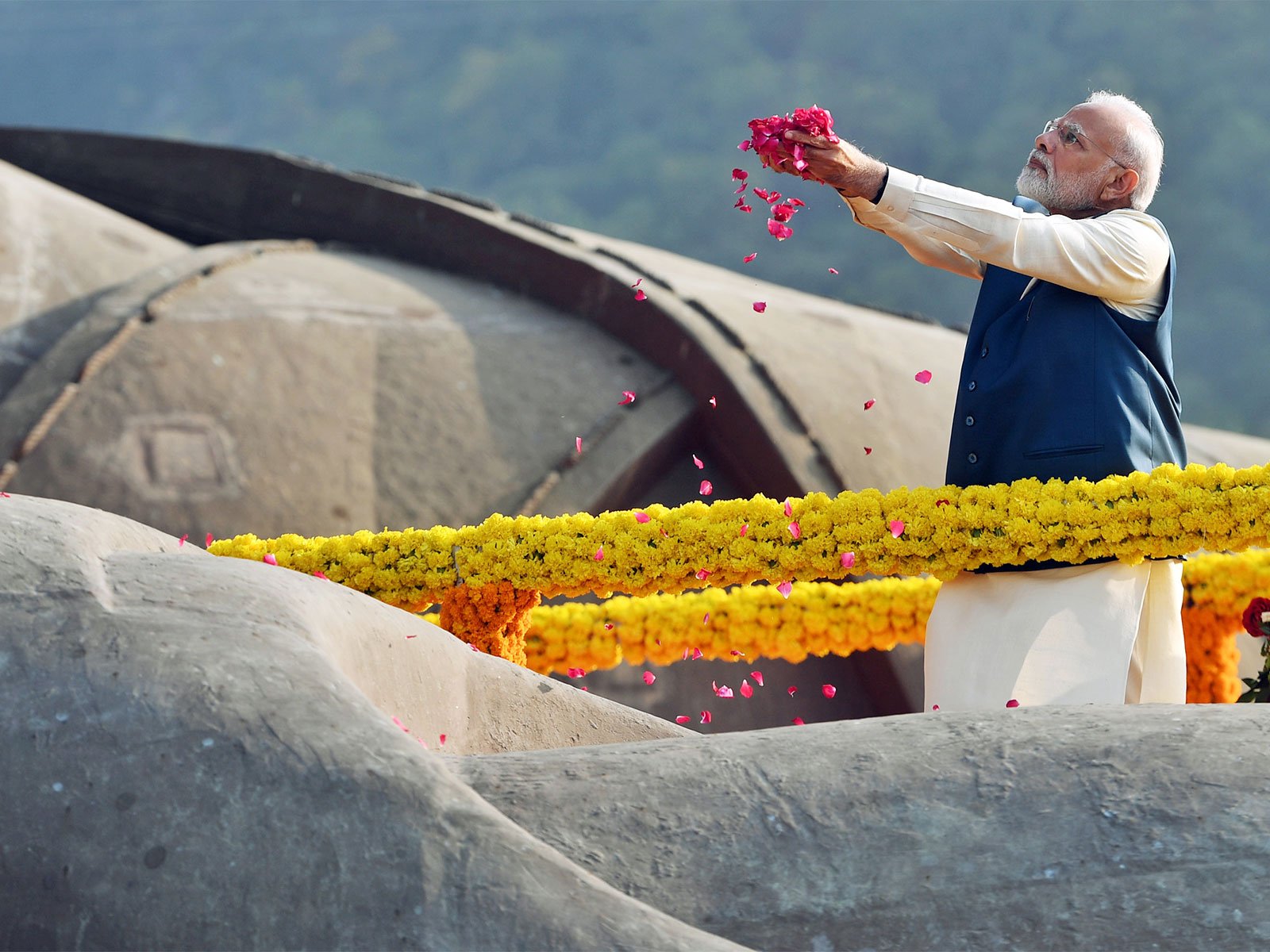
Prime Minister Narendra Modi on Saturday, October 31, 2026, paid floral tributes to Sardar Vallabhbhai Patel at the Statue of Unity in Kevadia, Gujarat, marking the 151st birth anniversary of India’s first Deputy Prime Minister and the observance of Rashtriya Ekta Diwas, or National Unity Day.
Remembering Patel’s contribution to India’s freedom struggle and nation-building, Modi described him as the “pioneer of ‘Akhand Bharat'” and the “Iron Man of the country”. He said Patel had dedicated his life to building a strong, prosperous and capable India, adding that his sacrifices and commitment continued to inspire the country’s pursuit of development and self-reliance.
The annual observance of Rashtriya Ekta Diwas highlights Patel’s role in national integration, particularly his efforts to bring hundreds of princely states into the Indian Union following Independence. The occasion is marked by ceremonial tributes, the Run for Unity and events across the country promoting national unity and integrity.
PM Modi Pays Tribute to Sardar Vallabhbhai Patel at Statue of Unity
Modi visited the Statue of Unity in Kevadia, Gujarat, on Patel’s birth anniversary and offered floral tributes to the country’s first Deputy Prime Minister. The monument, located near the Sardar Sarovar Dam, stands as a tribute to Patel’s contribution to India’s political integration after Independence.
In a message posted on X earlier in the day, the Prime Minister remembered Patel as a leader whose vision and determination helped shape modern India.
“Heartfelt tributes Sardar Vallabhbhai Patel, the pioneer of ‘Akhand Bharat’ and the Iron Man of the country, on his birth anniversary. He dedicated his life to the creation of a strong, prosperous, and capable India,” Modi said.
The Prime Minister added that Patel’s sacrifices and commitment to public service remained a source of inspiration for the country’s efforts to build a developed and self-reliant India.
Modi’s remarks placed particular emphasis on Patel’s role in strengthening national unity. The reference to ‘Akhand Bharat’ reflected the historical significance of the integration of princely states, which helped establish the territorial and political foundation of the Indian Union after the end of British rule.
Why India Celebrates Rashtriya Ekta Diwas on October 31
Rashtriya Ekta Diwas is observed every year on October 31 to commemorate the birth anniversary of Sardar Vallabhbhai Patel. The Centre introduced the national observance in 2014 to recognise his contribution to India’s unity and encourage citizens to uphold the country’s integrity and security.
Patel was born on October 31, 1875, in Nadiad, in present-day Gujarat. He became one of the leading figures of India’s freedom movement and later played a central role in shaping the administrative and political structure of independent India.
Known as the Iron Man of India, Patel is particularly remembered for his role in integrating the princely states into the Indian Union. At the time of Independence in 1947, the country faced the challenge of bringing hundreds of princely territories into a unified political system.
As India’s first Deputy Prime Minister and Home Minister, Patel led the political and administrative efforts to secure the accession and integration of these states. His work helped prevent the fragmentation of the newly independent country and strengthened the foundations of the Indian Union.
The annual observance of Rashtriya Ekta Diwas is intended to renew public commitment to national unity, territorial integrity and security. Government programmes on the day also highlight Patel’s leadership and his contribution to the formation of modern India.
Run for Unity Highlights Patel’s Contribution to National Integration
The Run for Unity is among the main public events organised on Rashtriya Ekta Diwas. The initiative encourages people from different communities and backgrounds to participate in activities promoting national solidarity.
The event is organised in several parts of the country, with government officials, students, security personnel, public representatives and citizens taking part. Participants use the occasion to reaffirm their commitment to India’s unity and integrity.
The run is linked to Patel’s efforts to bring the princely states together after Independence. His political leadership during that period is widely regarded as one of the most consequential developments in the early years of the Indian Republic.
Alongside the public run, the observance includes floral tributes, ceremonial programmes and activities that focus on Patel’s role in the freedom movement and the integration of the country.
President Droupadi Murmu and Other Leaders Pay Tributes
Several senior political leaders also paid floral tributes to Sardar Vallabhbhai Patel on his 151st birth anniversary. President Droupadi Murmu, Vice President C. P. Radhakrishnan, Union Home Minister Amit Shah and Union Minister Hardeep Singh Puri were among those who honoured the leader.
The participation of leaders from different constitutional and government positions reflected the national significance attached to Patel’s birth anniversary. The observance is not limited to Gujarat, where he was born, but is marked through programmes and tributes across India.
Patel’s legacy remains closely associated with the country’s political consolidation after 1947. His work involved negotiations with princely rulers, administrative planning and efforts to establish a unified political framework during a period of major uncertainty and transition.
The annual tributes provide an opportunity for public institutions to recall these contributions and highlight the importance of national integration in India’s development.
Amit Shah Calls for a Drug-Free India by December 31, 2029
Union Home Minister Amit Shah addressed the Run for Unity event in New Delhi, where he recalled Patel’s role in uniting the country after Independence. Shah said Patel’s contribution to national integration continued to serve as an example for future generations.
Shah also used the occasion to appeal for a nationwide effort to make India drug-free by December 31, 2029. He described the goal as important for the country’s young population and future generations.
The appeal placed the issue of drug abuse alongside the broader message of national responsibility associated with Rashtriya Ekta Diwas. The government’s anti-drug efforts involve public awareness, law enforcement, rehabilitation and action against networks involved in the illegal drug trade.
Shah’s remarks called for participation beyond government agencies, encouraging citizens and institutions to contribute to efforts aimed at preventing substance abuse. His target date of December 31, 2029, provides a stated deadline for the nationwide campaign.
How Sardar Vallabhbhai Patel Helped Unite India After Independence
Patel’s contribution to India’s national integration remains the central reason for his association with Rashtriya Ekta Diwas. When British rule ended in August 1947, the Indian subcontinent was divided into India and Pakistan, while hundreds of princely states faced decisions about their political future.
These princely states were governed by hereditary rulers under arrangements with the British Crown. The end of British paramountcy meant that their relationship with the departing colonial administration would no longer continue in the same form. Their accession and integration became a major challenge for the new Indian government.
As Deputy Prime Minister and Home Minister, Patel worked with V. P. Menon, a senior civil servant who played a key role in developing and implementing the integration strategy. Together, they pursued negotiations with princely rulers and encouraged them to sign the Instrument of Accession, through which they agreed to join India in specified areas of governance.
The process required political negotiations, administrative arrangements and, in some cases, the use of more direct measures. Most princely states joined India through accession arrangements, although a few cases involved prolonged disputes and complex political developments.
Hyderabad, Junagadh and Jammu and Kashmir presented particularly difficult challenges. Their circumstances differed, and each required a distinct political and administrative response. The eventual integration of these territories became part of the larger process through which the Indian Union took shape.
Patel’s leadership helped the new government address the risk of political fragmentation at a time when the country was also dealing with Partition-related violence, displacement and the challenge of establishing administrative institutions.
Why the Statue of Unity Is Central to Patel’s Legacy
The Statue of Unity in Kevadia is one of the most prominent national monuments dedicated to Sardar Vallabhbhai Patel. Standing at 182 metres, it is recognised as the world’s tallest statue and has become a major landmark in Gujarat.
The monument was inaugurated on October 31, 2018, on Patel’s birth anniversary. Its location near the Narmada River and the Sardar Sarovar Dam connects the memorial with the region where Patel was born and raised.
The statue represents Patel’s role in bringing the princely states together and building a unified country after Independence. It also serves as a major visitor destination, attracting tourists, students and people interested in India’s history and national movement.
Annual celebrations at the site give the government an opportunity to highlight Patel’s contributions through public ceremonies and programmes. Modi’s visit on the 151st birth anniversary continued this tradition of commemorating the leader at the monument built in his honour.
Patel’s Role in Building India’s Administrative Institutions
Patel’s contribution to independent India extended beyond the integration of princely states. He also played an important role in shaping the country’s administrative structure during its early years.
As India’s first Home Minister, he was responsible for important internal governance issues at a time when the country was dealing with the consequences of Partition and the transition from colonial administration to self-government.
Patel strongly supported the development of a professional civil service that could maintain administrative continuity and implement government policies across the country. He is often associated with the development of the modern Indian administrative system and the strengthening of the All India Services.
His approach reflected the belief that political independence required strong institutions capable of maintaining stability, implementing laws and supporting national development. The civil services were expected to provide administrative coordination across states and the Union government.
This aspect of Patel’s legacy is often discussed alongside his role in political integration. Bringing territories together was only one part of the challenge; building institutions capable of governing the newly unified country was another.
151st Birth Anniversary Highlights Patel’s Continuing National Legacy
The 151st birth anniversary observance once again brought attention to Patel’s place in India’s political history. From the integration of princely states to the development of administrative institutions, his work influenced the structure of the country in the years immediately following Independence.
Modi’s tribute at the Statue of Unity described Patel as the pioneer of ‘Akhand Bharat’ and the Iron Man of India, while emphasising the continued relevance of his dedication and sacrifices. Other senior leaders also paid their respects and participated in programmes organised to mark Rashtriya Ekta Diwas.
The annual observance is intended to connect Patel’s historical contribution with the present-day importance of national unity and security. The Run for Unity, ceremonial tributes and public programmes provide different ways for citizens to participate in the occasion.
As India marks another birth anniversary of its first Deputy Prime Minister, Patel’s role in bringing the country together remains the defining part of his national legacy. His efforts during the uncertain years after Independence continue to shape how the country remembers the process of political integration and the establishment of a unified Indian Union.
For breaking news and live news updates, like us on Facebook or follow us on Twitter and Instagram. Read more on Latest India on thefoxdaily.com.

COMMENTS 0