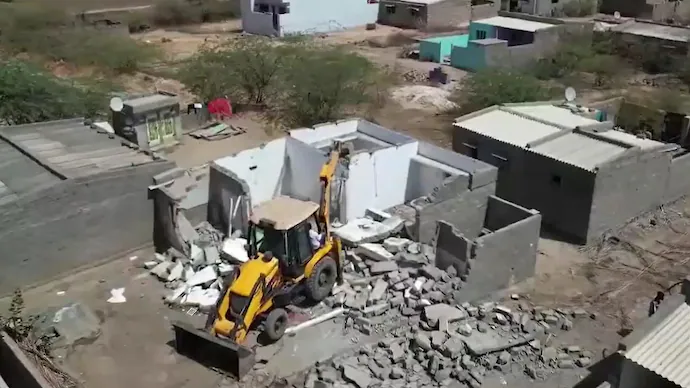
Authorities in Gujarat’s East Kutch district have removed 1,445 illegal encroachments from Government Land this year, reclaiming more than 5 lakh square metres of land valued at over Rs 200 crore. The large-scale operation has been carried out by the district administration and police as part of an ongoing effort to address unauthorised occupation of public land.
The drive has covered several areas of East Kutch, including Gandhidham, Anjar, Adipur and Rapar. According to information shared by the administration, the cleared land represents a significant recovery of government property across the district.
The operation follows directions from the Gujarat government to take action against illegal encroachments. Police and administrative officials have coordinated their efforts to identify and remove unauthorised occupations, with the campaign extending across multiple locations.
The reported value of the reclaimed land, which exceeds Rs 200 crore, highlights the financial significance of the operation. However, the administration’s figures relate to the estimated value of the government land cleared, rather than money collected or recovered as revenue.
East Kutch encroachment drive: Key details
The figures released by the district administration provide an overview of the scale of the anti-encroachment campaign carried out in East Kutch this year.
- Total encroachments removed: 1,445.
- Government land reclaimed: More than 5 lakh square metres.
- Estimated land value: Over Rs 200 crore.
- Locations covered: Gandhidham, Anjar, Adipur, Rapar and other areas of East Kutch.
- Authorities involved: District administration and police.
- Basis for the drive: Directions from the Gujarat government to act against illegal occupation of government land.
The figures indicate that the campaign has been conducted across a broad area rather than being limited to a single locality. The removal of more than 1,400 encroachments also points to the scale of the administrative effort required to reclaim public property.
At the same time, the information released so far does not specify the number of individual occupants affected, the types of structures removed or the precise distribution of the reclaimed land among the locations covered.
Government land cleared across Gandhidham, Anjar, Adipur and Rapar
The encroachment-removal campaign has covered several parts of East Kutch, including Gandhidham, Anjar, Adipur and Rapar. These locations form part of the district-wide operation intended to address the unauthorised occupation of government property.
Clearing encroachments across multiple areas requires coordination between officials responsible for identifying government land, verifying occupation and carrying out removal operations. The administration and police have worked together in the East Kutch drive, according to the information shared about the campaign.
The district administration has reported that more than 5 lakh square metres of land have been cleared so far this year. The announcement does not provide a location-wise breakdown showing how much land was reclaimed in each town or how many encroachments were removed from individual areas.
Such details would help establish where the largest recoveries have occurred and how the operation has progressed across the district. For now, the overall figures offer the clearest picture of the campaign’s reported scale.
Why authorities are targeting illegal occupation of government land
Government land is held for public purposes and may be used for infrastructure, civic facilities, administrative requirements and other authorised activities. Unauthorised occupation can complicate the management of public property and restrict the government’s ability to use land for its intended purposes.
Encroachment-removal campaigns are intended to restore control over land that authorities identify as illegally occupied. In East Kutch, the administration has linked its operation to directions from the Gujarat government to take action against such occupation.
Reclaiming land can also help authorities establish clearer control over government assets. Where encroachments prevent access to public property or interfere with planned uses, their removal may create opportunities for the land to be managed according to official requirements.
However, the removal of an encroachment does not automatically mean that the reclaimed land will immediately be assigned to a new project or public service. The information released about the East Kutch campaign does not identify specific future uses for the recovered plots.
The distinction is important because the immediate outcome of an anti-encroachment drive is the removal of unauthorised occupation. Any subsequent decision about the land’s use would depend on the government’s plans and the applicable administrative procedures.
Authorities also target encroachments allegedly linked to criminal backgrounds
The operation has also included action against encroachments on government land allegedly involving people described by the administration’s account as history-sheeters, accused in murder cases, notorious liquor smugglers and individuals involved in intimidation.
The inclusion of these categories indicates that authorities have pursued cases involving alleged criminal activity alongside the broader campaign against illegal occupation of public land.
However, allegations and criminal records must be distinguished from proven guilt in individual cases. A person accused of an offence is not necessarily convicted, and the available information does not provide case-by-case details about the individuals connected to the encroachments.
The announcement also does not specify how many of the 1,445 cases involved people with alleged criminal links, what offences were involved in individual matters or whether separate criminal proceedings accompanied the land-reclamation action.
The central reported outcome remains the removal of encroachments from government property. Any assessment of related criminal cases would require additional information about the individuals involved, the allegations made and the outcomes of legal proceedings.
Role of police and district administration in the operation
The East Kutch campaign has involved coordinated action by the police and the district administration. Their combined role is significant in a large-scale operation that requires officials to address illegal occupation at multiple locations.
The administration is responsible for matters relating to government land and the implementation of official directions, while police involvement can support enforcement operations where required. The reported coordination reflects a joint approach to carrying out the drive across the district.
The campaign follows directions from the Gujarat government, placing the local operation within a broader state-level effort to address unauthorised occupation of government property.
Nevertheless, the available announcement does not describe the complete operational process, including how each encroachment was identified, what notices were issued or what procedures were followed in individual cases. It also does not provide a detailed account of the number of officials involved or the resources used.
These details would be relevant to understanding how the operation was implemented and how authorities addressed different types of occupation. The published figures establish the reported scale of the results but do not, on their own, explain every step taken in the removal process.
What the Rs 200 crore land valuation means
The government land reclaimed in East Kutch has been valued at more than Rs 200 crore, according to the administration’s figures. This estimate gives an indication of the financial value of the public property affected by the campaign.
Land valuation and cash recovery, however, are different measures. The reported Rs 200 crore represents the estimated value of the reclaimed land; it should not be interpreted as an amount collected through fines, penalties, sales or compensation.
The figures also do not establish whether the entire reclaimed area has been independently valued plot by plot or whether the estimate follows a particular valuation method. No detailed breakdown of land prices, individual properties or valuation criteria was included in the available information.
Even with those limitations, the reported value underlines why the management of government land can be financially significant. Public property represents an asset that authorities must identify, protect and administer, and unauthorised occupation can make that task more difficult.
The practical long-term impact of the drive will depend partly on whether the reclaimed land remains under effective government control and is managed according to the relevant rules. The announcement does not yet provide details about monitoring arrangements or the future allocation of the recovered land.
Questions that remain about the East Kutch drive
Although the administration has announced substantial figures for the campaign, several details remain unclear from the information released so far.
- Location-wise results: The total number of encroachments removed is available, but individual figures for Gandhidham, Anjar, Adipur and Rapar have not been provided.
- Types of encroachments: The announcement does not detail how many cases involved residential structures, commercial premises or other forms of occupation.
- Legal procedures: Information about notices, individual disputes, appeals and other procedures followed in specific cases is not included.
- Future use of the land: The administration has not identified specific projects or public purposes for which the reclaimed plots will be used.
- Prevention of renewed encroachment: Details about monitoring and other measures to prevent the land from being occupied again have not been disclosed in the available account.
These details would help provide a fuller assessment of the campaign beyond the headline figures. They would also clarify how the authorities intend to maintain the results of the operation over time.
What happens next?
The removal of 1,445 encroachments marks a substantial reported recovery of government land in East Kutch this year. The operation has covered multiple locations and reclaimed an area exceeding 5 lakh square metres, with an estimated value of more than Rs 200 crore.
The longer-term significance of the drive will depend on how the administration manages the recovered land, ensures compliance with applicable rules and addresses any further cases of unauthorised occupation.
Continued coordination between the police and administrative authorities may remain important if the government intends to sustain its campaign against encroachments. However, the available information does not establish a future timetable, a target for additional removals or a specific next phase of the operation.
Conclusion
Gujarat’s East Kutch district has removed 1,445 illegal encroachments from government land this year, reclaiming more than 5 lakh square metres of property valued at over Rs 200 crore. The operation has covered Gandhidham, Anjar, Adipur, Rapar and other areas, with the police and district administration working together following state government directions.
The campaign highlights the scale of the effort to restore government control over public property. Its reported results are substantial in terms of the number of encroachments removed and the area reclaimed, although the announcement does not provide a detailed breakdown of individual cases or specify how the recovered land will be used.
The next important measure will be the effective management and protection of the reclaimed land. Preventing renewed unauthorised occupation and ensuring that government property is administered according to applicable rules will be central to sustaining the results of the operation.
For breaking news and live news updates, like us on Facebook or follow us on Twitter and Instagram. Read more on Latest India on thefoxdaily.com.




COMMENTS 0