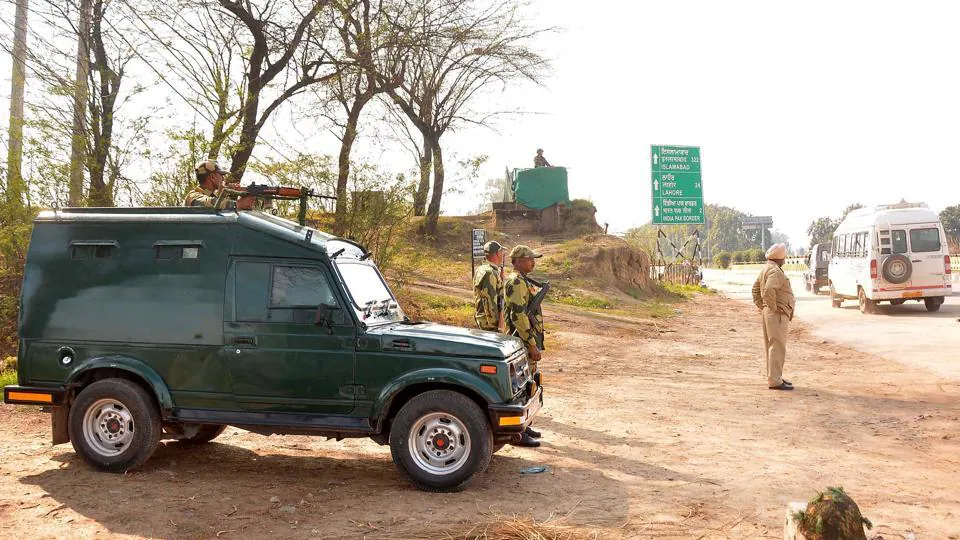
A Punjab Police constable assigned to an anti-drone unit allegedly used his operational knowledge to help cross-border drug traffickers deliver heroin into India, with investigators linking him to at least 24 suspected consignments since June 2026. The case has raised concerns about the use of drones for narcotics smuggling along the India-Pakistan border and the potential risks posed when personnel familiar with security deployments are accused of collaborating with trafficking networks.
Karandeep Singh, who was arrested by the Border Security Force (BSF) in Tarn Taran district on October 15 while allegedly smuggling 15 kilograms of high-grade heroin, was subsequently handed over to the Narcotics Control Bureau (NCB). According to officers cited in the report, investigators believe he helped smugglers identify safer locations for drone-based deliveries while maintaining his position within the police force.
The investigation has also brought a second individual, Lakwinder Singh, a former sarpanch of Rajoke village in Tarn Taran, into custody. Authorities are examining whether the two arrests expose a wider cross-border trafficking operation that continued despite an apparent decline in drone interceptions in the area.
Punjab Constable Allegedly Used Anti-Drone Knowledge to Assist Smugglers
Karandeep Singh was posted with a Punjab Police anti-drone unit responsible for helping detect and intercept drones allegedly used to transport drugs and weapons across the India-Pakistan border. His assignment gave him familiarity with security deployments and the operational environment in Tarn Taran district.
An NCB officer, speaking on condition of anonymity, alleged that Karandeep used this knowledge to guide his handlers towards locations where drone deliveries could be completed with a lower risk of detection. Investigators reportedly examined communications between the constable and contacts across the border to identify the suspected delivery locations.
According to the officer, Karandeep initially began collecting drug consignments in June. From August onwards, he allegedly became more directly involved in helping his handlers identify suitable drop zones. Investigators said the communications and locations they examined allowed them to link the accused to at least 24 suspected deliveries.
The allegations are particularly significant because anti-drone personnel are expected to help prevent the very activity the constable is accused of facilitating. However, the allegations remain part of an ongoing investigation, and the reported number of deliveries should not be treated as a final judicial finding.
Arrest Followed Recovery of 15 Kilograms of Heroin
The case came to light on October 15, when the BSF intercepted Karandeep in Tarn Taran while he was allegedly transporting 15 kilograms of high-grade heroin. The NCB subsequently took over the investigation into the suspected trafficking operation.
The recovery forms a central part of the case against the constable, while investigators are also examining his alleged communications with handlers operating from Pakistan and his role in earlier consignments.
Authorities are expected to use the evidence gathered during questioning and forensic examination to establish the extent of the suspected operation. The available account does not establish whether all 24 alleged deliveries involved the same quantity of heroin or whether every suspected consignment was successfully recovered by traffickers.
The distinction matters because drone-based smuggling operations can involve multiple participants, including people who arrange deliveries, collect payloads and transport drugs away from border areas. Establishing the role of each suspect requires evidence connecting individuals to particular consignments and communications.
How Drug-Smuggling Drones Deliver Heroin Across the Border
Drones have become a recurring concern for security agencies monitoring the India-Pakistan border. According to the officers cited in the report, the drones used by traffickers can carry payloads weighing approximately five to 15 kilograms of heroin.
The consignments are reportedly attached to drones using hooks. After crossing the border, a drone can release its payload at a designated location, where a person on the ground may retrieve it and move the drugs away from the immediate border area.
This method can reduce the need for a courier to cross the border physically. It also creates challenges for security forces because a drone may be detected only after it has entered the area, while the people expected to collect its payload may be difficult to identify.
In the Punjab case, investigators allege that Karandeep’s familiarity with anti-drone deployments helped him provide information about potential drop zones. If established, such assistance could have enabled handlers to make more informed decisions about where to send consignments.
However, identifying a suspected delivery location does not automatically establish who collected a particular payload or whether every flight resulted in a successful transfer. Investigators must connect flight records, communications, recovered material and the actions of individual suspects to build a complete account of the operation.
Constable Allegedly Recruited Through Drug Addiction
According to an officer familiar with the investigation, Karandeep told interrogators that he had previously been addicted to heroin. Investigators suspect that traffickers exploited this vulnerability to recruit him into the smuggling network.
A second officer said the constable was allegedly contacted through encrypted calls from Pakistan earlier in 2026. He was reportedly offered a share of drugs and money in exchange for participating in the operation.
The officer added that Karandeep claimed he did not know how the people contacting him had learned about his drug use. The account also described how trafficking networks may approach people in border villages and other vulnerable communities to recruit individuals who can assist with local collection and distribution.
These statements have been attributed to the accused during questioning and to officers involved in the case. They do not independently establish the full circumstances of his alleged recruitment or the identities and responsibilities of everyone involved.
The allegations nevertheless highlight a potential vulnerability for enforcement agencies: people familiar with security procedures may be targeted because their knowledge can be useful to criminal networks. The case also underscores the importance of monitoring for possible conflicts of interest and investigating credible indications of misconduct without assuming guilt before the evidence is tested.
Why Karandeep Singh Obtained an Arms Licence
Investigators have also raised questions about an arms licence obtained by Karandeep for a personal weapon. According to an NCB officer, the constable cited a threat to his life arising from his alleged role in helping police uncover drug-related cases.
The officer alleged that the licence application was intended to preserve Karandeep’s standing within the police force while he secretly assisted trafficking handlers. This is an allegation about the motive behind the application, rather than an independently established finding.
The detail has attracted attention because the constable reportedly occupied a position associated with intercepting cross-border smuggling. Investigators will need to establish whether his claimed assistance in previous drug seizures was genuine, whether the cases were connected to his alleged trafficking activities and whether the arms licence was obtained through misleading representations.
Two Police Tips Allegedly Helped Maintain His Cover
According to the NCB officer, Karandeep passed information to police on two occasions that led to drug seizures. Investigators suspect that these actions may have helped him maintain credibility while allegedly facilitating other consignments.
The reported pattern illustrates a challenge in complex criminal investigations: a suspect may provide information that leads to genuine seizures while also being accused of participating in other illegal activities. A successful tip-off, by itself, does not prove that a person was acting in good faith or that the person was involved in a wider network.
Authorities will need to determine what information Karandeep supplied, how the resulting seizures were carried out and whether there is evidence that those incidents were intended to divert suspicion from other activities.
The available information does not identify the dates, quantities or locations associated with the two reported seizures. Those details would be necessary to assess how the incidents relate to the wider allegations.
Former Rajoke Sarpanch Lakwinder Singh Also in NCB Custody
The investigation widened after local Punjab media reported the arrest of Lakwinder Singh, a former sarpanch of Rajoke village in Tarn Taran district. He was also reported to be in NCB custody as investigators examined his possible connection to the suspected smuggling operation.
A BSF officer said Lakwinder had been on the force’s radar for an extended period. Local BSF teams had reportedly searched his residence several times but did not recover evidence during those searches.
The officer said forensic analysis of several recovered drones had shown flight paths near or above Lakwinder’s house on multiple occasions. Investigators suspected that the drones may have released drug consignments at or near the property.
According to the officer, Lakwinder had previously denied knowledge of the suspected activity, and searches had not produced material that established his involvement. His arrest has now renewed scrutiny of the drone movements and the possible use of locations within Rajoke as collection points.
Drone flight paths can help investigators identify places that warrant further examination, but location data alone does not establish who owned, controlled or used a property or whether its occupants knew about a suspected delivery. The evidence against each individual must be assessed separately.
Rajoke Village Has Emerged as a Cross-Border Smuggling Hotspot
Rajoke, a border village in Tarn Taran district, has been identified by security officials as a recurring location of concern in cross-border smuggling cases.
According to the BSF officer, at least 11 drones had been shot down in the area since 2023. The number of reported interceptions declined from 2025, and only one drone was reportedly intercepted in Rajoke in April 2026.
The apparent reduction had led some local BSF officers to believe that traffickers were no longer using the route as frequently. The arrests of Karandeep and Lakwinder have prompted officials to reconsider that assessment.
The BSF officer suggested that the decline in interceptions did not necessarily mean the trafficking activity had stopped. Instead, the suspected network may have adapted its methods to reduce the chances of detection.
This distinction is important when interpreting border-security statistics. A fall in the number of drones intercepted can reflect a genuine decline in attempted smuggling, but it can also reflect changes in routes, timing, flight patterns or other operational methods. Interception figures alone cannot establish which explanation applies in a particular area.
The current investigation may help determine whether Rajoke remained an active route, how the suspected drop zones were selected and whether other locations were used to collect payloads.
Punjab Accounted for Nearly All Drone-Related Drug Seizures Reported in 2025
The scale of drone-based narcotics smuggling in Punjab is reflected in seizure figures cited in the report. Drug enforcement agencies registered 305 drone-related seizure cases across India in 2025, recovering 468 kilograms of narcotics.
Punjab accounted for 298 of those cases and 461 kilograms of seized drugs, primarily heroin. The figures indicate that the state represented the overwhelming majority of the reported cases and recovered quantity during that period.
These numbers measure recorded seizure cases and recovered narcotics, not the total amount trafficked across the border. They also do not establish how many consignments escaped detection or how many separate trafficking networks were operating.
Nevertheless, the concentration of reported cases in Punjab demonstrates why the state remains a major focus for agencies working to counter drone-assisted smuggling. The combination of cross-border routes, local collection points and the potential involvement of insiders creates a complicated enforcement challenge.
The Karandeep case adds another dimension to that challenge because the accused was allegedly assigned to a unit intended to counter drone activity. Investigators will need to establish whether the alleged conduct involved only his individual actions or whether other personnel or local contacts also assisted the operation.
Another Punjab Police Officer Arrested in a Separate Heroin Case
The allegations against Karandeep emerged weeks after Punjab Police arrested an inspector assigned to a counter-intelligence unit on September 26. The inspector was accused of smuggling 3.35 kilograms of heroin, six pistols and six mobile phones.
The September case and the October arrest involve different officers and should not automatically be treated as part of the same operation. The available information does not establish a direct connection between the two investigations.
However, both cases have drawn attention to allegations involving law-enforcement personnel and narcotics-related offences. Such cases can complicate efforts to disrupt trafficking networks because officers may have access to operational information, local contacts or resources that are valuable to criminal groups.
Any broader assessment of misconduct would require details about the evidence, charges and outcomes in each case. Arrests and allegations alone do not establish guilt or demonstrate that wrongdoing is widespread across a police force.
Drug Trafficking Remains a National Security Priority
Union Home Minister Amit Shah has described the fight against narcotics as a continuing national challenge. Speaking at a Police Commemoration Day event in New Delhi, Shah said that, despite progress against other security threats, several problems remained unresolved.
Shah said the Union Home Ministry had set a target of freeing the country from the drug menace by December 31, 2029. He called for a coordinated effort during the remainder of 2026 and throughout 2027, 2028 and 2029.
The stated target places drug enforcement among the government’s longer-term priorities. Tackling the problem requires more than intercepting individual consignments: agencies must also investigate supply networks, identify collection points, disrupt financial arrangements and prevent the recruitment of people who can assist traffickers.
In border districts, those efforts can involve coordination among the BSF, state police, the NCB and other relevant agencies. Each organisation has different responsibilities, making information sharing and evidence-led investigations important when a case crosses institutional boundaries.
The allegations against Karandeep also illustrate why internal accountability can be important to border enforcement. If a person with operational knowledge is found to have assisted smugglers, agencies may need to review how sensitive information is accessed, monitored and protected. Any such measures would need to be based on the evidence uncovered during the investigation.
What Investigators May Examine Next
Several questions remain central to the case. Investigators will need to establish the extent of Karandeep’s alleged involvement, identify the people who communicated with him from across the border and determine how the suspected consignments were collected and distributed.
- Communications evidence: Investigators may examine available call records, encrypted communications and other digital evidence to establish contact patterns and the information allegedly exchanged.
- Drone forensics: Recovered drone data and flight-path analysis may help identify suspected routes, landing or drop locations and links between different incidents.
- Physical evidence: Recovered heroin, equipment and other material may help connect particular suspects to specific consignments.
- Suspected collection points: Authorities may examine locations identified through drone analysis to determine whether drug payloads were delivered there and who, if anyone, collected them.
- Financial and personal links: Investigators may seek evidence of payments, transfers or other arrangements allegedly connecting participants in the suspected network.
- Separate roles of suspects: The evidence will need to distinguish the alleged activities of Karandeep, Lakwinder and any other individuals who may be identified.
These are potential investigative avenues rather than confirmation that every step has already been taken. The available report does not provide a complete account of the evidence gathered or indicate when the investigation will conclude.
Why the Case Matters for Border Security
The case highlights the evolving nature of cross-border narcotics smuggling and the difficulty of detecting operations that combine unmanned aircraft with people on the ground. Even when security agencies intercept drones, the people arranging deliveries and collecting payloads may remain unidentified unless investigators can connect the flight to a specific network.
It also underscores the importance of distinguishing a reduction in visible incidents from a confirmed reduction in trafficking. The reported decline in drone interceptions in Rajoke had led some officers to believe that the route was no longer active. The latest arrests have raised questions about whether traffickers continued operating through methods that were harder to detect.
At the same time, the allegations must be treated carefully. Karandeep’s arrest, the reported recovery of heroin and the NCB’s investigation are significant developments, but the full extent of the alleged network and the responsibility of each suspect remain matters for the investigative and judicial process.
For authorities, the central task is to establish how the suspected deliveries were organised, determine whether security information was misused and identify any additional participants supported by evidence. The outcome could provide a clearer picture of how drone-based smuggling networks operate along the Punjab border and what measures may be needed to counter them.
Frequently Asked Questions
Who is Karandeep Singh?
Karandeep Singh is a Punjab Police constable who was assigned to an anti-drone unit. The BSF arrested him in Tarn Taran on October 15, 2026, while he was allegedly smuggling 15 kilograms of high-grade heroin. The NCB subsequently took over the case.
How many drug deliveries is Karandeep Singh accused of helping?
According to an NCB officer cited in the report, investigators linked Karandeep to at least 24 suspected deliveries based on communications with handlers in Pakistan and the drop-zone locations he allegedly provided.
How did the constable allegedly assist the smugglers?
Investigators allege that he used his knowledge of anti-drone deployments in Tarn Taran district to guide handlers towards locations where drone-delivered drug consignments could be collected.
How much heroin was recovered when Karandeep was arrested?
The BSF reportedly intercepted Karandeep while he was allegedly smuggling 15 kilograms of high-grade heroin on October 15, 2026.
Who is Lakwinder Singh?
Lakwinder Singh is a former sarpanch of Rajoke village in Tarn Taran district. He was reported to have been arrested and placed in NCB custody as investigators examined his possible links to the suspected drone-smuggling operation.
Why is Rajoke village significant in the investigation?
Security officials have identified Rajoke as a recurring cross-border smuggling hotspot. According to a BSF officer, at least 11 drones were shot down in the area from 2023 onwards, although interceptions declined in 2025 and only one was reportedly recorded there in April 2026.
How much narcotics did agencies seize in drone-related cases in 2025?
The figures cited in the report state that agencies registered 305 drone-related seizure cases across India in 2025 and recovered 468 kilograms of narcotics. Punjab accounted for 298 cases and 461 kilograms, primarily heroin.
What is the government’s stated target for tackling drugs?
Union Home Minister Amit Shah said the Home Ministry had set a target of freeing India from the drug menace by December 31, 2029, through coordinated efforts over the remaining part of 2026 and the following three years.
Conclusion
The allegations against Karandeep Singh have placed renewed attention on drone-assisted heroin smuggling along the India-Pakistan border. Investigators suspect that the Punjab Police constable used his knowledge of anti-drone deployments to help handlers identify drop zones for at least 24 drug deliveries, while the arrest of former Rajoke sarpanch Lakwinder Singh has expanded the inquiry into possible local collection points.
The case also raises questions about the meaning of declining drone-interception figures and the safeguards needed to protect sensitive operational information. As the NCB investigates the alleged deliveries and the roles of those in custody, the evidence gathered will be crucial in determining how the suspected network operated and whether further arrests or charges follow.
For breaking news and live news updates, like us on Facebook or follow us on Twitter and Instagram. Read more on Latest India on thefoxdaily.com.





COMMENTS 0