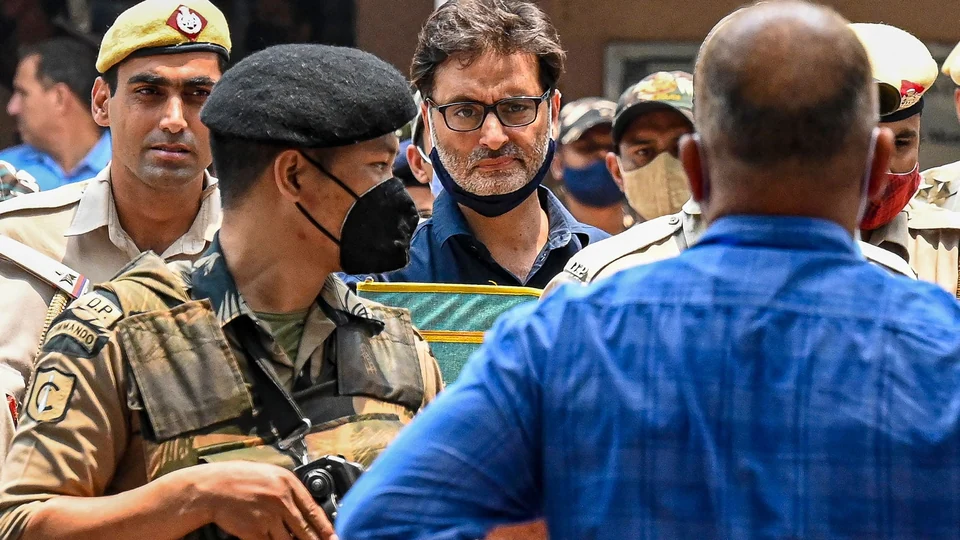
A Delhi Court has ordered the commencement of trial against jailed Kashmiri separatist leader Yasin Malik, Baramulla MP Sheikh Abdul Rashid, popularly known as Engineer Rashid, and five other accused in an alleged ₹8.94 crore terror-funding and money-laundering case linked to Pakistan-based hawala channels.
Special Judge Prashant Sharma of the Rouse Avenue Courts formally framed charges against the accused on Friday and directed that the recording of prosecution evidence begin on November 19. The case concerns allegations that money generated through criminal activities was transferred, concealed and used to support secessionist activities in Jammu and Kashmir.
The proceedings mark a further stage in the money-laundering case being investigated by the Enforcement Directorate (ED). The agency alleges that funds were routed through multiple channels, including cash couriers and foreign contributions, to finance activities associated with separatist groups in the Valley.
The court had ordered the framing of charges on September 9, observing that the material on record raised a “strong suspicion” about the involvement of the seven accused in generating, receiving and laundering alleged proceeds of crime. The decision to proceed with the trial does not amount to a final determination of their guilt.
Yasin Malik Pleads Not Guilty, Says He Will Contest the Case
Friday’s proceedings were held in-camera, meaning they were conducted privately rather than in an open courtroom. Malik, the chief of the Jammu and Kashmir Liberation Front (JKLF), appeared through video conferencing from Tihar Jail.
Malik pleaded not guilty to the charges under the Prevention of Money Laundering Act (PMLA) and told the court that he would contest the case. His plea means the prosecution will have to present its evidence as the trial proceeds.
The court’s September order had concluded that sufficient material existed to raise a strong suspicion against all seven accused of committing an offence under Section 3 of the PMLA. Special Judge Prashant Sharma had stated that the material available at that stage justified framing charges.
The accused in the case are Yasin Malik, Zahoor Ahmad Shah Watali, Abdul Rashid Sheikh, Shabir Ahmad Shah, Masarat Alam, Naval Kishore Kapoor and Trison Farms and Constructions Pvt Ltd.
Sheikh Abdul Rashid, who is widely known as Engineer Rashid, is the Baramulla MP named in the case. The proceedings involve allegations against the accused as part of the wider investigation into the movement and use of funds allegedly linked to unlawful and secessionist activities in Jammu and Kashmir.
With prosecution evidence scheduled to begin on November 19, the next stage will focus on the material the investigating agency presents in support of its allegations. The accused will have the opportunity to contest the prosecution’s case through the legal process.
What Is the ₹8.94 Crore Terror-Funding Case?
The Enforcement Directorate alleges that criminal activities under investigation generated proceeds of crime amounting to ₹8.94 crore. According to the agency, the money was subsequently received, transferred, concealed, possessed, acquired and used by the accused through different channels.
The ED’s case concerns the alleged laundering of funds connected with terrorist and secessionist activities in Jammu and Kashmir. The agency has alleged that the money was moved through a network of intermediaries and financial channels to support activities linked to the separatist movement.
One of the agency’s allegations is that cash couriers carried funds from the Pakistan High Commission in New Delhi to members of the Hurriyat leadership, including Malik. The ED claims the money was intended to promote a secessionist agenda and support subversive activities in the Union Territory.
These allegations form part of the prosecution’s case and have not been established as final findings of guilt against all the accused. The trial will examine the evidence and the role attributed to each individual or entity.
The investigation also examined material allegedly recovered from Ghulam Mohd Bhat, who worked as an accountant-cum-cashier with Watali. According to the ED, documents recovered from Bhat indicated that Malik, Shabir Shah and Masarat Alam received foreign contributions through Watali during the 2015-16 financial year.
The agency has relied on these records to support its allegations about the movement of funds and the alleged links between financial transactions and separatist activities. The significance and evidentiary value of the material will be considered through the judicial process.
ED Alleges Foreign Fundraising Network Linked to Yasin Malik
The Enforcement Directorate has also relied on emails associated with Malik that it says indicate he developed a network to raise funds abroad for terrorist, secessionist and unlawful activities in Jammu and Kashmir.
According to the agency, the fundraising was carried out in the name of a “freedom struggle”, and the funds were allegedly used to sustain the JKLF and intensify secessionist violence. These claims are part of the ED’s allegations in the money-laundering case.
The agency further alleged that Malik received another ₹15 lakh through Watali during the 2015-16 financial year. It stated that the additional amount brought the total allegedly received by Malik through the transactions under discussion to ₹30.75 lakh.
The alleged transactions are relevant to the ED’s broader investigation into how funds were raised, transferred and used. The agency’s case seeks to establish a connection between the money and criminal activities covered by the relevant laws.
However, the allegations must be distinguished from a final judicial finding. Malik’s not-guilty plea means he has disputed the charges, and the prosecution evidence scheduled to be recorded from November 19 will form part of the next stage of the proceedings.
Alleged ₹15.75 Lakh Received From Saudi Arabia in 2013
The National Investigation Agency (NIA), in its second supplementary charge sheet, alleged that Malik received ₹15.75 lakh from Saudi Arabia in 2013.
The ED treated the amounts identified in the investigation as proceeds of crime allegedly derived from criminal activity connected with scheduled offences. The allegations concerning the Saudi Arabian funds form part of the wider inquiry into the sources and movement of money associated with the case.
The agency’s investigation has examined alleged foreign contributions, transfers through intermediaries and funds said to have been used to support separatist activities. The prosecution will need to establish the relevance of the evidence to the charges framed by the court.
The available information does not provide a separate breakdown explaining how the alleged ₹15.75 lakh received in 2013 relates to every transaction included in the broader ₹8.94 crore figure. The amounts should therefore be understood within the specific context in which the agencies have presented them, rather than treated as interchangeable totals.
How the ED and NIA Cases Are Connected
The money-laundering proceedings are linked to an NIA case registered in 2017 over an alleged larger conspiracy involving terrorist and secessionist activities in Jammu and Kashmir.
The NIA invoked provisions of the Indian Penal Code, including Section 120B concerning criminal conspiracy, Section 121 concerning waging war against the government and Section 121A concerning conspiracy to commit offences under Section 121. It also invoked provisions of the Unlawful Activities (Prevention) Act (UAPA).
The Enforcement Directorate registered its case on June 14, 2017, to investigate the alleged laundering of proceeds generated through criminal activities covered by the scheduled offences. The agency filed its main prosecution complaint in 2020.
A supplementary complaint filed in January 2023 named Malik as an accused in the ED proceedings. The investigation focused on the alleged financial networks and channels through which funds were raised and transferred.
The two investigations address connected but distinct aspects of the allegations. The NIA case concerns the alleged wider conspiracy involving terrorist and secessionist activities, while the ED proceedings examine the alleged laundering of proceeds associated with the scheduled offences.
The ED’s case relies on the premise that funds allegedly generated through criminal activity were subsequently moved or used through transactions that fall within the scope of the PMLA. The court’s decision to frame charges allows the prosecution to present evidence on those allegations during trial.
Yasin Malik’s 2022 Conviction in the NIA Case
The underlying NIA case ultimately resulted in Malik’s conviction in 2022. The agency had alleged that he was involved in terrorist and subversive activities in Jammu and Kashmir and in raising and receiving funds through illegal channels, including hawala transactions.
The earlier conviction is part of the background to the current proceedings, which concern alleged money laundering linked to the broader criminal activity investigated by the NIA. The present ED trial will address the charges framed in the money-laundering case and the evidence relied upon by the prosecution.
The distinction matters because the current proceedings concern the alleged handling and use of proceeds of crime under the PMLA. The court will consider the evidence relevant to those charges rather than treating the framing of charges as proof of every allegation made by the investigating agencies.
What Happens Next in the Terror-Funding Case?
The immediate next step is the recording of prosecution evidence, which the court has scheduled to begin on November 19. The prosecution will present the material it relies on to support its allegations against the seven accused.
The evidence is expected to be considered in the context of the alleged ₹8.94 crore in proceeds of crime, the claimed movement of funds through hawala channels, the alleged foreign contributions and the transactions identified during the investigation.
The accused will be able to contest the prosecution’s case through the legal process. Malik has already pleaded not guilty and stated that he intends to fight the charges.
The trial will therefore be an important stage in determining whether the prosecution can establish the allegations under the PMLA. Until the court reaches a final decision, the allegations against the accused remain allegations rather than established findings of guilt in this case.
Key Facts About the Yasin Malik and Engineer Rashid Case
- Court: Rouse Avenue Courts, Delhi.
- Judge: Special Judge Prashant Sharma.
- Case: Alleged ₹8.94 crore terror-funding and money-laundering case.
- Key accused: Yasin Malik, Baramulla MP Sheikh Abdul Rashid alias Engineer Rashid and five others.
- Legal provision: Section 3 of the Prevention of Money Laundering Act.
- Prosecution evidence: Scheduled to begin on November 19.
- Malik’s plea: He pleaded not guilty and said he would contest the charges.
- Related investigation: An NIA case registered in 2017 concerning an alleged larger conspiracy involving terrorist and secessionist activities in Jammu and Kashmir.
The Delhi court’s order moves the long-running money-laundering case into the trial stage, with prosecution evidence due to begin on November 19. The proceedings will examine the ED’s allegations about the sources, movement and use of funds allegedly linked to secessionist activities in Jammu and Kashmir, while the accused retain the right to contest the charges.
For breaking news and live news updates, like us on Facebook or follow us on Twitter and Instagram. Read more on Latest India on thefoxdaily.com.




COMMENTS 0