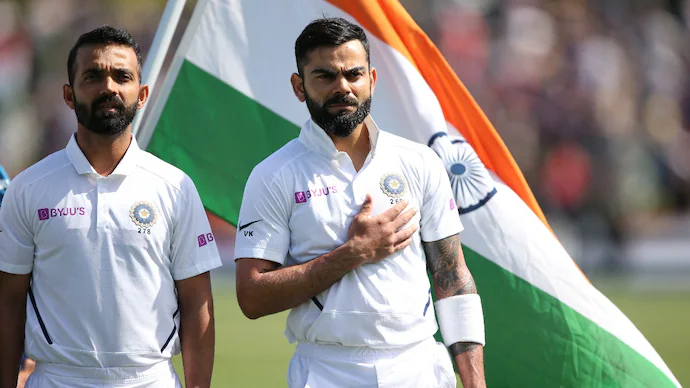
Former India batter Ajinkya Rahane has sparked discussion among cricket fans after revealing his all-time India Test XI, leaving out prominent names such as Virat Kohli, Rohit Sharma and Jasprit Bumrah. Instead, Rahane selected a team featuring several former teammates from different stages of his career, with Sachin Tendulkar, Rahul Dravid and MS Dhoni among the headline choices.
Rahane made his selections during an interaction with Sony Sports Network. He was asked to choose his all-time Indian Test XI from players he had played alongside in international or domestic cricket. His team reflects his personal experience of sharing dressing rooms with some of India’s most recognisable cricketers.
The lineup includes Murali Vijay and Shikhar Dhawan as openers, Dravid at No. 3 and Tendulkar at No. 4. Rahane selected himself at No. 5, followed by Dhoni at No. 6 as captain and wicketkeeper. Ravindra Jadeja and Ravichandran Ashwin provide the spin-bowling and all-round options, while Bhuvneshwar Kumar, Mohammed Shami and Ishant Sharma complete the pace attack.
The most noticeable omissions are Kohli, Rohit and Bumrah, all of whom have played significant roles in Indian Cricket. However, Rahane’s selections were made within a specific condition: the players had to be individuals he had played alongside in international or domestic cricket. His XI should therefore be understood as a personal selection rather than a definitive ranking of India’s greatest Test cricketers.
Ajinkya Rahane’s All-Time India Test XI: Full Team
Rahane’s selected team combines experienced batters, a former India captain, two accomplished spin options and three fast bowlers who were part of India’s successful overseas Test campaigns.
| Position or Role | Player |
|---|---|
| Opening batter | Murali Vijay |
| Opening batter | Shikhar Dhawan |
| No. 3 batter | Rahul Dravid |
| No. 4 batter | Sachin Tendulkar |
| No. 5 batter | Ajinkya Rahane |
| No. 6, captain and wicketkeeper | MS Dhoni |
| All-rounder and spin bowler | Ravindra Jadeja |
| Spin bowler | Ravichandran Ashwin |
| Fast bowler | Bhuvneshwar Kumar |
| Fast bowler | Mohammed Shami |
| Fast bowler | Ishant Sharma |
The selection gives Rahane a batting order that features several generations of Indian cricket. Dravid and Tendulkar represent an earlier era, while Vijay, Dhawan, Rahane and Dhoni were teammates during different periods of India’s modern Test journey.
Jadeja and Ashwin provide two spin-bowling options, while the three selected fast bowlers offer different strengths with the ball. Nevertheless, the team is a personal selection, and Rahane did not establish that the XI was intended to be a statistically ranked combination or the strongest possible Indian Test side.
Why Did Rahane Pick Himself in the Playing XI?
One of the most discussed aspects of Rahane’s selection is his decision to include himself at No. 5. The former India vice-captain placed himself in the middle order, ahead of Dhoni, who was chosen to bat at No. 6 while also taking responsibility for captaincy and wicketkeeping.
Including himself makes the XI a reflection of Rahane’s own cricketing journey. The selection exercise asked him to choose players he had played alongside, and he opted to give himself a place in the team he constructed.
Rahane was an important part of India’s Test setup for several years. His career included performances in challenging overseas conditions and a memorable period as captain during India’s 2020-21 tour of Australia.
His place at No. 5 also gives the selected side another specialist batter between Tendulkar and Dhoni. In a traditional Test batting order, the fifth position can be important because it often requires a player to bat with the top order after early wickets or help stabilise the innings before the lower middle order takes over.
However, Rahane’s inclusion should not automatically be interpreted as a claim that he considers himself superior to the players omitted from the team. The available account does not establish a detailed explanation for every selection, so the reasons behind individual choices should not be assumed.
MS Dhoni Named Captain and Wicketkeeper
Rahane selected MS Dhoni as both captain and wicketkeeper, placing the former India skipper at No. 6 in the batting order. Dhoni’s inclusion is notable because he was Rahane’s first captain in international cricket.
The choice reflects a personal connection between the two players. Dhoni led India during the early stages of Rahane’s international career, giving the former batter direct experience of his leadership.
Dhoni’s selection also gives the XI a designated wicketkeeper without requiring another specialist batter to be added to the lineup. In Test Cricket, the wicketkeeper’s role extends beyond catching and stumpings. The position requires concentration over long periods, communication with bowlers and the ability to support field placements and tactical decisions.
Dhoni’s experience as an international captain makes him a natural candidate for the leadership role in a personal all-time XI. However, choosing him as captain does not mean that the team represents an official assessment of every Indian captain’s achievements.
The selection is best understood in the context of Rahane’s playing career and his experience with the former India skipper. It also gives the team a clear leadership figure alongside experienced players such as Dravid, Tendulkar, Ashwin and Jadeja.
Virat Kohli Misses Out as Rahane Prefers Sachin Tendulkar
The omission of Virat Kohli is one of the biggest talking points from Rahane’s team. Kohli has been a central figure in India’s Test cricket over the past decade, making his absence particularly noticeable in a lineup described as an all-time XI.
Rahane selected Tendulkar at No. 4 instead. Tendulkar is one of the most celebrated batters in international cricket, and his long career made him a prominent figure across generations of Indian teams.
However, the two players belong to different stages of India’s Test history. Tendulkar’s career began long before Kohli made his international debut, and their respective contributions came under different playing conditions and team structures.
Comparing batters from different eras requires more than looking at individual statistics. Batting positions, opposition attacks, playing conditions, team responsibilities and the demands of the game can vary considerably between generations.
Rahane’s selection does not establish that Tendulkar is definitively better than Kohli in every measure of Test batting. Instead, it identifies the player he chose for the No. 4 position in his personal team.
The omission of Kohli is therefore a discussion point rather than evidence of a direct criticism. Without a fuller explanation from Rahane, it would be inaccurate to attribute a specific motive to the decision.
Why Rohit Sharma Is Also Missing From the XI
Rohit Sharma was another prominent omission. Rahane opted for Murali Vijay and Shikhar Dhawan as his opening pair rather than selecting Rohit at the top of the order.
Vijay and Dhawan shared the Indian dressing room with Rahane and featured in India’s Test setup during a period when the team was developing combinations for home and overseas conditions.
Opening in Test cricket requires a particular set of skills. Batters must deal with the new ball, assess the pitch and negotiate the opposition’s most aggressive bowling spells. A successful opening partnership can give the middle order a more stable platform.
Vijay and Dhawan offered Rahane familiar options for these positions. Vijay was known for his role as a Test opener, while Dhawan brought an attacking batting approach to the top of the order.
Rohit’s omission does not, by itself, provide enough information to determine why Rahane preferred the other two players. The selection could reflect personal experience, team balance or individual preference, but the supplied material does not establish a specific explanation.
Jasprit Bumrah’s Absence Raises Questions About the Pace Attack
Rahane’s pace-bowling choices have also attracted attention because Jasprit Bumrah is not included in the XI. Bumrah has become one of India’s leading fast bowlers and has played a significant role in the team’s Test performances in recent years.
Instead, Rahane selected Bhuvneshwar Kumar, Mohammed Shami and Ishant Sharma. All three were associated with India’s efforts to establish a more effective fast-bowling attack, particularly during the late 2010s.
Their selection provides a glimpse into the period of Indian cricket that Rahane experienced. India increasingly relied on fast bowlers capable of taking wickets in different conditions, including on overseas tours where seam movement, bounce and sustained pressure can play major roles.
Each of the three selected bowlers offers a different profile. Bhuvneshwar is associated with swing bowling, Shami with seam movement and attacking pace, and Ishant with the ability to bowl extended spells and exploit bounce.
Bumrah’s omission is still notable because of his importance to India’s more recent Test campaigns. However, the selection criteria matter here as well: Rahane was asked to choose from players he had played alongside in international or domestic cricket.
The supplied account does not establish why Rahane selected these three bowlers instead of Bumrah. It would therefore be misleading to conclude that he deliberately dismissed Bumrah’s achievements or considered him an inferior bowler.
Ravindra Jadeja and Ravichandran Ashwin Complete the Bowling Combination
Rahane selected both Ravindra Jadeja and Ravichandran Ashwin, giving the XI two specialist spin-bowling options and additional depth with the bat.
Jadeja’s all-round abilities can provide balance in a Test lineup. His left-arm spin offers a different angle from an off-spinner, while his batting gives the team another option in the lower middle order.
Ashwin, meanwhile, is recognised for his off-spin bowling and tactical variation. His inclusion alongside Jadeja gives the team two bowlers who can operate in different conditions and offer contrasting approaches to spin.
The combination could be useful in a variety of Test match situations. On surfaces that assist spin, both bowlers could play important roles in building pressure and creating wicket-taking opportunities. Their batting abilities could also help extend the innings if the top and middle order lose wickets.
The three selected fast bowlers complement the spin options, creating a bowling attack with both pace and spin. However, the effectiveness of any hypothetical XI would depend on the conditions, opposition and form of the players involved.
Ajinkya Rahane’s International Career and Test Record
Rahane built his reputation as a dependable middle-order batter who could contribute in challenging conditions. His international career included appearances in Test cricket, One Day Internationals and T20 Internationals, as well as a period of leadership in the Indian Test team.
According to the supplied report, Rahane announced his retirement from all forms of cricket in July 2026. He last represented India in the two-Test series against the West Indies in 2023, after which he was dropped from the Test side.
His reported international career statistics are as follows:
| Format | Matches | Runs | Batting Average |
|---|---|---|---|
| Test cricket | 85 | 5,077 | 38.46 |
| One Day Internationals | 90 | 2,962 | Not provided |
| T20 Internationals | 20 | 375 | Not provided |
His Test record reflects a lengthy period in India’s middle order. Test cricket demands patience, concentration and the ability to adapt to changing conditions, and Rahane’s career included several high-pressure assignments away from home.
His leadership during the 2020-21 Border-Gavaskar Trophy in Australia remains a particularly important part of his career. India recovered from losing the opening Test and being dismissed for 36 in Adelaide to win the series 2-1.
Rahane’s Leadership During India’s Historic Australia Tour
Rahane captained India during the 2020-21 Border-Gavaskar Trophy after regular captain Virat Kohli returned home following the opening Test. India faced a difficult situation after the Adelaide defeat, but the team responded with a series of determined performances.
The visitors won the second Test in Melbourne, drew the third Test in Sydney and secured the series with a memorable victory at Brisbane. The final result gave India a 2-1 series win against Australia.
The Brisbane victory was particularly significant because India entered the match facing a formidable opponent at a venue where Australia had enjoyed a long record of success. Injuries and player unavailability also affected India’s options during the series.
Rahane’s captaincy during that period became an important part of his international legacy. The team’s recovery showed the value of collective contributions, adaptability and maintaining belief despite setbacks.
That experience also provides context for his choice of Dhoni as captain in the all-time XI. Rahane has played under different leaders, and his selection reflects the individuals he chose for his hypothetical team rather than a formal ranking of India’s captains.
Is Rahane’s All-Time India Test XI Balanced?
Rahane’s XI includes a mix of established batters, a wicketkeeper-captain, two spin options and three fast bowlers. On paper, the combination provides several ways to approach a Test match, although its suitability would depend on the conditions.
The batting order features Vijay and Dhawan at the top, Dravid and Tendulkar in the next two positions, and Rahane and Dhoni in the middle order. Jadeja and Ashwin add batting depth below them.
The bowling attack has three specialist fast bowlers and two prominent spin options, with Jadeja offering an additional all-round contribution. That balance could allow the team to adapt to different pitches without relying entirely on one style of bowling.
There are also questions that cannot be answered without knowing the intended conditions. A team selected for a fast, bouncy surface might require different bowling priorities from one intended for a dry pitch that offers substantial assistance to spinners.
Similarly, a hypothetical all-time XI is not the same as a team chosen for a particular match. The strongest combination depends on the opposition, venue and roles required from each player.
Rahane’s selection is therefore most useful as a window into his personal cricketing preferences and career experiences, rather than as a definitive verdict on the history of Indian Test cricket.
What Rahane’s Selection Tells Us About India’s Different Test Eras
The XI brings together players associated with different phases of India’s Test development. Tendulkar and Dravid represent an earlier generation, while Dhoni, Rahane, Ashwin and Jadeja were important figures in later teams.
The selected pace attack also reflects a period when India’s fast bowlers became increasingly important to overseas performances. The presence of Bhuvneshwar, Shami and Ishant points towards the combination of swing, seam movement, pace and endurance that helped shape India’s bowling resources.
At the same time, the absence of Kohli, Rohit and Bumrah shows the limits of reading too much into a single selection exercise. An all-time team depends on the criteria used, and Rahane’s choices were restricted to players he had played alongside.
Different selectors could produce entirely different teams depending on whether they prioritise statistical achievements, leadership, individual match-winning performances, longevity or personal experience.
That is what makes these selections engaging for cricket fans. They encourage comparisons between eras and playing styles, but they do not necessarily settle debates about who belongs among India’s greatest Test cricketers.
Conclusion: Rahane’s XI Reflects Personal Experience, Not a Final Verdict
Ajinkya Rahane’s all-time India Test XI has attracted attention because it excludes major names such as Virat Kohli, Rohit Sharma and Jasprit Bumrah while including Rahane himself at No. 5.
His team features Sachin Tendulkar, Rahul Dravid, MS Dhoni, Ravindra Jadeja, Ravichandran Ashwin and three fast bowlers associated with India’s successful Test campaigns. Dhoni’s appointment as captain and wicketkeeper also reflects his personal connection with Rahane, having led him during the early stages of his international career.
Ultimately, the selection should be viewed as Rahane’s personal all-time team under the conditions of the exercise. The available information does not establish that his omissions were intended as criticism of Kohli, Rohit or Bumrah.
The debate is likely to continue among fans, particularly over the choice of Tendulkar ahead of Kohli and the decision to leave Bumrah out of the pace attack. Yet the lineup’s greatest value lies in the conversation it creates about India’s Test history, the evolution of its players and the different qualities that make a successful Test team.
For breaking news and live news updates, like us on Facebook or follow us on Twitter and Instagram. Read more on Latest Cricket on thefoxdaily.com.






COMMENTS 0